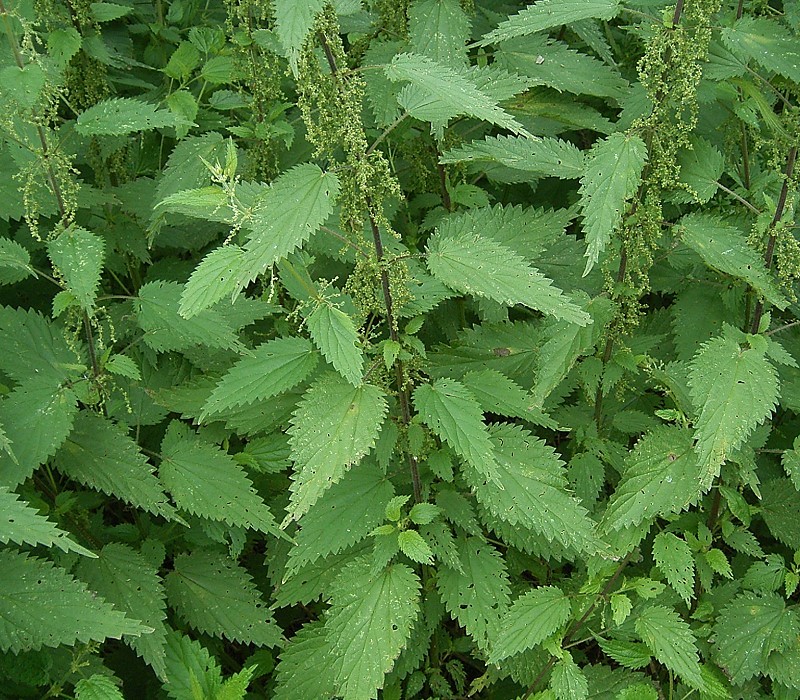
Photo: Frank Vincentz, CC BY-SA 3.0 · source

Herbaceous plant · Nettle family (Urticaceae)
Common nettle
Urtica dioica
In other languages: Grote brandnetel (Nederlands) · Ortie dioïque (Français)
Grows wild in Belgium.
Common nettle is one of the best-known and most disliked plants in Belgium, but also one of the most important for butterflies. It grows in dense patches on rich soil: along woodland edges, ditches and riverbanks, in rough ground, near stables and in garden corners. You recognise it by its square stems, its opposite, coarsely toothed leaves and, of course, its stinging hairs. The small green flowers hang in tassels and are easily overlooked; male and female flowers grow on separate plants. The caterpillars of the peacock, small tortoiseshell and red admiral depend largely on it.
Caution: The stinging hairs cause a painful, itchy rash that usually fades within a few hours. Children and dogs that run through a patch suffer most: plant nettles away from play areas. Dried or cooked leaves no longer sting.
Light
Sun or partial shade
preferably some sun
Moisture
Normal to wet
must not dry out
Hardiness
Fully hardy
down to -30 °C
Size
1 m
tall, 0.6 m wide
Flowering
June–September
| Pruning months | March and June–July |
|---|---|
| Height | 1 m |
| Native to Belgium | Yes |
| Flowering | June–September |
Identify
How to recognise it
- Habit
- Upright perennial 0.5–1.5 m tall, forming dense patches thanks to creeping rhizomes.
- Leaf
- Opposite, heart-shaped to oval with a long tip, 5–15 cm, coarsely toothed and covered in stinging hairs.
- Flower
- Small green flowers in hanging tassels from the leaf axils, from June to September. Male and female flowers on separate plants; wind-pollinated.
- Stem
- Square and sturdy, with stinging hairs and ordinary hairs.
- Roots
- Creeping, bright yellow rhizomes just below the surface.
- Confusion with
- Small nettle is annual and lower, with smaller leaves and flowers of both sexes on one plant. Dead-nettles and hedge woundwort look similar but do not sting and have showy two-lipped flowers.
Flowering: June–September · Pruning: March and June–July
In your garden
Why grow it?
- Food plant for the caterpillars of the peacock, small tortoiseshell, red admiral, map butterfly and comma, and for dozens of moths.
- Nettle aphids appear early in spring and are a first meal for ladybirds, which then go on to protect your vegetable garden.
- Seed-eating birds pick at the tiny seeds in autumn and winter.
- Young tips have been a spring vegetable for centuries, in soup or cooked like spinach.
- Nettle liquid feed is a classic, free plant food for the vegetable garden.
- The stems once provided fibre for rope and cloth.
Common nettle: where does it grow best?
- In the wild: woodland edges, wet woodland, ditch sides, riverbanks, rough ground and places where manure or waste once lay.
- Sun to partial shade. For butterfly caterpillars a sunny, sheltered spot is best.
- Rich, moist soil high in nitrogen and phosphate; on poor sandy soil it stays small.
- In the garden: a butterfly corner at the back, next to the compost heap or along a hedge.
Goes well with
- Hemp-agrimony: Nectar for the butterflies whose caterpillars live on nettles.
- Common comfrey: Likes the same rich, moist soil and attracts bumblebees.
- Hop: Climbs through the rough ground; also a food plant of the comma.
- Elder: Happily grows among nettles and gives flowers and berries.
Maintenance
Common nettle: when and how to plant it?
- It usually turns up by itself. To give it a place, get a piece of rhizome from someone who has too much, or buy a plant from a native-plant nursery.
- Plant in March–April or in October, 40–50 cm apart, with the yellow rhizomes just below the surface.
- You can sow in March–April: scatter the fine seed on the soil and press it in, without covering. Keep it moist.
- Choose a sunny spot: peacocks and small tortoiseshells prefer to lay their eggs on nettles in the sun.
- To contain the patch, dig in a root barrier or plant it in a bottomless bucket.
- Wear gloves. Never dig up plants from the wild.
Care
- Water
- Only after planting. After that not needed, except in a long drought on a dry spot.
- Feeding
- Not needed; on rich soil it grows vigorously by itself. A spadeful of compost on poor soil is enough.
- Cutting
- Cut half of the patch in late June: the young shoots that come back are ideal for a second brood of caterpillars.
- Spreading
- Pull out runners from moist soil; the yellow rhizomes lie shallow and come out easily.
- Seed
- Cut down the female plants in August if you do not want seedlings.
- Caterpillars
- Look before you cut: if you see black, spiny caterpillars in a web, leave that part standing.
Tip: A small patch of nettles in the sun, half of it cut in late June, is worth its weight in gold for butterflies: no food plant, no caterpillars, and no caterpillars, no butterflies.
Pruning and mowing
Pruning months: March and June–July.
When: In two rounds, from late June to mid-July; remove the dead stems in March.
How:
- Never cut the whole patch at once: take one half first and the other half 2–3 weeks later.
- Check for caterpillar nests first and leave those spots alone.
- Leave the dead stems standing in winter: eggs and insects overwinter in them.
- Cut them down to just above the ground in March and put them on the compost heap.
Caution: Wear sturdy gloves and long sleeves. Check the plants for caterpillars first: a web full of black caterpillars is a future cloud of butterflies.
Propagation
- Rhizomes
- In March or October, cut off a piece of yellow rhizome with a few buds and replant it elsewhere. It almost always takes.
- Seed
- Sow on the surface in March–April; the seed needs light to germinate. You will get both male and female plants.
Common nettle: how does it get through the winter?
Hardy to −30 °C.
- It dies back above ground; the rhizomes survive in the soil.
- The dead stems shelter insects; seed-eating birds pick off the last seeds.
- Fully hardy, to about −30 °C. In mild winters low shoots sometimes stay green.
Diseases and pests
- Spreading: On rich soil the patch expands quickly. Use a root barrier or pull out the edges every year.
- Stinging hairs: A burning, itchy feeling that fades within a few hours. Wear gloves and teach children to recognise the plant.
- Aphids: In spring it can be covered in aphids. Leave them: they feed ladybirds and their larvae.
- Rust: Orange swellings on stems and leaves in spring. A rust fungus that also lives on sedges; harmless.
Through the year
- March: Cut off the dead stems. Pick young tips for soup (wearing gloves).
- April: Plant or divide. First aphids, and the ladybirds that follow them.
- May: First caterpillar nests of peacock and small tortoiseshell.
- June: Flowering begins. In late June, cut half of the patch.
- July: Flowering. In mid-July, cut the other half; check for caterpillars first.
- August: Flowering and seed set. New caterpillars on the young leaves.
- September: Last flowers. Leave the seeds for the birds.
- October: The plant dies back. Leave the stems standing.
- December: Rest. Insects overwinter in the dead stems.
You and this species
Did you know?
- Each stinging hair is a tiny needle of glass-like material: the tip snaps off at a touch and injects a mixture that includes histamine into the skin.
- In Hans Christian Andersen’s fairy tale The Wild Swans, a princess knits shirts of nettles to save her brothers.
- During the First World War, Germany used nettle fibre as a substitute for cotton.