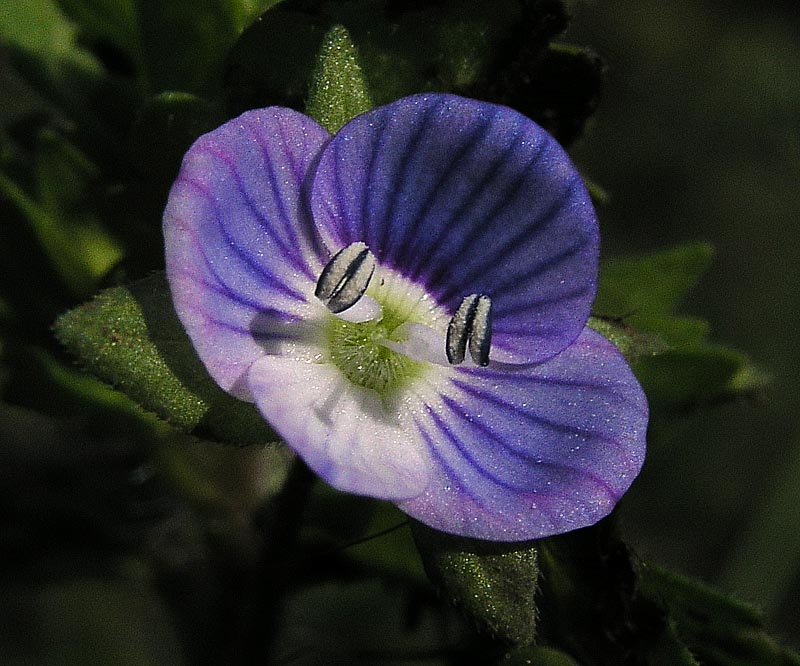
Photo: Michael H. Lemmer, CC BY-SA 2.5 · source

Herbaceous plant · Plantain family (Plantaginaceae)
Common field-speedwell
Veronica persica
In other languages: Grote ereprijs (Nederlands) · Véronique de Perse (Français)
Grows wild in Belgium.
Common field-speedwell is a low, annual plant with sky-blue flowers that you find everywhere in vegetable gardens, borders, fields, on road verges and on bare, dug soil. It originally comes from south-west Asia, reached Europe in the 19th century and is now one of the most common weeds of fields and gardens throughout Belgium. You can recognise it by its sprawling, hairy stems, its triangular to oval, coarsely toothed leaves and its single flowers about 1 cm across on long stalks, with dark veins and a pale lower lobe. It flowers mainly from March to October, but in mild weather even in the middle of winter. For hoverflies and small bees it is an early, modest source of food, and as ground cover it keeps bare soil covered in winter.
Light
Sun or partial shade
preferably some sun
Moisture
Normal
no wet feet
Hardiness
Fully hardy
down to -20 °C
Size
0.15 m
tall, 0.3 m wide
Flowering
January–December
| Height | 0.15 m |
|---|---|
| Native to Belgium | No, naturalised |
| Flowering | January–December |
Identify
How to recognise it
- Habit
- Annual, with sprawling to ascending, branched stems 10–40 cm long; the plant rarely grows taller than 15–20 cm.
- Leaf
- Triangular to oval, 1–3 cm, light green, coarsely toothed, short-stalked and hairy; opposite lower down, alternate higher up the stem.
- Flower
- Single in the leaf axils, on a stalk longer than the leaf; 8–12 mm across, sky blue with dark blue veins, the lower lobe paler to white. The corolla drops off quickly at the slightest touch.
- Fruit/Seed
- A two-lobed, heart-shaped capsule that is wider than long, with widely spreading lobes and glandular hairs; a few boat-shaped seeds per lobe.
- Roots
- A thin, shallow taproot with fine side roots: easy to pull up.
- Look-alikes
- Green field-speedwell and grey field-speedwell have smaller flowers, under 8 mm, on shorter stalks. Ivy-leaved speedwell has ivy-like lobed leaves and small, pale blue flowers. Slender speedwell, which creeps through lawns, is perennial, has small, kidney-shaped leaves and rarely sets seed.
Flowering: January–December
In your garden
Why grow it?
- It flowers almost all year, even in early spring when little else is in bloom: pollen and nectar for hoverflies and small solitary bees.
- It covers bare soil in autumn and winter, so the surface is less likely to cap or be washed out.
- A harmless weed: shallow-rooted and easy to hoe off or pull up.
- One of the prettiest little blue flowers of the vegetable garden, finely marked with dark veins.
- A living piece of history: it shows how a plant from Asia conquered all of Europe in barely two centuries.
Common field-speedwell: where does it grow best?
- In the wild: fields, vegetable gardens, borders, road verges, waste ground, disturbed places and gaps in lawns.
- Loose, fertile soil, preferably rich in humus: loam, clay or sand, normally moist.
- Sun to partial shade.
- It appears mainly where the soil is regularly worked; in a closed turf or under a thick mulch it does not last long.
Goes well with
- Red dead-nettle: Purple flowers in the same early spring, important for bumblebee queens.
- Field forget-me-not: Tiny blue flowers on the same loose, worked soil.
- Common poppy: Red flowers above a blue carpet on a dug field or at the edge of the vegetable garden.
- Daisy: White and yellow at the edge of the lawn, also in flower almost all year.
Maintenance
Common field-speedwell: when and how to plant it?
- Usually you do not need to do anything: its seed is already present in almost every garden soil and germinates by itself on bare ground.
- If you still want to sow it, take seed from your own garden or from a friend. Never dig up plants from the wild.
- Sow in spring or autumn on loosened, bare soil, press the seed in lightly and barely cover it.
- Young plants can be moved with a small clump of soil, 15–20 cm apart.
- Water after sowing or moving if the weather is dry; after that it looks after itself.
Care
- Watering
- Not needed.
- Feeding
- Not needed: it grows well on ordinary garden soil by itself.
- Keeping it in check
- Too much of it? Hoe or pull it up before the capsules ripen. This is easy, as the roots are shallow.
- Mulching
- A layer of mulch or leaf mould smothers the seedlings where you do not want them.
- Self-seeding
- Let a few plants set seed at the edge of the vegetable garden if you want to keep it as ground cover.
Tip: Simply leave common field-speedwell on empty vegetable beds over winter: it keeps the soil covered, and in spring you hoe it off in no time.
Pruning and mowing
When: Not needed. Weed or hoe where there is too much of it, ideally before the capsules ripen.
How:
- Hoe in dry weather, so the loosened plants dry out quickly.
- Pull larger plants by hand; the shallow roots come up easily.
- Pulled plants without ripe seed can go on the compost heap.
Caution: Do not wait too long: a single plant keeps forming new capsules for months, and the seed stays viable in the soil for several years.
Propagation
- Seed
- It sows itself almost all year round. The seed germinates on bare, worked soil, especially in spring and autumn.
- Moving plants
- Young plants with a small clump of soil establish easily in a new spot.
Common field-speedwell: how does it get through the winter?
Hardy to −20 °C.
- It overwinters as a green plant or as a seedling and keeps flowering in mild weather.
- Frost does it little harm: after a cold spell it flowers again.
- As green ground cover it protects bare soil in the vegetable garden from capping and being washed out.
- In February–March its flowers are sometimes the first touch of blue in the garden.
Diseases and pests
- Too many seedlings: On frequently dug soil it can form a carpet. Hoe in time and mulch the soil.
- Competing with sown crops: Among young vegetables it can smother the seedlings. Weed along the rows; between large vegetables it can stay.
- Aphids: Sometimes aphids on the young shoots. Ladybirds and hoverfly larvae usually deal with them.
- Confusion in the lawn: Creeping little blue flowers in grass are often slender speedwell, a perennial species. Common field-speedwell rarely lasts long in a mown lawn.
Through the year
- January: In mild weather, the first little flowers.
- February: Flowering in sheltered spots; early food for hoverflies.
- March: Flowering well. Weed out seedlings where you want to sow.
- April: Full flower; hoe between young vegetables.
- May: Flowering and setting seed; leave some plants at the edges.
- June: Flowering. Pull it up where there is too much.
- July: Flowering; fewer flowers in dry weather.
- August: Flowering. Pulled plants without ripe seed on the compost heap.
- September: New seedlings appear on bare soil.
- October: Leave it as green ground cover on empty beds.
- November: It keeps flowering in mild weather.
- December: Overwinters as a green plant; sometimes still a flower.
You and this species
Did you know?
- The species only reached Europe from south-west Asia in the 19th century and spread so fast that it now grows in almost every field. The scientific name persica and the French name refer to Persia, present-day Iran.
- The corolla is only loosely attached and drops at the slightest touch, so speedwell is no good as a cut flower.
- The Dutch name ereprijs and the German Ehrenpreis literally mean ‘honour and praise’: the genus was once held in high regard as a herb.