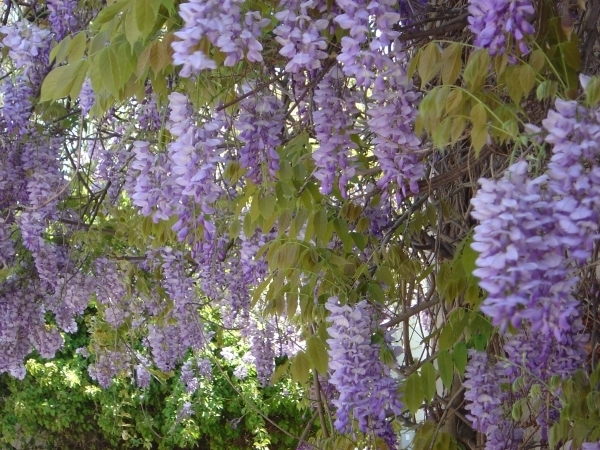
Photo: nlamore from USA, CC BY 2.0 · source

Pruning guide · Climber
Wisteria: when and how to prune
Wisteria sinensis
Prune a wisteria twice a year: in July–August cut the long new shoots back to 5–6 leaves, and in January–February shorten them further to 2–3 buds.
A wisteria left to itself mostly puts on leaves and long whippy shoots; two prunes a year encourage short flowering spurs covered in flower clusters. This guide covers Chinese wisteria; Japanese wisteria is pruned the same way.
| Pruning months | January–February and July–August |
|---|---|
| Nesting season (15 March–15 August) | Take care in July–August |
| Flowering | April–May |
| Good for bees, butterflies and birds | Yes, for bees |
| Native to Belgium | No, planted |
| Poisonous to people and pets | Yes, take care with children and pets |
Wisteria: when to prune it?
The summer prune comes in July–August, about two months after flowering: the new shoots are long by then and you can clearly see what can go.
The winter prune comes in January–February, when the plant is bare: you can then tell the fat, round flower buds from the slim, pointed leaf buds.
In between, cut off shoots heading for gutters, windows, shutters or the roof, and runners along the ground, before they root.
What else to prune in those months? January · February · July · August
Wisteria: how to prune it?
- Wear gloves and work from a sturdy ladder: the seeds and pods are poisonous, and a wisteria often grows high.
- In summer: cut all long, green shoots of this year back to 5–6 leaves from the branch they grow from. Only keep the shoots you need to extend the framework, and tie those in.
- In winter: shorten those same shoots further to 2–3 buds, so short flowering spurs form. Spare the fat, round buds: those are the flower buds.
- Train a young plant as a framework: one or two main stems, and side branches led horizontally along wires or over the pergola.
- Check the ties and the structure every winter: stems twining round a wire or downpipe grow so strong that they bend it or tear it loose.
- After flowering, remove the faded flower clusters and the pods where children or dogs go.
How much to cut, and how often?
- Twice a year: each prune is light, but you need both. If you only prune once, you get lots of long shoots and fewer flowers.
- Don’t leave long shoots unpruned: within a few years they become thick stems you can no longer remove without damage.
- Renovate a neglected wisteria over a few winters: each time, saw out some of the old, overlong or tangled stems. It will flower less for a few years, but it comes back.
What does it mean for wildlife?
- In April–May the fragrant flower clusters are full of bumblebees and honeybees; the large, bluish-black violet carpenter bee, increasingly seen in Belgium and the Netherlands, loves them too.
- A dense wisteria on a house wall or over a pergola is a nesting place for blackbirds, house sparrows and robins. The summer prune in July and early August still falls in the nesting season (15 March–15 August): look carefully first, as disturbing an active nest is against the law. After mid-August you are outside it.
- The winter prune falls outside the nesting season: the best time for bigger jobs and for checking the structure.
- Prunings can go on a dead hedge or the compost heap. Do keep pods and seeds away from children and dogs, though: they are poisonous.
Common mistakes
- Pruning only once a year, or not at all, so it mostly makes leaves and long shoots and flowers poorly.
- Cutting off the fat, round flower buds in winter.
- Letting stems grow into gutters, downpipes or round young trees until they twist them out of shape.
- Feeding heavily: too much nitrogen gives leaves instead of flowers.
- Pruning in July without checking for nests first.
Caution: Don’t leave long shoots unpruned: within a few years they become thick stems that twist gutters and shutters. Wisteria is poisonous: wear gloves and keep clippings away from children, pets and livestock.
Nearby: related pruning guides
Similar to: Difference from common laburnum · Difference from Japanese wisteria