Photo: nlamore from USA, CC BY 2.0 · source

Climber · Pea family (Fabaceae)
Chinese wisteria
Wisteria sinensis · also: Wisteria
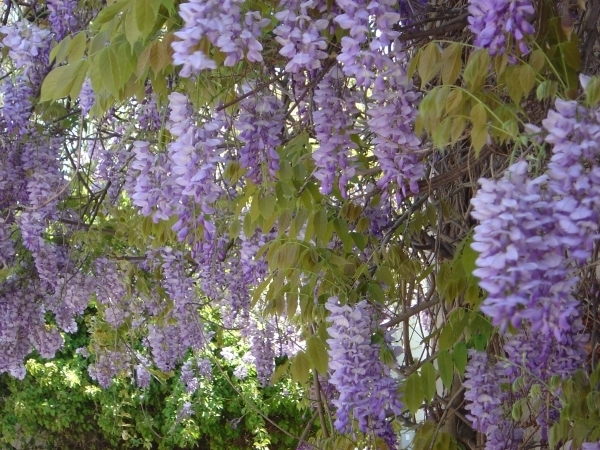
Chinese wisteria is a vigorous twining climber from China that winds itself around supports up to 15–20 m high. In May it is hung with long racemes of bluish-purple, fragrant flowers, before or with the leaves – a spectacle for bumblebees and bees. It needs a very sturdy pergola or a strong wall trellis, as its stems grow so powerful that they can strangle gutters, downpipes and young trees. With two prunings a year it flowers profusely. The seeds and pods are poisonous.
Caution: The seeds and pods are poisonous: they cause vomiting, stomach ache and diarrhoea, especially in children and dogs. The stems grow so strong they can strangle gutters and young trees.
Light
Full sun
warm and bright
Moisture
Normal
no wet feet
Legal basis
Any garden soil
any pH
Hardiness
Throughout Belgium
no protection needed
Size
twines to 15–20 m
tall
Flowering
April–May
| Pruning months | January–February and July–August |
|---|---|
| Height | twines to 15–20 m |
| Native to Belgium | No, planted |
| Good for bees, butterflies and birds | Yes, for bees |
| Poisonous to people and pets | Yes, take care with children and pets |
| Flowering | April–May |
Identify
Chinese wisteria: how do you recognise it?
- Habit
- Vigorous, woody twining climber up to 15–20 m, with thick, sinuous stems; can also be grown as a free-standing standard.
- Leaf
- Alternate, odd-pinnate with 7–13 leaflets.
- Stems
- Thick, woody stems that twist around supports.
- Flower
- Hanging racemes of 15–30 cm, bluish-purple and fragrant, in May, before or with the leaves.
- Fruit
- Velvety pods; the seeds are poisonous.
- Difference from Japanese wisteria
- Japanese wisteria has even longer racemes and twines the other way.
Flowering: April–May · Pruning: January–February and July–August
Identify by feature: Purple or blue flowers · Hanging flower clusters · Pods · Twining climbers
Looks like it, but isn’t
- Japanese wisteria (Wisteria floribunda): even longer racemes; twines the other way.
In your garden
Why grow it?
- One of the most spectacular flowering plants in the garden, with racemes of 15–30 cm.
- Fragrant flowers in May, busy with bumblebees and bees.
- Provides shade over a pergola in summer.
- Can live to a great age and develop an impressive, gnarled trunk.
Chinese wisteria: where does it grow best?
- Full sun: in shade it hardly flowers.
- Any well-drained soil that isn’t too wet.
- It twines around its support and needs a very sturdy pergola, heavy-gauge wires or a wall trellis on spacers; light structures give way after a few years.
- Keep it away from downpipes, gutters, shutters and trees: it can strangle them.
- Light
- Full sun
- Legal basis
- Any garden soil
- Moisture
- Normal
- Size
- 15 m tall, 5 m wide
- Hardiness
- Throughout Belgium, no protection needed
Goes well with
- Common lilac: Flowers at the same time in May, with a similar colour and scent.
- English lavender: Flowers in summer at the sunny foot of the pergola, once the wisteria has finished.
- Rosemary: An evergreen, fragrant shrublet for the same warm, sunny spot.
Good and bad companions
Best kept away from
- Twines around young trees and shrubs and can strangle them: hawthorn, goat willow, japanese cherry, judas tree, chusan palm, olive tree
Maintenance
Chinese wisteria: when and how to plant it?
- Plant in autumn or spring, from a pot.
- Buy a grafted or cutting-raised plant that is already flowering: seedlings sometimes take 10–20 years to flower.
- Plant 30–50 cm from the wall or post and guide the shoots to the support.
- From the start, choose one or a few main stems and tie the side branches in horizontally: that is where the flower racemes will come later.
Care
- Watering
- In dry spells during the first year, and in late summer, when it forms next year’s flower buds.
- Feeding
- Sparingly: too much nitrogen gives lots of leaves and few flowers.
- Tying in
- Tie young stems in loosely and check every year that they are not growing into the wires or ties.
- Runners
- It sends out long runners over the ground: cut them off before they root.
Tip: No room for a pergola? Grow wisteria as a free-standing standard on a sturdy post: with the same pruning it flowers just as profusely.
Chinese wisteria: when to prune it?
Pruning months: January–February and July–August.
When: Twice a year: in July–August and in January–February.
How:
- In summer, cut the long new shoots back to 5–6 leaves; in winter, shorten them further to 2–3 buds. This gives you plenty of flower clusters.
- In summer, also remove shoots heading for gutters, windows or the roof.
- In winter, spare the fat, round buds: those are flower buds; the slim, pointed ones are leaf buds.
Caution: Don’t leave long shoots unpruned: within a few years they become thick stems that twist gutters and shutters.
Propagation
- Layering
- In spring, lay a long, pliable shoot on the ground and cover a section with soil; after a year you can cut it free.
- Sowing
- Possible, but a seedling only flowers after many years and often less well: better to buy a grafted plant.
Chinese wisteria: how does it get through the winter?
Hardy throughout Belgium: no protection needed.
- Hardy; the flower buds can, however, be frosted by night frost in April.
- In winter you see the framework best: the ideal time to check the support and tie in the stems.
Diseases and pests
- No flowers: Usually a seedling, too much shade, too much fertiliser or too little pruning. Prune twice a year and give no nitrogen.
- Bud drop: The flower buds drop before they open, due to drought or night frost in spring. Water in dry spells.
- Strangling: Stems in downpipes, gutters or around young trees. Cut them away in time; a thick stem can no longer be removed without damage.
Through the year
- January: Winter pruning: shorten side shoots to 2–3 buds.
- February: Finish winter pruning; check the support and wires.
- April: Buds swell: cover in night frost where possible.
- May: Flowering: long, fragrant racemes.
- June: Remove spent racemes and pods; cut off runners.
- July: Summer pruning: long shoots back to 5–6 leaves.
- August: Summer pruning; water in dry spells.
- October: Planting.
Use
What can you use it for?
- Garden and landscape
- Spectacular flowering climber for a sturdy pergola or house wall.
- For wildlife
- Bumblebees and bees flock to the flower clusters.
Caution: Seeds and pods are poisonous. The stems grow so strong they can strangle gutters and young trees.
Good for wildlife
- Bumblebees
- Nectar and pollen for bumblebees, also from deep flowers and early in spring.
- Bees
- Nectar and pollen for honeybees and wild bees.
You and this species
Did you know?
- The stems grow so strong that they can twist downpipes, gutters and even balconies.
- The name Wisteria honours the American physician Caspar Wistar.
- An exotic from China that does not spread in the wild here; a wisteria can live for more than a hundred years.
- The genus Wisteria was named by the botanist Thomas Nuttall after the American physician and anatomist Caspar Wistar.
- As a member of the pea family, wisteria lives with bacteria in root nodules that fix nitrogen from the air; extra nitrogen fertiliser mainly produces lots of leaves.