Side by side
Chinese wisteria or Japanese wisteria? How to tell them apart
Wisteria sinensis · Wisteria floribunda
How to tell them apart – Chinese wisteria: fewer leaflets (7–13) and shorter racemes whose flowers open almost all at once, before or with the leaves; Japanese wisteria: twining climber with pinnate leaves of many leaflets and very long, hanging flower racemes that open from top to bottom.
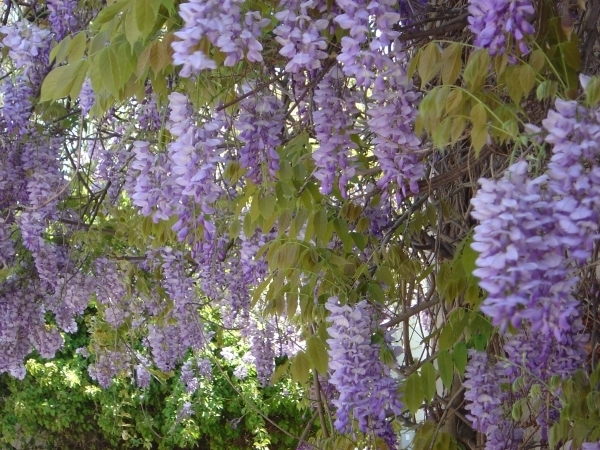


How do you recognise them?
- Chinese wisteria
- Vigorous twining climber with pinnate leaves and long, hanging racemes of bluish-purple flowers in May.
- Compared with Japanese wisteria: fewer leaflets (7–13) and shorter racemes whose flowers open almost all at once, before or with the leaves.
- Japanese wisteria
- Twining climber with pinnate leaves of many leaflets and very long, hanging flower racemes that open from top to bottom.
| Chinese wisteria | Japanese wisteria | |
|---|---|---|
| Leaves | Alternate, odd-pinnate with 7–13 leaflets. | Alternate, odd-pinnate with 13–19 leaflets, 20–35 cm long. |
| Flowering | Hanging racemes of 15–30 cm, bluish-purple and fragrant, in May, before or with the leaves (April–May). | Hanging racemes of 30–50 cm, violet, pink or white and fragrant, May–June, at the same time as the leaves (May–June). |
| Fruit | Velvety pods; the seeds are poisonous. | Velvety pods of 10–15 cm; the seeds are poisonous. |
| Bark | Thick, woody stems that twist around supports. | Grey, woody stems that twist around their support. |
| Shape and height | Climber, twines to 15–20 m | Climber, twines to 8–10 m |
| Site | Full sun, any garden soil, normal | Full sun, any garden soil, normal |
| Native to Belgium | No, planted | No, planted |
| Good for bees, butterflies and birds | Yes, for bees | – |
| Poisonous to people and pets | Yes, take care with children and pets | Yes, take care with children and pets |
| Pruning months | January–February and July–August | January–February and July–August |
What does it mean for your garden?
- Chinese wisteria is poisonous to people and pets: take care with children and animals.
- Japanese wisteria is poisonous to people and pets: take care with children and animals.
Read on
- Plant profile: Chinese wisteria
- Plant profile: Japanese wisteria
- Chinese wisteria: when and how to prune
- Japanese wisteria: when and how to prune
- Identification key
Also looks like
Identify by feature
This comparison is compiled from the Bladwijzer species pages.