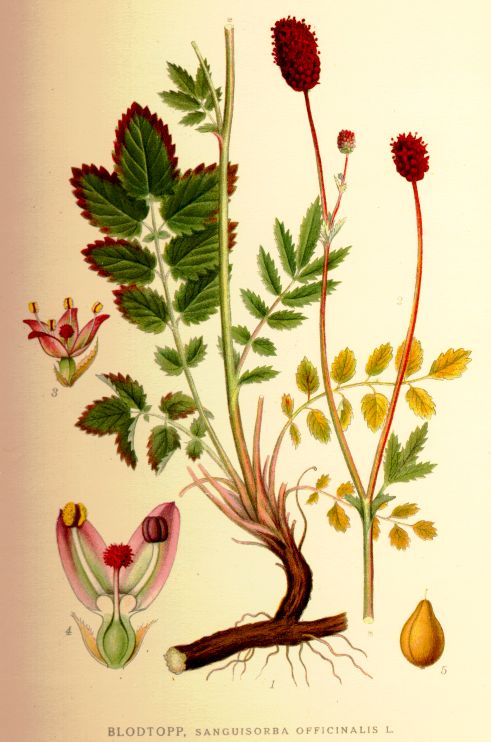
Photo: Carl Axel Magnus Lindman, Public domain · source

Pruning guide · Perennial
Great burnet: when and how to prune
Sanguisorba officinalis
Great burnet is best pruned in March.
| Pruning months | March |
|---|---|
| Flowering | June–September |
| Good for bees, butterflies and birds | Yes, for bees and butterflies |
| Native to Belgium | Yes |
Great burnet: when to prune it?
Leave the stems standing all winter and cut them down in March, before the new shoots appear.
What else to prune in those months? March
Great burnet: how to prune it?
- Cut all old stems back to just above the ground.
- Also clear the dead leaves from the rosette.
- There is no need to remove faded heads: they are attractive and useful in winter.
How much to cut, and how often?
- One pruning period a year: March.
What does it mean for wildlife?
- Great burnet flowers in June–September, when it attracts bees and butterflies.
- If you only cut back in March, the old stems stand through the winter: insects overwinter in them and birds eat the seeds.
- As a native plant, it feeds more insects than a non-native species.
Caution: Do not cut or mow in summer: the caterpillars of the large blues are living in the flower heads then.
Nearby: related pruning guides
- Burnet (Sanguisorba tenuifolia)
- Canadian burnet (Sanguisorba canadensis)
- Japanese burnet (Sanguisorba obtusa)
- Menzies' burnet (Sanguisorba menziesii)
- Salad burnet
Plant profile: Great burnet · Pruning calendar and basic rules
This guide is compiled from the Bladwijzer plant profile and pruning calendar.