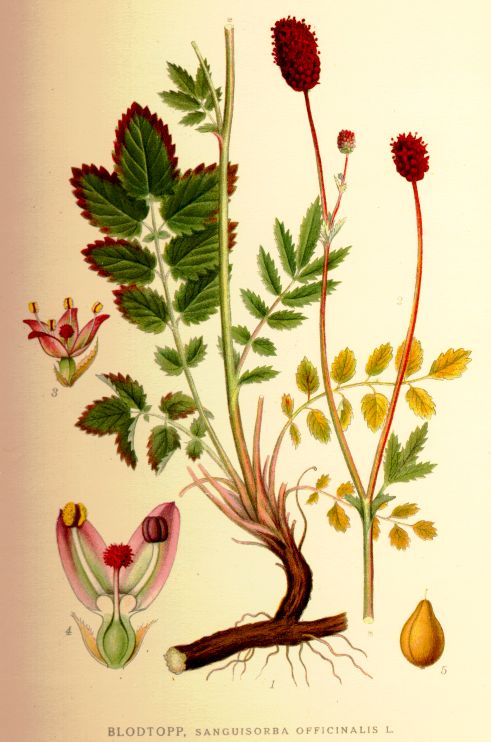
Photo: Carl Axel Magnus Lindman, Public domain · source

Perennial · Rosaceae
Great burnet
Sanguisorba officinalis
In other languages: Grote pimpernel (Nederlands) · Grande pimprenelle (Français)
Great burnet is a native perennial of damp hay meadows and riverbanks, in Belgium and across much of Europe and Asia. From a rosette of pinnate leaves with toothed leaflets, slender, branched stems rise to 1.2 m. From June to September they carry dozens of small, oval, deep wine-red flower heads that sway like bobbles between other plants. Gardeners love its airy, natural look in a border with ornamental grasses, and it is the food plant of rare butterflies, the scarce large blue and the dusky large blue. Well-known cultivars include compact ‘Tanna’, about 50 cm tall, and free-flowering ‘Red Thunder’.
Light
Sun or partial shade
preferably some sun
Moisture
Normal to wet
must not dry out
Legal basis
Loam, clay or peat
any pH
Hardiness
Fully hardy
down to -30 °C
Size
1.2 m
tall, 0.6 m wide
Flowering
June–September
| Pruning months | March |
|---|---|
| Height | 1.2 m |
| Native to Belgium | Yes |
| Good for bees, butterflies and birds | Yes, for bees and butterflies |
| Poisonous to people and pets | Not known to be poisonous |
| Flowering | June–September |
Identify
Great burnet: how do you recognise it?
- Habit
- A basal rosette of leaves with slender, branched flower stems 0.8–1.2 m tall; about 60 cm wide.
- Leaves
- Pinnate, with 7–15 oval, toothed leaflets; fresh green above, bluish green below.
- Flower
- Oval heads 1–2 cm long, densely packed with tiny flowers without petals; the colour comes from the sepals.
- Colour
- Deep wine red to burgundy.
- Roots
- A sturdy, branched rhizome; the clump widens slowly but does not spread aggressively.
Flowering: June–September · Plants: March–May and September–October · Pruning: March
In your garden
Why grow it?
- Airy dark red bobbles from June to September that bring lightness and movement to the border.
- A native plant that suits a wildlife garden and a damp flower meadow.
- Food plant of the scarce large blue and the dusky large blue, two rare butterflies.
- Bees, bumblebees and other butterflies visit the flower heads.
- The dark heads stay standing into winter and also look lovely in a bouquet.
Great burnet: where does it grow best?
- Sun to partial shade; it flowers most freely in full sun.
- Loam, clay or peaty soil, acid to chalky.
- Normal to wet soil: it likes moist soil that does not dry out in summer.
- Plant 50–60 cm apart, three to four plants per m², among other plants and grasses that give it some support.
- Light
- Sun and partial shade
- Soil type
- Loam, clay or peat
- Acidity
- Not fussy
- Moisture
- Normal or wet
- Size
- 1.2 m tall, 0.6 m wide
- Hardiness
- Hardy (to -30 °C)
Goes well with
- Purple loosestrife: Purple spikes beside the dark red bobbles, both native and for moist soil.
- Meadowsweet: Creamy, scented plumes in the same moist soil.
- Hemp agrimony: Pink flower heads, native and excellent for butterflies.
- Purple moor-grass: A native grass with airy plumes for the bobbles to sway between.
- Culver’s root: Tall, vertical spikes beside the slender stems.
Maintenance
Great burnet: when and how to plant it?
Plant in March–May and September–October.
- Plant from March to May or in September–October, when the soil is not frozen or waterlogged.
- Dig a hole twice as wide as the pot and mix in a little compost.
- Set the plant at the same depth as it was in the pot and firm the soil well.
- Water in thoroughly and keep the soil moist for the first few weeks.
- Mulch with compost or leaf mould to hold in moisture.
Care
- Water
- Keep the soil moist, especially in sun. In drought the leaves turn brown and flowering is limited.
- Feeding
- Little needed: a layer of compost in spring. In soil that is too rich the stems flop.
- Support
- The slender stems can lean after rain. Plant it among other plants or give it a ring of twigs.
- Deadheading
- Leave the flower heads: they stay attractive into winter.
- Flower meadow
- If it grows in a damp hay meadow, do not mow between mid-June and mid-September, so the large blues can complete their life cycle.
Tip: Plant it among grasses and other perennials that support it, in soil that stays moist: the dark red bobbles will then sway through the border all summer.
Great burnet: when to prune it?
Pruning months: March.
When: Leave the stems standing all winter and cut them down in March, before the new shoots appear.
How:
- Cut all old stems back to just above the ground.
- Also clear the dead leaves from the rosette.
- There is no need to remove faded heads: they are attractive and useful in winter.
Caution: Do not cut or mow in summer: the caterpillars of the large blues are living in the flower heads then.
Propagation
- Division
- In March–April or September–October, lift a clump and split it with a sharp spade into pieces with a few buds each. Replant straight away and water.
- Seed
- Sow fresh seed in autumn in a pot outdoors: the cold helps germination. Cultivars do not come true from seed, so division is easier.
Great burnet: how does it get through the winter?
Hardy to −30 °C.
- Fully hardy, to about −30 °C: no protection is needed in Belgium.
- Leave the seed heads standing: they decorate the winter garden.
- In a large pot: keep the compost moist and stand the pot in a sheltered spot against a wall.
Diseases and pests
- Powdery mildew: White powder on the leaves, mainly in dry summers. Water, leave space around the plant and remove affected leaves.
- Flopping stems: Too rich a soil or too much shade. Plant it among supportive neighbours or give it a ring of twigs.
- Brown leaves: A sign of drought. Water and mulch.
- Slugs: They eat the young shoots in spring. Pick them off in the evening.
Through the year
- March: Cut down old stems. Add compost. Plant or divide.
- April: Plant. Watch out for slugs.
- May: Plant. Add support if needed.
- June: Flowering begins.
- July: In flower. Water in dry spells.
- August: Full bloom. Bees and butterflies on the flower heads.
- September: Last flowers. Plant or divide.
- October: Plant. Leave the flower heads standing.
- December: The seed heads decorate the winter garden.
Use
Good for wildlife
- Bees
- Nectar and pollen for honeybees and wild bees.
- Butterflies
- Nectar for butterflies.
You and this species
Did you know?
- The caterpillars of the large blues first feed inside the flower heads, then get themselves carried by certain ants into their nest, where they go on to feed on the ant brood.
- Sanguisorba means ‘blood-absorbing’: in old herbals the plant was believed to stop bleeding.
- Great burnet belongs to the rose family, although you would hardly guess it from the flower heads.