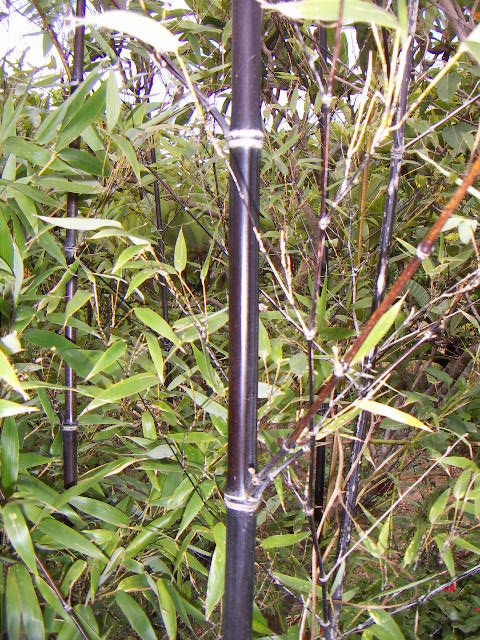
Photo: No machine-readable author provided. Jordi Coll Costa assumed (based on copyright claims)., CC BY-SA 3.0 · source

Shrub · Grass family (Poaceae)
Bamboo
Phyllostachys · also: Phyllostachys
Bamboo is a woody, evergreen grass with hollow canes and narrow leaves that forms a dense 3–8 m screen within a few years. The best-known garden bamboo, Phyllostachys, grows fast, rustles beautifully in the wind and gives sturdy canes. But it spreads aggressively with long underground runners that can pop up next door: only plant it with a strong root barrier. If you want no worries, choose a clump-forming bamboo such as Fargesia (umbrella bamboo): it stays in a compact clump and usually reaches 2–4 m.
Caution: Phyllostachys spreads aggressively by underground runners: only plant it with a root barrier (70 cm deep) or choose a clump-forming Fargesia. Removing an escaped bamboo is hard work: every rhizome has to come out, and anything left behind sprouts again.
Light
Sun or partial shade
preferably some sun
Moisture
Normal
no wet feet
Legal basis
Any garden soil
any pH
Hardiness
Throughout Belgium
no protection needed
Size
3–8 m
tall
| Pruning months | March–April |
|---|---|
| Height | 3–8 m |
| Native to Belgium | No, planted |
| Good for bees, butterflies and birds | Little |
| Poisonous to people and pets | Not known to be poisonous |
Identify
Bamboo: how do you recognise it?
- Habit
- Evergreen, woody grass canes of 3–8 m, shooting up in a dense grove from underground rhizomes.
- Leaf
- Narrowly lance-shaped, 5–15 cm, in fans on thin side shoots.
- Canes
- Hollow, with distinct nodes; in Phyllostachys a groove above each side branch.
- Flower
- Flowers rarely, sometimes only after decades.
- Difference from Fargesia
- Fargesia (umbrella bamboo) grows in a clump, without invasive runners.
Harvest and fruit: April–June · Pruning: March–April
Looks like it, but isn’t
- Fargesia (umbrella bamboo): grows in a clump, without invasive runners.
In your garden
Why grow it?
- A fast, evergreen screen and windbreak, all year round.
- Rustles in the wind and gives the garden a calm, oriental feel.
- The canes make sturdy plant supports.
- A clump-forming Fargesia makes an evergreen hedge without invasive runners.
Bamboo: where does it grow best?
- Sun to partial shade, sheltered from cold, drying easterly winds; Fargesia prefers partial shade.
- Any moist but free-draining soil; no wet feet.
- Allow at least 3–4 m width for Phyllostachys, inside a root barrier; Fargesia stays much narrower.
- Without a barrier, not near a patio, a pond or the property boundary: runners creep under paving and pierce pond liners.
- Light
- Sun or partial shade
- Legal basis
- Any garden soil
- Moisture
- Normal
- Size
- 6 m tall, 4 m wide
- Hardiness
- Throughout Belgium, no protection needed
Goes well with
- Japanese maple: Fine red or green leaves and autumn colour beside the evergreen bamboo screen: together, a Japanese feel.
- Sacred bamboo: Not a true bamboo, but just as airy, with red autumn and winter colour and no invasive runners.
- Japanese aralia: Large, glossy, hand-shaped leaves contrasting with the fine bamboo foliage, even in shade.
Maintenance
Bamboo: when and how to plant it?
- Plant in spring (April–May), from a pot: it will then root in before summer.
- For Phyllostachys, first dig in a root barrier: a continuous ring of rigid plastic (HDPE) 70 cm deep, with a seam that overlaps generously and is clamped tight.
- Leave the barrier 5–10 cm above ground, so runners can’t grow over the edge unseen.
- For a Fargesia hedge: 2–3 plants per metre. Water well after planting.
Care
- Watering
- Bamboo is thirsty: water generously in the first year and in dry summers, especially in pots. Curled leaves are a sign of thirst.
- Feeding
- Some compost or a nitrogen-rich fertiliser in spring.
- Leave the leaves
- Leave fallen leaves under the bamboo: they keep the soil moist and feed the plant.
- Runners
- Every year in late summer, walk round the edge of the barrier and spade off any runners growing over or outside it.
Tip: If in doubt, choose a Fargesia: it stays in a clump and needs no root barrier. A Phyllostachys can also grow in a large, sturdy container, but then it needs dividing every few years.
Bamboo: when to prune it?
Pruning months: March–April.
When: In March–April.
How:
- Saw the oldest or dead canes off at ground level; this keeps the grove airy and fresh.
- Every year, spade off any runners that come up outside the barrier.
- For a lower bamboo, cut the canes just above a node; the side shoots will then fill out.
Caution: A cut cane never grows taller again: only top canes if you really mean to.
Propagation
- Division
- In March–April, before the new shoots appear, spade off a piece with at least 2–3 canes and a good chunk of rhizome; replant it straight away and water well.
Bamboo: how does it get through the winter?
Hardy throughout Belgium: no protection needed.
- Most garden bamboos are hardy here. In harsh winters with cold easterly winds the leaves can dry out, but the plant regrows in spring.
- Bamboo in pots: protect the root ball from freezing and water now and then on frost-free days, as it loses water in winter too.
- Heavy snow bends the canes over: shake it off so they don’t snap.
Diseases and pests
- Spreading runners: Runners appear outside the barrier or next door. Spade them off and dig them out; don’t leave any piece of rhizome behind, as it will sprout again.
- Bamboo mite: Yellow to white flecks on the leaves, with fine webbing underneath. Cut out affected canes and keep the plant airy.
- Yellow leaves in spring: Normal: in April–May bamboo replaces part of its foliage. Yellow leaves in summer point to drought or hunger: water and feed a little.
- Dried-out leaves after winter: Caused by frost and drying wind. Be patient: new leaves appear in spring; only saw off canes that are truly dead.
Through the year
- March: Pruning: remove old and dead canes. Division possible.
- April: Last month for pruning; planting and dividing. Normal leaf change.
- May: New shoots spring up; planting still possible.
- June: The new canes have reached full height; water in dry spells.
- August: Water generously in dry summers, especially in pots.
- September: Walk round the root barrier and spade off runners.
- December: Protect pots from freezing.
Use
What can you use it for?
- Garden and landscape
- Fast-growing evergreen screen and windbreak.
- Also used for
- The canes make sturdy plant supports.
Caution: Phyllostachys spreads aggressively by underground runners: only plant it with a root barrier (70 cm deep) or choose a clump-forming Fargesia.
Edible and useful
- Young shoots (April–June)
- From April to June, cut young shoots that stand 10 to 30 cm above the ground, just below soil level, with a sharp spade or knife. This also keeps the spreading rhizomes in check. Peel off the tough sheaths until you reach the pale, tender core. In most Phyllostachys species the shoots are edible, though some are more bitter than others. Always cook them first; then they are delicious stir-fried, in soups, curries or salads.
- Storing
- Raw shoots quickly turn tough and bitter: prepare them on the day you harvest. Cooked, peeled shoots keep for a few days in water in the fridge (change the water daily); you can also freeze them in pieces.
- Fermenting
- In parts of Asia, bamboo shoots are traditionally lacto-fermented. At home, pickling in vinegar after cooking is the safest route (see recipe).
Caution: Raw bamboo shoots contain a substance that releases cyanide in the body: never eat them raw. Cut them into slices or pieces and boil them for at least 20 to 30 minutes in plenty of water without a lid; change the water if they still taste bitter, and always pour the cooking water away. Only use shoots from a bamboo you have identified with certainty and that has not been sprayed.
Eating and using is at your own risk: see the terms of use.
Recipes
- Stir-fried bamboo shoots (Dish · 4 people (as a side dish) · 1 hour)
- Pickled bamboo shoots (Vinegar · 1 jar of 500 ml · 20 min + 2 days standing)
- Bamboo shoot rice with soy sauce (takenoko gohan) (Dish · serves 4 · 30 min + 40 min boiling + 25 min rice)
- Dried bamboo shoots (Dried · ± 50 g dried · 1 hr + 8 hrs drying)
You and this species
Did you know?
- Phyllostachys sends out long underground runners: without a root barrier it will pop up next door too.
- A new cane reaches its full height and thickness within a few weeks; after that it never gets any thicker.
- Some bamboo species flower only after decades, and then everywhere at once; after flowering the plants often die.
- A new bamboo cane emerges from the ground at its final thickness. Within weeks to months it shoots up to full height, and after that it stops growing.
- Chinese moso bamboo (Phyllostachys edulis) provides both edible bamboo shoots and the material for bamboo flooring.