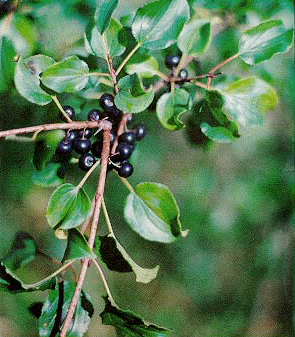
Photo: John M. Randall, The Nature Conservancy, Davis, CA, Public domain · source

Shrub · Buckthorn family (Rhamnaceae)
Buckthorn
Rhamnus cathartica · also: Purging buckthorn, Common buckthorn
Buckthorn is a native, thorny shrub or small tree of 2–6 m. Many short side shoots end in a thorn, and the finely toothed leaves have striking curved veins that run towards the tip. In May–June it bears small greenish-yellow flowers, followed in September–October by black berries crowded along the twigs. It is a food plant of the brimstone butterfly and grows on chalky soil, dry or damp. The berries and bark are poisonous and strongly laxative.
Caution: The berries and bark are poisonous and strongly laxative: just a few berries can cause vomiting, stomach cramps and severe diarrhoea, especially in children. Keep young children and pets away from them. Birds eat the berries without any problem.
Light
Sun or partial shade
preferably some sun
Moisture
Dry to wet
not fussy
Legal basis
Any garden soil
neutral to chalky
Hardiness
Throughout Belgium
no protection needed
Size
2–6 m
tall
Flowering
May–June
| Pruning months | November–March |
|---|---|
| Height | 2–6 m |
| Native to Belgium | Yes |
| Poisonous to people and pets | Yes, take care with children and pets |
| Flowering | May–June |
Identify
Buckthorn: how do you recognise it?
- Habit
- Shrub or small tree of 2–6 m, densely branched, with thorny side shoots.
- Leaf
- Almost opposite, often in clusters on short side shoots, 3–7 cm, oval, finely toothed, with 3–4 pairs of curved veins running towards the tip.
- Bark
- Dark greyish-brown to blackish and glossy, later flaking; many short side shoots end in a thorn.
- Flower
- Small, greenish-yellow, four-petalled flowers in clusters, in May–June; male and female on separate shrubs.
- Fruit
- Round, black berries (6–8 mm) crowded along the twigs, in September–October; poisonous and strongly laxative.
- Difference from alder buckthorn
- Alder buckthorn has untoothed, alternate leaves and no thorns.
- Difference from blackthorn
- Blackthorn has alternate leaves, white blossom on bare twigs and blue sloes.
Flowering: May–June · Pruning: November–March
Identify by feature: Black berries · Thorns or prickles
Looks like it, but isn’t
- Alder buckthorn Frangula alnus: untoothed, alternate leaves and no thorns. Difference from alder buckthorn
- Blackthorn Prunus spinosa: alternate leaves, white blossom on bare twigs and blue sloes. Difference from blackthorn
In your garden
Why grow it?
- Food plant of the brimstone butterfly: its caterpillars feed on the leaves.
- Flowers for bees and berries for birds in autumn.
- A thorny, native shrub that makes a mixed hedge dense and impenetrable.
- Grows on dry chalk as well as on damp soil.
Buckthorn: where does it grow best?
- Sun to partial shade; in sun it flowers more and bears more berries.
- Chalky soil, dry or damp. On acid soil, alder buckthorn is the better choice.
- Allow 3 m width.
- Not right next to a play area: the black berries tempt children.
- Light
- Sun or partial shade
- Legal basis
- Any garden soil
- Moisture
- Dry to wet
- Size
- 5 m tall, 3 m wide
- Hardiness
- Throughout Belgium, no protection needed
Goes well with
- Alder buckthorn: The other food plant of the brimstone, for the more acid or wetter part of the hedge.
- Blackthorn: Another thorny native shrub: together an impenetrable hedge and a safe nesting site.
- Hawthorn: White blossom in May and red berries next to the black berries of buckthorn.
- Wild privet: Grows on the same chalky soil, with scented flowers for the same insects.
Maintenance
Buckthorn: when and how to plant it?
- Plant from November to March, bare-root or root-balled.
- In a mixed hedge: one plant every 1–1.5 m, among other native shrubs.
- Only female shrubs bear berries, and only with a male nearby: plant several together.
- Plant at the same depth as before, firm the soil and water.
Care
- Watering
- In dry spells during the first year; after that, no longer needed.
- Feeding
- Not needed.
- Caterpillars
- Let the brimstone caterpillars get on with it in May–June: they eat a few leaves, but the shrub is none the worse for it.
- Thorns
- Wear sturdy gloves when working in or under the shrub.
Tip: Want brimstones in your garden? Plant a few buckthorns (or alder buckthorns) in a sunny spot: the butterflies will find them on their own.
Buckthorn: when to prune it?
Pruning months: November–March.
When: Dead, diseased and broken branches can be removed at any time of year. If pruning is needed, do it during winter dormancy (November–March).
How:
- Needs little pruning; thin out old branches in winter.
- In a mixed hedge it also tolerates trimming: cut it in winter along with the rest of the hedge.
- Wear sturdy gloves against the thorns.
Caution: Finish the winter pruning before mid-March, when the nesting season begins.
Propagation
- Sowing
- Sow the seeds from ripe berries outdoors in autumn; they usually germinate in spring. Wear gloves and wash your hands afterwards.
- Layering
- Bend a low branch to the ground and cover it with soil; after a year you can cut it free.
Buckthorn: how does it get through the winter?
Hardy throughout Belgium: no protection needed.
- Fully hardy.
- The black berries often hang on for a long time; thrushes and other birds eat them in autumn and winter.
Diseases and pests
- Crown rust: Small orange spots with tiny cups on the leaves in spring: buckthorn is the alternate host of crown rust, a rust fungus of oats and grasses. The shrub itself is hardly affected, but don’t plant it next to a field of oats.
- Aphids: Aphids on the young shoots in spring. Ladybirds and tits usually clear them up.
- No berries: A male shrub never bears berries, and a female one only with a male nearby.
Through the year
- January: Winter pruning: thin out old branches.
- February: Prune and plant.
- March: Finish pruning before mid-March; last month to plant.
- April: Brimstones lay eggs on the young leaves.
- May: Flowering: greenish-yellow flowers for bees.
- September: The black berries ripen: food for birds.
- November: Plant; winter pruning can begin.
- December: Winter pruning.
Use
What can you use it for?
- For wildlife
- Food plant of the brimstone butterfly; flowers for bees and berries for birds.
- Garden and landscape
- Native, thorny shrub for a mixed hedge on chalky or damp soil.
Caution: The berries and bark are poisonous and strongly laxative.
You and this species
Did you know?
- Like alder buckthorn, it is a food plant of the brimstone butterfly. The berries are a powerful laxative, hence the name cathartica (purging).
- The berries were once used to make sap green, a green colour for painters and manuscript illuminators.
- In North America, where it was introduced as a hedging plant, it has become a troublesome invasive species that overruns woodland.