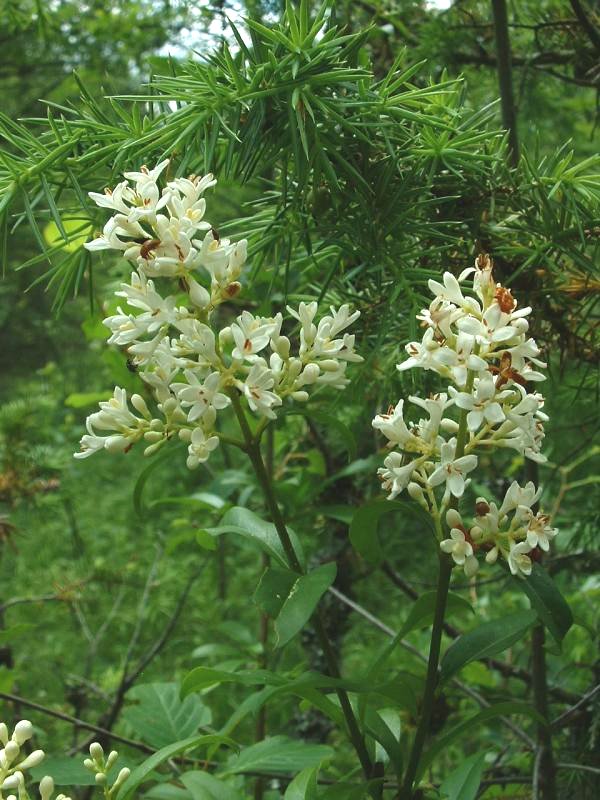
Photo: Wikimedia Commons, CC BY-SA 3.0 · source

Shrub · Olive family (Oleaceae)
Wild privet
Ligustrum vulgare · also: Common privet
Wild privet is our native privet: a shrub of 2–4 m with narrow, glossy leaves that only drop during the course of the winter. In June–July it bears white, strongly scented panicles full of butterflies, bees and hoverflies; then come glossy black, poisonous berries that hang on into winter for the birds. It is the food plant of the privet hawk-moth. As a hedge it tolerates hard pruning; as a free-growing shrub it fits into any mixed hedge.
Caution: The black berries and the leaves are poisonous: in children they cause vomiting and diarrhoea, and privet is also poisonous to dogs, cats, horses and livestock. Don’t give clippings to animals. Birds eat the berries without any problem.
Light
Sun or partial shade
preferably some sun
Moisture
Normal
no wet feet
Legal basis
Any garden soil
neutral to chalky
Hardiness
Throughout Belgium
no protection needed
Size
2–4 m
tall
Flowering
June–July
| Pruning months | May–June, August–September and November–March |
|---|---|
| Height | 2–4 m |
| Native to Belgium | Yes |
| Good for bees, butterflies and birds | Yes, for bees, butterflies and birds |
| Poisonous to people and pets | Yes, take care with children and pets |
| Flowering | June–July |
Identify
Wild privet: how do you recognise it?
- Habit
- Shrub of 2–4 m with slender, upright branches.
- Leaf
- Opposite, lance-shaped, 3–6 cm, untoothed; drops during the course of the winter.
- Bark
- Grey and smooth.
- Flower
- White, strongly scented panicles in June–July.
- Fruit
- Glossy black berries that last all winter; poisonous.
- Difference from garden privet
- Garden privet has broader, oval leaves that stay on longer.
Flowering: June–July · Pruning: May–June, August–September and November–March
Identify by feature: Long, narrow leaves · Black berries
Looks like it, but isn’t
- Garden privet Ligustrum ovalifolium: broader, oval leaves that stay on longer. Difference from garden privet
In your garden
Why grow it?
- Native: flowers for insects, berries for birds and leaves for privet hawk-moth caterpillars.
- A semi-evergreen hedge that tolerates hard pruning.
- Fragrant white flowers in June–July.
- A native alternative to butterfly bush.
Wild privet: where does it grow best?
- Sun to partial shade; in sun it flowers best.
- Ideally chalky, free-draining soil, but it grows on almost any soil; no wet feet.
- As a free-growing shrub, allow 2–3 m width; as a hedge, keep it 50–70 cm wide.
- Suitable for a clipped hedge, an informal mixed hedge or a hedgerow.
- Light
- Sun or partial shade
- Legal basis
- Any garden soil
- Moisture
- Normal
- Size
- 4 m tall, 2.5 m wide
- Hardiness
- Throughout Belgium, no protection needed
Goes well with
- Hawthorn: Together the backbone of a native mixed hedge, full of blossom and berries.
- Dog rose: Roses and hips in the hedge; both like chalk and sun.
- Cornelian cherry: Yellow flowers in February in the same chalk-loving hedge.
- Spindle: Pink fruits and red autumn colour next to the black privet berries.
Good and bad companions
Goes well with
- Together a mixed native hedge, good for birds and insects: hawthorn, blackthorn, hazel, dog rose, common dogwood, guelder rose, field maple, hornbeam
- Suits the woodland edge or the light shade of: ginkgo, box elder, ash, honey locust, field maple, silver maple
Maintenance
Wild privet: when and how to plant it?
- Plant from November to March, bare-root or root-balled.
- For a hedge: 3–4 plants per metre in a single row, or 5 per metre in a staggered double row.
- Plant at the same depth as before and firm the soil well.
- After planting, cut all shoots back by half: the hedge will then branch from the base.
Care
- Watering
- In dry spells during the first year; hardly needed after that.
- Feeding
- Not needed; a little compost in spring for a hedge that is clipped often.
- Building a young hedge
- For the first few years, clip twice a year and let the hedge gain only 10–20 cm each time; keep the top slightly narrower than the base.
- Flowers and berries
- A tightly clipped hedge flowers little. Let part of the hedge or a few shrubs grow freely, for flowers and berries.
Tip: Want a hedge that stays green for longer in winter? Choose the cultivar ‘Atrovirens’: a wild privet that holds on to its leaves for longer.
Wild privet: when to prune it?
Pruning months: May–June, August–September and November–March.
When: Clip a hedge in May–June and late August; thin out a free-growing shrub in winter.
How:
- Tolerates hard pruning: an old, bare hedge can be cut back hard in winter and will regrow.
- Clip a hedge with a slightly narrower top than base and stretch a line for a straight edge.
- On a free-growing shrub, saw a few of the oldest stems off at ground level every few years.
Caution: Before the May–June clip, check that no birds are nesting in the hedge; thin out free-growing shrubs before mid-March.
Propagation
- Hardwood cuttings
- In winter, push 20 cm lengths of one-year-old shoots two thirds of the way into the ground; they root very easily.
- Sowing
- Sow the seeds from ripe berries outdoors in autumn; they are slow to germinate.
Wild privet: how does it get through the winter?
Hardy throughout Belgium: no protection needed.
- Fully hardy.
- The leaves drop during the course of the winter; in mild winters some stay on.
- The black berries hang on all winter, as food for thrushes and blackbirds.
Diseases and pests
- Bare base: A hedge that is wider at the top than at the bottom goes bare at the base. Clip it to a trapezium shape, or cut an old hedge back hard in winter.
- Big green caterpillar: In summer a fat green caterpillar with purple and white diagonal stripes and a horn at the rear eats the leaves: the privet hawk-moth. Leave it be; the shrub doesn’t suffer.
- Aphids and thrips: Curled leaves or silvery-grey mottling in summer; usually harmless.
Through the year
- January: Thin out free-growing shrubs; berries for the birds.
- February: Winter pruning of free-growing shrubs; planting.
- March: Last winter pruning before mid-March; last month for bare-root planting.
- May: First clip of the hedge, late May; watch out for nests.
- June: Clip the hedge if you didn’t manage in May; free-growing shrubs start to flower.
- July: Flowering: scented panicles full of butterflies; privet hawk-moth caterpillars.
- August: Second clip, from late August.
- September: Last clip of the hedge; black berries.
- November: Planting, taking hardwood cuttings and thinning out free-growing shrubs.
- December: Winter pruning of free-growing shrubs.
Use
What can you use it for?
- Garden and landscape
- Native, semi-evergreen hedge.
- For wildlife
- Food plant of the privet hawk-moth; berries for birds.
Caution: The berries are poisonous.
Good for wildlife
- Caterpillars
- Host plant: caterpillars of butterflies or moths eat the leaves.
- Birds
- Berries, seeds or insects as food, or a place to nest.
- Butterflies
- Nectar for butterflies.
- Bees
- Nectar and pollen for honeybees and wild bees.
- Hoverflies
- Open flowers for hoverflies; many of their larvae eat aphids.
You and this species
Did you know?
- Food plant of the privet hawk-moth, one of our largest moths.
- Its scented flowers attract so many butterflies that wild privet is a real native alternative to butterfly bush.
- Most privet hedges in gardens are not wild privet but garden privet (Ligustrum ovalifolium) from Japan, which has broader leaves that stay on the shrub longer.
- The Roman poet Virgil already mentioned privet: ‘alba ligustra cadunt’, the white privet flowers fall, as an image of fading beauty.