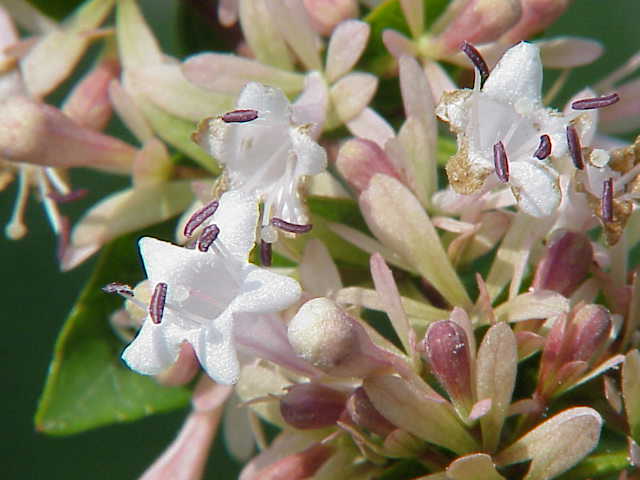
Photo: Kurt Stüber [1], CC BY-SA 3.0 · source

Shrub · Caprifoliaceae
Chinese abelia
Abelia chinensis
In other languages: Abelia (Nederlands) · Abélia de Chine (Français)
Abelia chinensis is a deciduous shrub from central and southern China. It forms a loose, rounded bush about 1.5 m tall and wide, with gracefully arching branches and small, glossy, oval leaves. From July into September it carries clusters of white, funnel-shaped flowers flushed soft pink, with a sweet scent. After flowering, the pink to reddish-brown sepals stay on the shrub for a long time, keeping it decorative into autumn. Gardeners know it above all as a butterfly magnet: on a sunny late-summer day it is covered in butterflies, bees and bumblebees.
Light
Sun or partial shade
preferably some sun
Moisture
Normal
no wet feet
Legal basis
Sand, loam or clay
acid to neutral
Hardiness
down to -18 °C
protect young plants
Size
1.5 m
tall, 1.5 m wide
Flowering
July–September
| Pruning months | March–April |
|---|---|
| Height | 1.5 m |
| Native to Belgium | No, planted |
| Good for bees, butterflies and birds | Yes, for bees and butterflies |
| Poisonous to people and pets | Not known to be poisonous |
| Flowering | July–September |
Identify
Chinese abelia: how do you recognise it?
- Habit
- A loose, rounded shrub about 1.5 m tall and wide, with slender, arching branches.
- Leaves
- Small, oval and finely toothed, glossy green; deciduous.
- Flowers
- Clusters of small, funnel-shaped flowers at the tips of the new shoots, white flushed pink, from July to September.
- Scent
- Sweet and honey-like, strongest on warm days.
- Calyx
- The pink to reddish-brown sepals persist after flowering and decorate the shrub into autumn.
Flowering: July–September · Plants: March–April and October–November · Pruning: March–April
In your garden
Why grow it?
- Flowers from July to September, when many shrubs are over.
- A top plant for butterflies, bees and bumblebees in late summer.
- Sweetly scented flower clusters, lovely near a seat or along a path.
- After flowering, the pink sepals remain attractive on the branches for weeks.
- Modest in size, so also suitable for a smaller garden or a large pot.
- Little pruning: removing a few old branches now and then is enough.
Chinese abelia: where does it grow best?
- Sun or partial shade; it flowers most freely in full sun.
- Any well-drained garden soil: sand, loam or clay, acid to neutral.
- Normally moist, without waterlogging in winter.
- A warm, sheltered spot, for example in front of a south- or west-facing wall, protects it in harsh winters.
- Allow about 1.5 m of space per shrub.
- Light
- Sun and partial shade
- Soil type
- Sand, loam or clay
- Acidity
- Acid or neutral
- Moisture
- Normal
- Size
- 1.5 m tall, 1.5 m wide
- Hardiness
- Hardy (to -18 °C)
Goes well with
- Lavender: Blue flowers and grey foliage at the base, also popular with butterflies.
- Sedum: Flowers in late summer and attracts the same butterflies and bees.
- Bluebeard: Blue flowers in August–September beside the white clusters.
- Michaelmas daisy: Extends the butterfly feast into October.
- Ornamental grasses: Light plumes that echo the loose shape of the shrub.
Maintenance
Chinese abelia: when and how to plant it?
Plant in March–April and October–November.
- Plant in March–April or in October–November, when the soil is neither frozen nor waterlogged.
- Dig a hole twice as wide as the root ball and mix in a few spadefuls of compost.
- Set the shrub at the same depth as it was in its pot and firm the soil well.
- Keep about 1.5 m from other shrubs.
- Water in thoroughly straight away, even if it is raining.
- Mulch the base with compost or wood chips; when planting in autumn, this also protects against frost.
Care
- Watering
- In the first year, water regularly in dry spells. Later it tolerates a dry period, but watering prolongs flowering.
- Feeding
- In April, some compost or an organic fertiliser for flowering shrubs. Do not feed after July.
- Mulching
- A layer of compost or wood chips in spring keeps the soil moist.
- In a pot
- Use a large pot with a drainage hole and good compost; water regularly in summer.
- Faded flowers
- Leave them: the pink sepals that remain are part of the charm.
Tip: Plant it by a sunny terrace or seat: in late summer you can then enjoy both the scent and the many butterflies it draws in.
Chinese abelia: when to prune it?
Pruning months: March–April.
When: Prune in March–April, once the hardest frosts are over. It flowers on this year’s shoots, so spring pruning costs no flowers.
How:
- Cut frosted or dead shoot tips back to healthy wood.
- Every year or two, remove a few of the oldest branches at the base so that young shoots can replace them.
- Shorten branches that are too long to just above a bud; do not shear the shrub, or it will lose its graceful shape.
- If the shrub has been badly frosted after a harsh winter, cut it back hard: it usually reshoots from the base.
Caution: Do not prune in late summer or autumn: any young shoots that grow afterwards are vulnerable to frost.
Propagation
- Softwood cuttings
- In May–June, take 8–10 cm cuttings from young shoots, remove the lower leaves and root them in moist compost under plastic in a warm, light place.
- Semi-ripe cuttings
- In July–August, take 10 cm cuttings from non-flowering shoots and root them in a mix of cutting compost and sand. Overwinter frost-free.
- Layering
- In summer, peg a low branch down into the soil; after a year, sever it and transplant it.
Chinese abelia: how does it get through the winter?
Hardy to −18 °C: protect young plants.
- Hardy to about −18 °C: it comes through most Belgian winters without trouble.
- In harsh winters the branches may be cut back by frost; the shrub then usually reshoots from the base.
- In autumn, mulch young shrubs with a thick layer of leaf mould or straw around the base.
- In a pot: stand the pot against a sheltered wall and wrap it in severe frost.
Diseases and pests
- Frost damage: Brown, dead shoot tips after a harsh winter. Wait until April and cut back to healthy wood.
- Few flowers: Caused by too much shade or too much nitrogen fertiliser. A sunnier spot and less fertiliser help.
- Yellow leaves: On very chalky or wet soil the leaves may turn yellow. Add compost or leaf mould and make sure the soil drains well.
- Aphids: Sometimes on young shoots in spring. Ladybirds usually deal with them; otherwise, hose them off with water.
Through the year
- March: Cut out frost damage. Plant.
- April: Remove a few old branches. Add compost. Plant.
- May: Mulch. Take softwood cuttings.
- June: Water in dry spells.
- July: Flowering begins. Take semi-ripe cuttings.
- August: Full flower, covered in butterflies. Water in dry spells.
- September: Last flowers. The pink calyces remain.
- October: Plant. The calyces decorate the shrub.
- November: Plant. Mulch the base against frost.
- December: Wrap pots in severe frost.
Use
Good for wildlife
- Bees
- Nectar and pollen for honeybees and wild bees.
- Butterflies
- Nectar for butterflies.
You and this species
Did you know?
- The genus is named after Clarke Abel, a British surgeon and naturalist who travelled to China with a diplomatic mission in the early 19th century.
- The well-known Abelia × grandiflora is a hybrid between Abelia chinensis and Abelia uniflora.
- Because the coloured sepals stay on after flowering, the shrub seems to keep flowering for weeks.