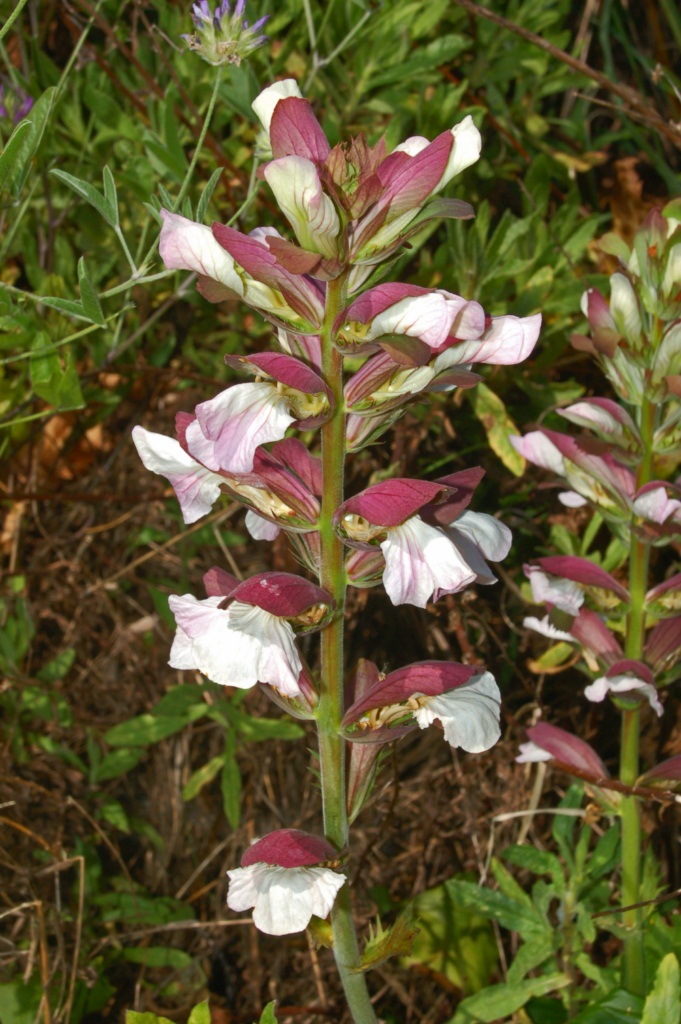
Photo: Hectonichus, CC BY-SA 3.0 · source

Perennial · Acanthaceae
Bear’s breeches
Acanthus mollis
In other languages: Akant (Nederlands) · Acanthe à feuilles molles (Français)
Bear’s breeches is a stately perennial from the Mediterranean region. It forms a broad clump of glossy, dark green, deeply cut leaves that often reach 50 cm or more in length. From June to August, sturdy spikes 1–1.5 m tall appear, carrying white, lipped flowers beneath purplish, spiny bracts. Gardeners love its architectural presence: a single plant instantly gives structure to a border or a sunny corner. Well-known forms include ‘Hollard’s Gold’, with golden-yellow young leaves, and the Latifolius Group, with extra-broad leaves.
Light
Sun or partial shade
preferably some sun
Moisture
Dry to normal
no wet feet
Legal basis
Sand, loam or clay
any pH
Hardiness
down to -15 °C
protect young plants
Size
1.2 m
tall, 0.9 m wide
Flowering
June–August
| Pruning months | March and September |
|---|---|
| Height | 1.2 m |
| Native to Belgium | No, planted |
| Good for bees, butterflies and birds | Yes, for bees |
| Poisonous to people and pets | Not known to be poisonous |
| Flowering | June–August |
Identify
Bear’s breeches: how do you recognise it?
- Habit
- Broad clump of basal leaves, 60–90 cm wide; 1–1.5 m tall in flower.
- Leaves
- Large, deeply cut and glossy dark green, hardly spiny. In mild winters they partly persist.
- Flower
- Upright spikes of white to pale pink lipped flowers, each beneath a purple, spiny bract, from June to August.
- Fruit
- Seed capsules that burst open when ripe and fling out the seeds.
- Roots
- Thick, fleshy and deep; every piece of root can grow into a new plant.
Flowering: June–August · Plants: April–May and September · Pruning: March and September
In your garden
Why grow it?
- Large, glossy leaves that add an exotic, architectural touch from spring to autumn.
- Tall, striking flower spikes in June–August that stay decorative long after flowering.
- Bumblebees and bees push between the lip and the bract to reach the nectar.
- Tolerates drought, lime and poor soil once it is well rooted.
- Grows in sun and in partial shade, for example against a wall or at the edge of trees.
- An established clump stays put for many years and needs little care.
Bear’s breeches: where does it grow best?
- Sun or partial shade: it flowers best in sun, while the leaves stay fresher in partial shade.
- Any well-drained soil: sand, loam or clay, from acid to chalky.
- Dry to normally moist; it dislikes wet soil in winter.
- A warm, sheltered spot, for example in front of a south-facing wall, helps young plants through winter.
- Allow 90 cm–1 m per plant and choose the spot for good: it is hard to get rid of.
- Light
- Sun and partial shade
- Soil type
- Sand, loam or clay
- Acidity
- Not fussy
- Moisture
- Dry or normal
- Size
- 1.2 m tall, 0.9 m wide
- Hardiness
- Hardy (to -15 °C)
Goes well with
- Spurge: Grey-green leaves and yellow flower heads, also happy in a dry, sunny spot.
- Catmint: A soft blue edging in front of the large, dark leaves.
- Giant feather grass: Light, swaying stems as a contrast to the heavy foliage.
- Globe thistle: Blue globes in the same sunny, dry spot, also loved by bees.
Maintenance
Bear’s breeches: when and how to plant it?
Plant in April–May and September.
- Plant in April–May or in September, so the roots can establish before summer or winter.
- Dig a hole twice as wide as the pot and loosen the bottom; on heavy clay, mix some coarse sand or gravel into the soil.
- Set the plant at the same depth as it was in the pot and firm the soil well.
- Keep 90 cm–1 m between it and other plants.
- Water in thoroughly straight away, and again in dry spells during the first weeks.
- Cover the base with a layer of leaves or straw for the first few winters.
Care
- Water
- Rarely needed once established. In long dry spells the leaves may droop; a good soaking helps.
- Feeding
- A spadeful of compost around the base in March–April. More is not needed.
- Mulching
- A layer of leaves or straw protects young plants from frost in winter.
- Old leaves
- Remove withered and frosted leaves in March; new leaves follow quickly.
- Root suckers
- Dig out shoots that appear outside the intended spot right away, with as much root as possible.
Tip: Choose the right spot from the start: when you move it, pieces of root always stay behind and sprout again, so you end up with two plants.
Bear’s breeches: when to prune it?
Pruning months: March and September.
When: After flowering, in September, cut off the spent spikes. In March, remove the old, withered leaves.
How:
- Cut the spent spikes off at the base, or leave them for winter structure and cut them in March instead.
- In March, remove dead and frost-damaged leaves down to the ground.
- Leaves that become tatty in summer from drought or mildew can be cut off; fresh leaves will follow.
Caution: Wear sturdy gloves: the bracts on the flower spikes are spiny.
Propagation
- Root cuttings
- From December to February: cut pieces of root 5–8 cm long, insert them upright in a pot of gritty cutting compost, thick end up, and keep them cool and barely moist. They sprout in spring.
- Division
- In April or September, slice a rooted piece off the edge of the clump with a sharp spade and replant it at once.
- Seed
- Sow ripe seed in a pot in spring. Seedlings take a few years to flower.
Bear’s breeches: how does it get through the winter?
Hardy to −15 °C: protect young plants.
- Hardy to about −15 °C: it comes through most Belgian winters without trouble, especially in dry, free-draining soil.
- In hard frost the leaves die back, but the roots sprout again in spring.
- Cover young plants with a thick layer of leaves, straw or wood chips for the first few winters.
- Wet feet in winter are more dangerous than frost: do not plant it where water lies.
Diseases and pests
- Slugs: They eat holes in the young leaves in spring. Pick them off in the evening and keep the base open and tidy.
- Powdery mildew: White powder on the leaves, especially in dry summers. Cut off affected leaves and water during drought.
- Spreading: The roots spread and every piece regrows. Dig out suckers in good time, with as much root as possible.
- No flowers: Too much shade or a plant that is too young. Give it more sun and some patience: it usually flowers well after two or three years.
Through the year
- January: Take root cuttings from an established plant.
- March: Cut away old and frosted leaves. Give compost around the base.
- April: Plant or divide. Watch for slugs on the young leaves.
- May: Plant. New leaves unfold in earnest.
- June: Flowering begins.
- July: Full bloom. Water during long dry spells.
- August: Flowering. Bumblebees visit the flowers.
- September: Cut off spent spikes or leave them standing. Plant or divide.
- November: Cover young plants with leaves or straw.
- December: Take root cuttings.
Use
Good for wildlife
- Bees
- Nectar and pollen for honeybees and wild bees.
You and this species
Did you know?
- The acanthus leaf has been a favourite motif since ancient Greece: you can see it on the capitals of Corinthian columns.
- The name comes from the Greek akantha, meaning thorn.
- In dry weather, the ripe seed capsules burst open and fling the seeds some distance.