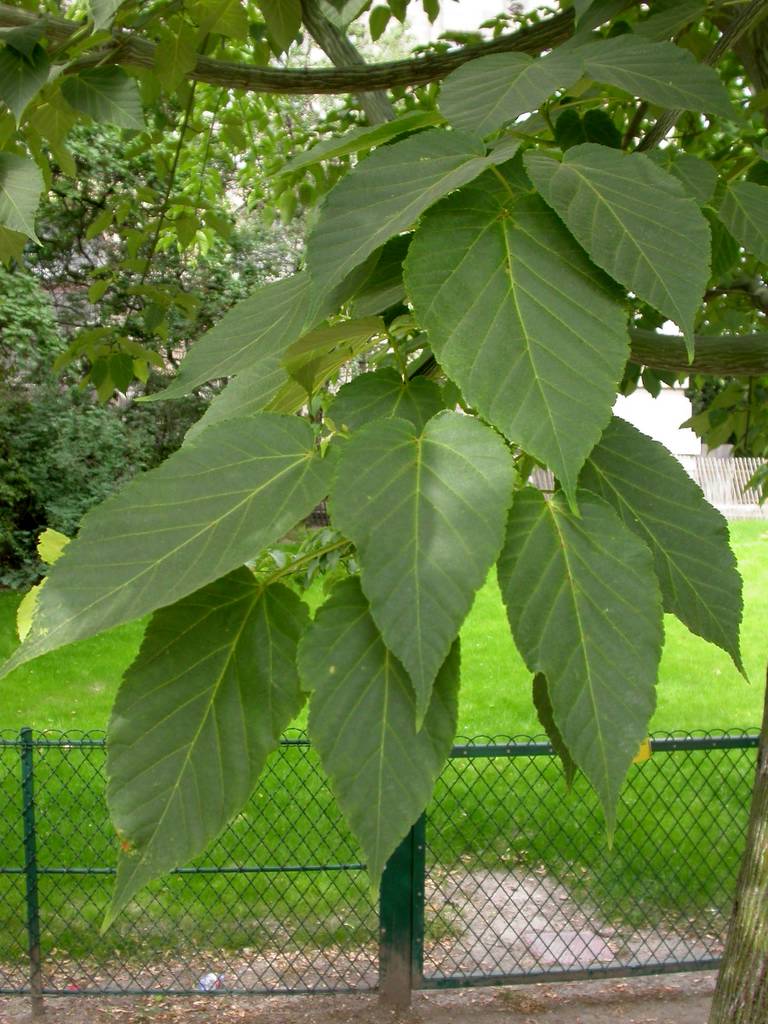
Photo: Abrahami, CC BY-SA 2.5 · source

Tree · Sapindaceae
Père David’s maple
Acer davidii
In other languages: Slangenhuidesdoorn (Nederlands) · Érable du père David (Français)
Père David’s maple comes from the mountain forests of central and southern China. It is a small tree or large multi-stemmed shrub with an open, rounded crown, usually reaching 8–10 m in gardens. Its great asset is the bark: green with fine white vertical stripes, like a snakeskin, which is why it is known as a snakebark maple. In April–May, hanging racemes of small yellow-green flowers appear, followed by winged seeds that often blush red. In autumn the glossy leaves turn yellow, orange and red. Well-known cultivars are ‘George Forrest’, with large leaves and red leaf stalks, and ‘Serpentine’, with smaller leaves and purplish bark.
Light
Sun or partial shade
preferably some sun
Moisture
Normal
no wet feet
Legal basis
Sand or loam
acid to neutral
Hardiness
Fully hardy
down to -23 °C
Size
10 m
tall, 8 m wide
Flowering
April–May
| Pruning months | July–August and November–December |
|---|---|
| Height | 10 m |
| Native to Belgium | No, planted |
| Poisonous to people and pets | Not known to be poisonous |
| Flowering | April–May |
Identify
Père David’s maple: how do you recognise it?
- Habit
- Small tree or multi-stemmed shrub with an open, rounded to spreading crown; up to about 10 m tall and 8 m wide.
- Bark
- Green to olive green with white or silvery-grey vertical stripes. At the base of old trunks the bark becomes rougher and greyer.
- Leaf
- Ovate, undivided or shallowly lobed, 7–15 cm long, with a toothed margin and pointed tip; glossy dark green, turning yellow, orange to red in autumn.
- Flower
- Small yellow-green flowers in hanging racemes in April–May, at the same time as the young leaves.
- Fruit
- Winged seeds (‘helicopters’) in hanging clusters, often flushed red in summer and ripe in autumn.
- Roots
- Fairly shallow and widely spreading: it dislikes digging or heavy competition close to the trunk.
Flowering: April–May · Plants: March–April and October–December · Pruning: July–August and November–December
In your garden
Why grow it?
- The green-and-white striped bark is attractive all year but stands out most in winter, when the tree is bare.
- Superb autumn colour in yellow, orange and red.
- Stays fairly modest in size: a fine specimen tree for a medium-sized garden.
- The hanging flower racemes in spring and the red-flushed seeds in summer are a bonus.
- Grown as a multi-stemmed tree, several striped trunks side by side look spectacular in low winter sun.
Père David’s maple: where does it grow best?
- Sun or partial shade; some afternoon shade prevents scorched leaf edges in hot summers.
- Light, humus-rich soil: sand or loam, acid to neutral. It grows less well on chalky soil.
- Moist but well-drained: no waterlogging, but no parched soil either.
- Sheltered from strong, cold winds, which can damage the young leaves and the thin bark.
- Allow 6–8 m of space and plant it where the trunk can be seen, for example in front of a dark hedge.
- Light
- Sun and partial shade
- Soil type
- Sand or loam
- Acidity
- Acid or neutral
- Moisture
- Normal
- Size
- 10 m tall, 8 m wide
- Hardiness
- Hardy (to -23 °C)
Goes well with
- Snowdrop: A white carpet in February beneath the green-and-white striped trunk.
- Hellebore: Flowers in late winter in the same light shade under the crown.
- Epimedium: A tough ground cover for the dry partial shade under trees.
- Witch hazel: Yellow or orange winter flowers next to the striking bark.
- Ferns: Fresh green at the base in summer.
Maintenance
Père David’s maple: when and how to plant it?
Plant in March–April and October–December.
- Plant in March–April or from October to December, when the soil is not frozen or waterlogged.
- Dig a hole twice as wide as the root ball, loosen the bottom and mix some compost or leaf mould into the excavated soil.
- Set the tree at the same depth as it was in the pot or nursery: the root collar stays at soil level.
- For a larger tree, drive in an angled stake on the windward side and tie the trunk loosely.
- Firm the soil well and water straight away with a few buckets.
- Spread a mulch of wood chips or leaf mould in a circle around the trunk, without touching the trunk itself.
Care
- Water
- For the first two years, water regularly in dry spells, a few buckets at a time. After that, only in long droughts.
- Feeding
- Usually unnecessary. A layer of compost in spring is enough.
- Mulching
- A fresh layer of mulch each spring keeps the shallow roots cool and moist.
- Clearing the trunk
- Gradually remove the lowest branches over a few years so the striped trunk can be seen.
- Protecting the bark
- Do not mow or strim against the trunk: the thin bark is easily damaged. A grass-free circle around the base helps.
- Stake
- Check the tree tie every year and remove the stake after two or three years.
Tip: Plant it where the low winter sun falls on the trunk, for example in front of a dark hedge: the white stripes then light up. A multi-stemmed specimen gives you even more bark to enjoy.
Père David’s maple: when to prune it?
Pruning months: July–August and November–December.
When: Prune only when needed, in summer (July–August) or early winter (November–December).
How:
- Gradually remove the lowest side branches over a few years to clear the trunk or trunks.
- Remove dead, damaged and crossing branches.
- Cut just outside the branch collar, the swollen ring at the base of the branch: the wound then closes best.
- Never prune much at once: a few branches a year at most.
Caution: Do not prune from January to May: the cuts then bleed heavily and the tree loses a lot of sap.
Propagation
- Seed
- Sow the winged seeds in autumn in a pot outdoors or in a cold frame; they germinate in spring after the winter cold. Seedlings may differ from the parent if other maples grow nearby.
- Softwood cuttings
- In May–June, take cuttings from young shoots and place them in moist cutting compost under plastic. Success is not guaranteed; nurseries also graft the cultivars.
Père David’s maple: how does it get through the winter?
Hardy to −23 °C.
- Hardy to about −23 °C: in Belgium it survives normal winters without protection.
- Young trees and the early young leaves can be damaged by severe frost or late spring frost; a sheltered spot helps.
- The striped bark looks its best in winter, especially in low sunlight.
- In a large pot: wrap the pot in hessian or bubble wrap and stand it against a wall so the roots do not freeze.
Diseases and pests
- Verticillium wilt: Branches suddenly wilt in summer, with dark streaks in the wood. Cut affected branches back well into healthy wood and dispose of them; do not replant a maple in that spot.
- Coral spot: Small coral-pink dots on dead or weakened branches. Cut these branches back into healthy wood.
- Aphids: Sticky leaves from honeydew in spring. Ladybirds and other natural enemies usually deal with them; otherwise spray off with water.
- Scorched leaf edges: Brown, dry leaf margins in hot, windy summers. Water in dry spells and choose a spot with some afternoon shade.
- Bark damage: Wounds from mowers or strimmers let in disease. Keep a grass-free circle around the trunk.
Through the year
- January: Dormant. Enjoy the striped bark. Do not prune.
- February: Do not prune: the sap is starting to rise.
- March: Plant. Apply compost and mulch.
- April: Hanging yellow-green flower racemes. Plant. Water young trees in dry spells.
- May: End of flowering. Watch for aphids. Take softwood cuttings.
- June: Seeds turn red. Water in dry spells.
- July: Prune: remove low, dead or crossing branches. Water in dry spells.
- August: Finish any pruning. Water young trees in dry spells.
- September: Seeds ripen. Collect seed.
- October: Autumn colour. Sow in a pot outdoors. Plant.
- November: Leaf fall. Plant. Prune if needed.
- December: Plant in mild weather. Prune if needed.
You and this species
Did you know?
- The tree is named after Armand David (1826–1900), a French missionary and naturalist who collected hundreds of plants and animals in China and also made the giant panda known in the West.
- There are about twenty maples with this kind of striped ‘snakebark’. Almost all come from East Asia; only Acer pensylvanicum grows in North America.
- The cultivar ‘George Forrest’ is named after the Scottish plant hunter who worked in south-west China in the early 20th century.