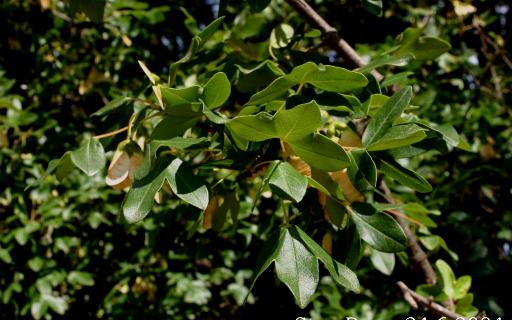
Photo: Sten Porse, CC BY-SA 3.0 · source

Tree · Sapindaceae
Montpellier maple
Acer monspessulanum
In other languages: Franse esdoorn (Nederlands) · Érable de Montpellier (Français)
The Montpellier maple grows wild around the Mediterranean, from Morocco and Spain to Turkey, and northwards into the warm river valleys of France and Germany. It is a small, slow-growing tree with a dense, rounded crown and small, leathery leaves with three blunt lobes. In April–May it bears hanging, greenish-yellow flower clusters that bees love, and in summer the winged fruits often take on a reddish tint. Gardeners choose it because it copes well with drought, heat and chalky soil. That makes it an ideal, modest-sized tree for a warm town garden or a sunny terrace.
Light
Full sun
warm and bright
Moisture
Dry to normal
no wet feet
Legal basis
Sand, loam or clay
neutral to chalky
Hardiness
Fully hardy
down to -20 °C
Size
8 m
tall, 7 m wide
Flowering
April–May
| Pruning months | July–August |
|---|---|
| Height | 8 m |
| Native to Belgium | No, planted |
| Good for bees, butterflies and birds | Yes, for bees |
| Poisonous to people and pets | Not known to be poisonous |
| Flowering | April–May |
Identify
Montpellier maple: how do you recognise it?
- Habit
- Small tree or large shrub, 6–8 m tall and 5–7 m wide, with a dense, rounded crown; slow-growing.
- Leaves
- Small, 3–6 cm, leathery, with three blunt lobes and smooth edges; glossy dark green, blue-green beneath. Yellow to orange in autumn.
- Flower
- Greenish-yellow flowers in hanging clusters in April–May, just before or with the young leaves.
- Fruit
- Winged double fruits with almost parallel wings, often flushed red in summer.
- Bark
- Grey-brown and smooth on young trees, later finely fissured.
Flowering: April–May · Plants: March–April and October–December · Pruning: July–August
In your garden
Why grow it?
- A small, slow-growing tree that also fits a town garden or front garden.
- Copes with drought, heat and chalky soil better than most maples.
- Early flowers in April–May, a welcome source of food for bees.
- A dense, rounded crown of fine leaves that casts pleasant, light shade.
- Yellow to orange autumn colour; the leaves often hang on the tree for a long time.
Montpellier maple: where does it grow best?
- Full sun and warmth; in shade it grows sparse and colours less well.
- Well-drained soil: sand, loam or clay, neutral to chalky.
- Dry to moderately moist; it will not tolerate wet feet.
- Ideal against a sunny wall or in a warm, paved spot in town.
- Allow 5–7 m of space and plant it at least 3 m from buildings.
- Light
- Sun
- Soil type
- Sand, loam or clay
- Acidity
- Neutral or chalky
- Moisture
- Dry or normal
- Size
- 8 m tall, 7 m wide
- Hardiness
- Hardy (to -20 °C)
Goes well with
- Lavender: A scented, grey edging for the same sunny, dry and chalky spot.
- Woodland sage: Purple spikes for bees, also happy in dry soil.
- Catmint: Long blue flowering at the foot of the tree.
- Grape hyacinth: Small blue spring bulbs beneath the crown, alongside the early flowers.
Maintenance
Montpellier maple: when and how to plant it?
Plant in March–April and October–December.
- Plant in March–April or from October to December, when the soil is not frozen or waterlogged.
- Dig a hole twice as wide as the root ball and loosen the bottom so that water can drain away.
- Set the tree at the same depth as it was in the pot: the root flare should stay just visible.
- Secure a standard tree to a stake on the windward side.
- Water well straight away, then weekly in dry spells during the first year.
- Mulch with wood chips or gravel, keeping it off the trunk.
Care
- Water
- Only in dry spells during the first and second years. After that it copes well with dry summers.
- Feeding
- Not needed; on poor soil it grows more compact and sturdy.
- Mulching
- A layer of wood chips round young trees keeps weeds down and the soil cool.
- In a pot
- It can stay for years in a large pot on a sunny terrace. Use free-draining compost and water regularly in summer.
- Shape
- It takes well to shaping, as a small round-headed or multi-stemmed tree.
Tip: Ideal for a warm town garden: plant it in full sun in well-drained soil and, after the second year, water only in long droughts.
Montpellier maple: when to prune it?
Pruning months: July–August.
When: Prune only in summer, in July–August, when the tree is in full leaf.
How:
- Remove dead, diseased and crossing branches, just outside the branch collar.
- Cut out water shoots and suckers at the base of the trunk.
- For a compact crown, shorten over-long shoots by a third.
- Keep wounds small; remove large branches gradually, over a few years.
Caution: Do not prune from January to May: maples ‘bleed’ heavily from the wounds then.
Propagation
- Seed
- Sow ripe seed in a pot in autumn and stand it outside in the cold; the seedlings come up in spring, sometimes only after a second winter.
- Softwood cuttings
- In June, 10 cm cuttings from young shoots in moist cutting compost under plastic; they do not always root easily.
Montpellier maple: how does it get through the winter?
Hardy to −20 °C.
- Hardy to about −20 °C: in Belgium an established tree needs no protection.
- Young trees on a cold, wet site are more vulnerable: well-drained soil is the best protection.
- In a pot: stand it against a wall, wrap the pot in hessian and raise it on pot feet so that water does not collect.
Diseases and pests
- Verticillium wilt: Branches suddenly wilt in summer, with brown streaks in the wood. Cut them well back into healthy wood and disinfect your secateurs; there is no cure.
- Aphids: Sticky young leaves in spring. Ladybirds usually clear them up; otherwise hose them off with water.
- Coral spot: Small pinkish-orange pustules on dead twigs. Cut dead wood back into healthy wood.
- Decline on wet soil: Yellow leaves and little growth on heavy, wet soil. Move it while young to a drier spot or improve the drainage.
Through the year
- March: Plant. Mulch round young trees.
- April: Greenish-yellow flower clusters; bees. Plant.
- May: Flowering. Watch for aphids.
- June: Water young trees in dry spells.
- July: Prune if needed. Red-flushed fruits.
- August: Last pruning. Water potted trees.
- October: Yellow to orange autumn colour. Plant. Sow ripe seed.
- November: Plant. Move potted trees to shelter.
- December: Plant in frost-free weather.
Use
Good for wildlife
- Bees
- Nectar and pollen for honeybees and wild bees.
You and this species
Did you know?
- The species name monspessulanum means ‘of Montpellier’: Mons Pessulanus is the Latin name of the city.
- In the wild it reaches as far north as the warm wine-growing valleys of the Moselle and the Rhine.
- You can recognise it by its small three-lobed leaves with smooth edges; its relative the field maple usually has five lobes.