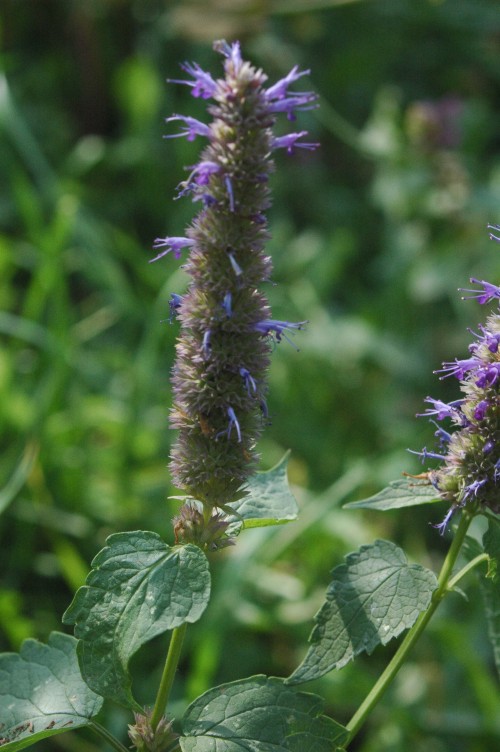
Photo: Stanislav Doronenko, CC BY 2.5 · source

Herb · Lamiaceae
Korean mint
Agastache rugosa
In other languages: Koreaanse munt (Nederlands) · Agastache rugueuse (Français)
Korean mint is a perennial from East Asia, from Korea and Japan to China and the Russian Far East. Like mint it belongs to the dead-nettle family, but it is not a true mint: it is a close relative of anise hyssop. It forms upright clumps about 1 m tall with square stems and heart-shaped, toothed leaves that smell of mint and aniseed. From July to September it carries dense spikes of small lilac to purple-blue flowers, humming with bees and bumblebees. The leaves are edible and give a fresh mint-and-aniseed flavour to salads, tea and fish dishes.
Caution: It self-seeds readily, especially on open, sunny ground. Cut off spent spikes if you do not want this, and pull up unwanted seedlings while young.
Light
Full sun
warm and bright
Moisture
Normal
no wet feet
Legal basis
Sand, loam or clay
any pH
Hardiness
Fully hardy
down to -20 °C
Size
1 m
tall, 0.5 m wide
Flowering
July–September
| Pruning months | March |
|---|---|
| Height | 1 m |
| Native to Belgium | No, planted |
| Good for bees, butterflies and birds | Yes, for bees and butterflies |
| Poisonous to people and pets | Not known to be poisonous |
| Flowering | July–September |
Identify
Korean mint: how do you recognise it?
- Habit
- Upright clump 80–100 cm tall and 40–50 cm wide, with square, branching stems.
- Leaves
- Heart-shaped to oval, 5–10 cm, toothed, opposite; fresh green and strongly scented of mint and aniseed.
- Flower
- Small lipped flowers in dense, candle-shaped spikes 5–15 cm long, lilac to purple-blue, from July to September.
- Scent and flavour
- Fresh and sweet, between mint and aniseed; milder than true mint.
- Lifespan
- A perennial that often lasts only a few years, but self-seeds readily.
Flowering: July–September · Harvest and fruit: May–September · Sowing: March–April · Plants: May and September · Pruning: March
In your garden
Why grow it?
- Three months of flowers, from July to September: one of the best plants for bees and butterflies.
- Edible leaves and flowers with a fresh mint-and-aniseed flavour for the kitchen.
- The whole plant smells wonderful when you brush past it.
- Easy to raise from seed and in flower in its first year.
- Fits the ornamental border as well as the vegetable or herb garden.
Korean mint: where does it grow best?
- Full sun: the sunnier the spot, the richer the flowering and the stronger the scent.
- Any well-drained soil: sand, loam or clay, acid to chalky.
- Moderately moist; in winter the soil must certainly not stay wet.
- Plant 40–50 cm apart, in groups of three or more for the best effect.
- Light
- Sun
- Soil type
- Sand, loam or clay
- Acidity
- Not fussy
- Moisture
- Normal
- Size
- 1 m tall, 0.5 m wide
- Hardiness
- Hardy (to -20 °C)
Goes well with
- Purple coneflower: Pink daisies beside the purple spikes, also a magnet for bees.
- Wild marjoram: A scented herb for the same sunny, dry spot, full of butterflies.
- Fountain grass: Soft plumes that contrast nicely with the upright spikes.
- Pot marigold: Orange flowers in the vegetable garden: together a colourful, edible edging.
Maintenance
Korean mint: when and how to plant it?
Plant in May and September.
- Sow indoors in March–April at 18–20 °C. Press the fine seed onto moist seed compost and barely cover it; it germinates in one to three weeks.
- Prick out the seedlings into small pots once they have two true leaves, in a light, not too warm spot.
- In May, harden the young plants off outside for a week and plant them out after the last frosts; bought plants can also go in in September.
- Make a hole slightly larger than the pot and plant at the same depth. On heavy clay, mix in some coarse sand or grit.
- Water straight away and keep the soil lightly moist for the first few weeks.
- Do not feed: on poor soil the stems stay sturdier and the scent stronger.
Care
- Water
- Rarely needed once established. Only in long droughts, and regularly in a pot.
- Feeding
- Not needed in open ground. In a pot, a little organic fertiliser now and then in spring.
- Harvesting
- Pick young leaves from June to September, and the flowers as soon as they open. For tea, cut stems just before full flower and dry them in bunches in an airy place.
- Spent flowers
- Cut them off if you want fewer seedlings; leave a few for the birds and for new plants.
- In the kitchen
- Use the leaves fresh in salads, with fish, in soups or as tea; the little flowers make a sweet decoration on a dessert.
Tip: Keep a few seedlings in reserve: the plant often lives only a few years, but it self-seeds readily, so you will always have young plants.
Korean mint: when to prune it?
Pruning months: March.
When: Cut back the old stems in March, when new shoots appear at the base.
How:
- Leave the stems standing in winter: they protect the crown of the plant and look lovely with frost.
- In March, cut them back to just above the new shoots at the base.
- In summer you can remove spent spikes; this limits self-seeding.
- A plant that grows too tall by June can be shortened by a third: it will flower a little later, on lower stems.
Caution: Do not cut back to the ground in autumn: more water then gets into the crown and the plant rots more easily in a wet winter.
Propagation
- Seed
- Sow indoors in March–April, barely covered, at 18–20 °C. Self-sown seedlings in the garden can be moved while young in spring.
- Division
- In spring, lift an older clump and split it into pieces with roots; this rejuvenates it at the same time.
- Softwood cuttings
- In May–June, 8 cm cuttings from non-flowering shoots in moist cutting compost; they root within a few weeks.
Korean mint: how does it get through the winter?
Hardy to −20 °C.
- Hardy to about −20 °C: in Belgium it survives the winter as long as the soil drains well.
- Winter wet is more dangerous than cold: on heavy, wet soil it often disappears after a few years.
- In a pot: stand it in a sheltered spot against a wall, a little drier, and keep the pot out of the rain.
- Always keep a few seedlings, so you have a spare if an old plant dies.
Diseases and pests
- Powdery mildew: White powder on the leaves in late summer, especially in dry weather or when planted too close. Allow space, water at the base and cut off affected leaves.
- Slugs: Young shoots eaten in spring. Protect young plants and only plant them out once they are sturdy.
- Winter rot: The plant fails to return in spring on wet soil. Choose a well-drained spot or a raised bed.
- Floppy stems: Caused by too much shade or too much fertiliser. Give it full sun and do not feed.
Through the year
- March: Cut back old stems. Sow indoors. Divide old clumps.
- April: Sow indoors. Prick out seedlings.
- May: Plant out after the last frosts. Take softwood cuttings.
- June: Harvest young leaves. Shorten plants that grow too tall.
- July: Flowering; bees and butterflies. Harvest and dry leaves and flowers.
- August: Flowering. Cut off spent spikes if you want fewer seedlings.
- September: Last flowers. Plant.
- October: Leave the stems standing for winter.
- December: Rest. The seed heads look lovely with frost.
Use
Edible and useful
- Leaves (May–September)
- Pick the young leaves and shoot tips from May to September. Korean mint tastes of mint and aniseed and is an everyday kitchen herb in Korea (baechohyang), especially with fish, in stews and in savoury pancakes. Also good as a tea.
- Storing
- Fresh, a few days in the fridge in a damp cloth. Dried (in bunches, upside down), the leaves keep for a year in a closed jar.
Caution: In normal kitchen or tea amounts, Korean mint is safe. During pregnancy do not drink large amounts. Despite its name, it is not a true mint and does not spread invasively.
Eating and using is at your own risk: see the terms of use.
Recipes
- Korean pancake with Korean mint (buchimgae) (Dish · 2 pancakes · 30 min)
Good for wildlife
- Bees
- Nectar and pollen for honeybees and wild bees.
- Butterflies
- Nectar for butterflies.
You and this species
Did you know?
- In Korea it is called baechohyang; the leaves go into dishes such as spicy fish soup.
- Despite its name it is not a true mint, but a close relative of anise hyssop in the same dead-nettle family.
- The square stems are a feature it shares with mint, sage, thyme and lavender.