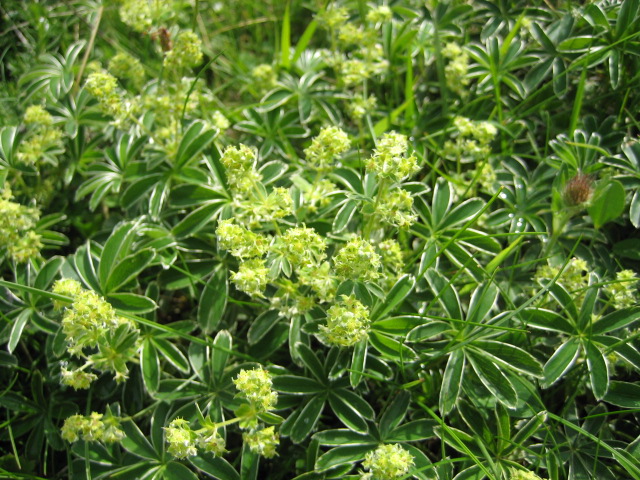
Photo: Rémih, CC BY-SA 3.0 · source

Perennial · Rosaceae
Alpine lady’s mantle
Alchemilla alpina
In other languages: Alpenvrouwenmantel (Nederlands) · Alchémille des Alpes (Français)
Alpine lady’s mantle grows wild in the mountains of Europe, from the Pyrenees and the Alps to Scandinavia and Scotland. It is a low, creeping perennial barely 15 cm high, with small hand-shaped leaves cut deeply into five to seven narrow lobes. The upper side is dark green and the underside silvery and silky, so each leaf seems to have a fine silver edge. From June to August small yellow-green flowers appear in loose clusters. Gardeners like it in a rock garden, between stones or as a delicate ground cover.
Light
Sun or partial shade
preferably some sun
Moisture
Dry to normal
no wet feet
Legal basis
Sand or loam
any pH
Hardiness
Fully hardy
down to -35 °C
Size
0.15 m
tall, 0.4 m wide
Flowering
June–August
| Pruning months | March and August |
|---|---|
| Height | 0.15 m |
| Native to Belgium | No, planted |
| Poisonous to people and pets | Not known to be poisonous |
| Flowering | June–August |
Identify
Alpine lady’s mantle: how do you recognise it?
- Habit
- A low, creeping mat 10–15 cm high and up to 40 cm wide, on creeping rhizomes that become woody.
- Leaves
- Small and hand-shaped, 2–4 cm, cut almost to the base into 5–7 lobes; dark green above, silvery and hairy beneath.
- Colour
- The silver of the underside shows over the leaf edge, so each leaf looks edged in silver.
- Flowers
- Tiny yellow-green flowers without petals, in loose clusters just above the leaves, from June to August.
- Roots
- Creeping rhizomes that root as they go; the plant spreads steadily without becoming invasive.
Flowering: June–August · Plants: March–April and September–October · Pruning: March and August
In your garden
Why grow it?
- Fine, silver-edged leaves that stay attractive from spring to autumn.
- Slowly forms a dense, low mat that keeps weeds down.
- Tolerates poor soil and dry spells, as long as the soil drains well.
- Ideal in a rock garden, between paving, on a low wall or at the front of a border.
- Fully hardy and seldom troubled by disease.
Alpine lady’s mantle: where does it grow best?
- Sun or partial shade; an open, light spot is ideal.
- Sandy or loamy soil that drains well; acid, neutral or chalky are all fine.
- Dry rather than wet: it dislikes wet feet in winter.
- Plant 30–35 cm apart, about 9–11 plants per m², for a closed mat.
- Light
- Sun and partial shade
- Soil type
- Sand or loam
- Acidity
- Not fussy
- Moisture
- Dry or normal
- Size
- 0.15 m tall, 0.4 m wide
- Hardiness
- Hardy (to -35 °C)
Goes well with
- Houseleek: Another plant for dry, stony spots, with neat rosettes beside the fine leaves.
- Thyme: Low, fragrant cushions that flower in summer and attract bees.
- Garden pink: Grey-blue leaves and pink flowers that look lovely beside the silver.
- Stonecrop: Low and drought-tolerant, flowering in summer and late summer.
Maintenance
Alpine lady’s mantle: when and how to plant it?
Plant in March–April and September–October.
- Plant in March–April or September–October.
- On heavy soil, work coarse sand or fine gravel into the top layer so water drains away freely.
- Set the plant at the same depth as it was in the pot, not deeper, or the crown may rot.
- Leave 30–35 cm between plants.
- Water in well and keep the soil slightly moist for the first few weeks.
- Spread a thin layer of fine gravel around the plant to keep the leaves dry and clean.
Care
- Watering
- Rarely needed once established; only in long summer droughts.
- Feeding
- Not needed. On soil that is too rich it grows looser and less compact.
- Weeding
- Keep the mat free of grass and weeds for the first two years, until it has closed up.
- Deadheading
- Cut off the flower clusters after flowering: the plant stays tidier and self-seeds less.
- Tidying
- In March, pull old brown leaves out of the mat.
Tip: Spread a thin layer of gravel around the plant: it keeps the crown dry, prevents rot and shows off the silver leaves.
Alpine lady’s mantle: when to prune it?
Pruning months: March and August.
When: No real pruning is needed. Cut off the spent flower stems in August and clear the old leaves in March.
How:
- After flowering, cut the flower stems just above the leaves.
- If the mat looks untidy, trim it lightly after flowering; fresh leaves soon follow.
- In March, comb the dead leaves out of the mat with your fingers or a hand rake.
Propagation
- Division
- In March–April or September: cut rooted pieces from the edge of the mat and replant them at once.
- Seed
- Sow in autumn in a tray and leave it outdoors over winter: the cold helps the seed germinate. Self-sown seedlings can also be moved.
Alpine lady’s mantle: how does it get through the winter?
Hardy to −35 °C.
- Fully hardy, to about −35 °C: no protection needed.
- Wet soil in winter is more dangerous than frost: make sure drainage is good.
- Remove fallen tree leaves from the mat, or it may rot underneath them.
- In a pot or trough: use a free-draining mix and stand the pot on pot feet.
Diseases and pests
- Rot: The crown turns brown and mushy on wet, heavy soil. Move the plant to a drier spot and mix gravel into the soil.
- Weeds in the mat: Grasses and weeds easily grow between the stems. Weed regularly, especially in the first two years.
- Bare centre: Older mats go bare in the middle. Divide them and replant the young pieces from the edge.
- Scorched leaves: In a hot, dry summer the leaves may turn brown. Give a few thorough soakings; the plant usually recovers quickly.
Through the year
- March: Pull old leaves out of the mat. Plant or divide.
- April: Planting. Weeding.
- May: New leaves. Remove weeds from the mat.
- June: Flowering begins.
- July: In flower. Water only in long dry spells.
- August: Cut off spent flower stems.
- September: Divide and plant.
- October: Planting. Clear fallen leaves from the mat.
- November: Clear fallen leaves from the mat.
You and this species
Did you know?
- Lady’s mantles set seed without pollination: the seedlings are clones of the mother plant.
- The name Alchemilla refers to the alchemists, who according to tradition collected the drops on the leaves.
- The slightly larger Alchemilla conjuncta is often sold under the name alpine lady’s mantle.