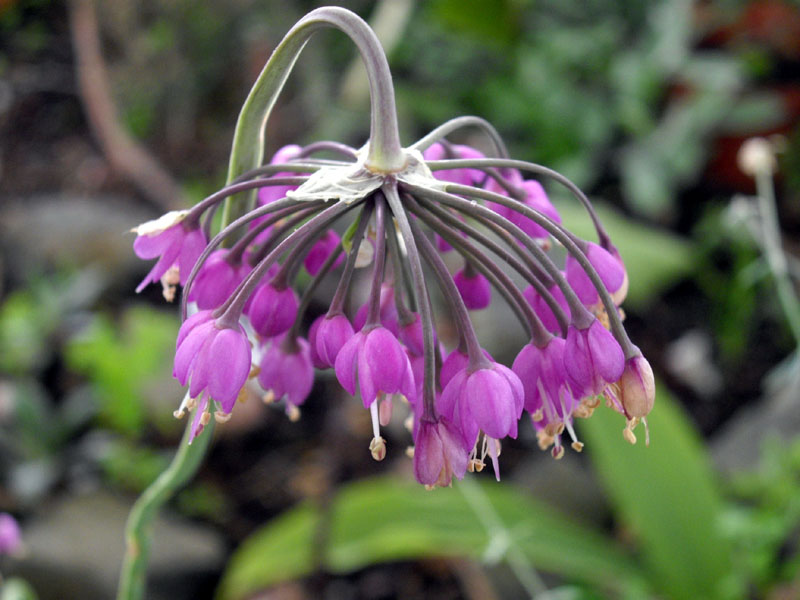
Photo: ghislain118 http://www.fleurs-des-montagnes.net, CC BY-SA 3.0 · source

Bulb or tuber · Amaryllidaceae
Nodding onion
Allium cernuum
In other languages: Allium cernuum (Nederlands) · Ail penché (Français)
Nodding onion is an ornamental onion from North America, where it grows wild from Canada to Mexico, in prairies, mountain meadows and on rocky slopes. It forms small clumps of slender bulbs with grassy leaves. In June and July loose heads of pink to lilac bells appear above them, nodding downwards from a stem that bends over at the top. That is where it gets its name: cernuum means ‘nodding’. Gardeners like it because it is tough, also grows in ordinary, rather moist garden soil and comes back year after year. There are forms in white, pale pink and deep pink.
Caution: All parts, and the bulbs in particular, are poisonous to dogs and cats, and also to horses and livestock. Keep loose bulbs out of reach of pets and children, and do not let dogs dig where you have planted them. In sensitive people the sap can irritate the skin.
Light
Sun or partial shade
preferably some sun
Moisture
Normal
no wet feet
Legal basis
Sand, loam or clay
any pH
Hardiness
Fully hardy
down to -30 °C
Size
0.45 m
tall, 0.15 m wide
Flowering
June–July
| Pruning months | March and August |
|---|---|
| Height | 0.45 m |
| Native to Belgium | No, planted |
| Good for bees, butterflies and birds | Yes, for bees and butterflies |
| Poisonous to people and pets | Yes, take care with children and pets |
| Flowering | June–July |
Identify
Nodding onion: how do you recognise it?
- Habit
- Small clump of upright stems, 30–45 cm tall and about 15 cm wide.
- Leaves
- Narrow, flat and grassy, up to about 30 cm long; they smell of onion when bruised.
- Flower
- Loose heads of small, bell-shaped flowers on a stem that bends over just below the head, in June and July.
- Colour
- Usually pink to lilac, sometimes almost white or deep pink. The stamens stick out beyond the flower.
- Bulb
- Slender, elongated bulbs clustered on a short rhizome, which together form a clump.
Flowering: June–July · Plants: March–April and September–October · Pruning: March and August
In your garden
Why grow it?
- An ornamental onion that also thrives in ordinary, moderately moist soil, not just in dry, poor spots.
- Bees, bumblebees and butterflies love to visit the flowers.
- The nodding heads give a playful, natural look to a border or prairie planting in June and July.
- Fully hardy and long-lived: the clumps fill out a little more every year.
- Small and narrow enough for the front of a border, a rock garden or a large pot.
Nodding onion: where does it grow best?
- Full sun or partial shade; it flowers most freely in sun.
- Sandy, loamy or clay soil; acid, neutral or chalky are all fine.
- Moderately moist soil is ideal. It copes with more moisture than most ornamental onions, but dislikes soil that stays waterlogged in winter.
- Plant in groups of 5–10 bulbs, 10–15 cm apart, at the front of a border or among low plants.
- Light
- Sun and partial shade
- Soil type
- Sand, loam or clay
- Acidity
- Not fussy
- Moisture
- Normal
- Size
- 0.45 m tall, 0.15 m wide
- Hardiness
- Hardy (to -30 °C)
Goes well with
- Coneflower: Large pink daisies in the same summer, also prairie plants from North America.
- Catmint: Blue clouds at its feet and even more food for bees.
- Hardy geranium: Covers the ground and hides the leaves as they die back.
- Fountain grass: Soft plumes that add to the airy feel of a prairie planting.
Maintenance
Nodding onion: when and how to plant it?
Plant in March–April and September–October.
- Plant dry bulbs in September–October; pot-grown plants can also go in during March–April.
- Loosen the soil and mix in some compost; on heavy clay, a handful of grit under the bulbs helps.
- Plant the bulbs 5–8 cm deep with the tip pointing up, or set a pot-grown plant at the same depth as it was in its pot.
- Space them 10–15 cm apart and plant in groups: that way the nodding heads show off best.
- Firm the soil and water in, especially pot-grown plants and spring plantings.
- Mark the spot so you do not damage the bulbs when you work in the border later.
Care
- Watering
- Moderately moist soil is enough. Water during long dry spells in spring or while flowering; in a pot, water regularly.
- Feeding
- A thin layer of compost in March is enough. Too much fertiliser gives floppy stems.
- Mulching
- A light mulch of leaf mould keeps the soil cool and moist; do not pile it too thickly over the bulbs.
- Deadheading
- Cut off the heads in August if you do not want seedlings. If you leave them, it self-seeds moderately.
- Foliage
- Let the leaves die back naturally after flowering: the bulb draws reserves from them for next year.
- Dividing
- Every 3–4 years, when the clump becomes congested and flowers less.
Tip: Plant it in small groups among low perennials: the nodding heads are best seen from slightly above, and the dying leaves then disappear unnoticed among the neighbours.
Nodding onion: when to prune it?
Pruning months: March and August.
When: Pruning is not really needed. Cut off the faded heads in August and clear away the dead leaves in March.
How:
- After flowering, cut the flower stems back to just above the foliage, unless you want to collect seed or let it self-sow.
- Leave the green leaves until they turn yellow and wither on their own.
- In March, gently pull away the dead leaves and stems or cut them off short.
Caution: Never cut off the leaves while they are still green: it weakens the bulb and it will flower less the following year.
Propagation
- Division
- In March–April or September–October, lift the clump and split it into smaller groups of bulbs. Replant straight away, 5–8 cm deep.
- Seed
- Sow ripe seed in autumn in a pot left outdoors; it germinates in spring. Seedlings flower after 2–3 years.
Nodding onion: how does it get through the winter?
Hardy to −30 °C.
- Fully hardy, to about −30 °C: no protection is needed in Belgium.
- The top growth dies down in autumn and reappears in spring.
- Wet feet in winter are the biggest risk: on heavy soil, make sure drainage is good.
- In a pot: stand it against a wall and keep the compost fairly dry in winter.
Diseases and pests
- Slugs: They eat the young leaves in spring. Pick them off in the evening or lay down a plank for them to hide under.
- Bulb rot: The bulbs go soft and the plant disappears in soil that stays too wet in winter. Plant in a better-drained spot or slightly raised.
- Rust: Orange pustules on the leaves, especially in damp summers. Cut off affected leaves and put them in the household waste, not on the compost heap.
- Few flowers: Usually too much shade or a clump that has become congested. Give it more light or divide the clump.
Through the year
- March: Clear dead leaves. Add compost. Plant pot-grown plants or divide clumps.
- April: Plant pot-grown plants. Watch out for slugs.
- May: Leaves in full growth. Water in dry spells.
- June: Flowering begins. Bees and butterflies on the flowers.
- July: Full flower. Water during long dry spells.
- August: Cut off faded heads or let them self-seed.
- September: Plant bulbs. Divide clumps.
- October: Plant bulbs. Sow ripe seed in a pot.
- November: Dormant: the leaves die down.
Use
Edible and useful
Not edible. Ornamental onions are true alliums, related to onion, garlic, leek and chives, and like them they are poisonous to dogs and cats: all parts, especially the bulbs, contain sulphur compounds that damage the red blood cells and can cause anaemia. Cats are more sensitive than dogs, and the signs (lethargy, pale gums, red or brown urine) sometimes appear only after a few days. Horses, sheep and other livestock can fall ill from them too. Even though the leaves and bulbs smell of onion, they are not grown as vegetables: do not eat them, and never store the bulbs with the kitchen onions, as they are not meant for eating and may have been treated with pesticides. Do not plant them where your dog digs, keep loose bulbs out of reach of pets and children, and do not put a vase of alliums where your cat chews the stems. If your dog or cat has eaten a bulb or leaves, call your vet, even if it shows no signs yet. If any is swallowed, call a poison centre (in Belgium 070 245 245) or your doctor at once.
Good for wildlife
- Bees
- Nectar and pollen for honeybees and wild bees.
- Butterflies
- Nectar for butterflies.
You and this species
Did you know?
- The name cernuum comes from the Latin cernuus, ‘bowed forward’ or ‘nodding’: the stem bends over just below the flower head.
- It is one of the most widespread wild onions in North America.
- As with all ornamental onions, the leaves only smell of onion when bruised: the smell comes from sulphur compounds released when the cells are damaged.