Photo: Sten Porse, CC BY-SA 3.0 · source

Bulb or tuber · Amaryllidaceae
Golden garlic
Allium moly
In other languages: Goudlook (Nederlands) · Ail doré (Français)
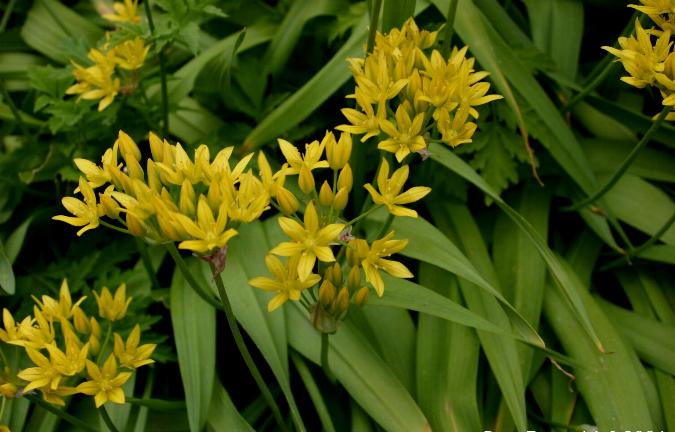
Golden garlic is a small ornamental onion from south-western Europe, mainly Spain and southern France. It grows to about 25 cm and in May–June carries loose umbels of bright yellow, star-shaped flowers above a few broad, grey-green leaves. Unlike many ornamental onions, it also flowers well in light shade, for example under shrubs or at the edge of a border. It increases readily by offsets and seed, so that after a few years you have a golden carpet. The cultivar ‘Jeannine’ has larger heads and flowers a little longer.
Caution: All parts, especially the bulbs, are toxic to dogs and cats, and in larger amounts also to grazing animals such as horses. Keep loose bulbs out of reach of children and pets. It spreads quickly by offsets and seed: do not plant it among delicate, slow-growing plants.
Light
Sun or partial shade
preferably some sun
Moisture
Dry to normal
no wet feet
Legal basis
Sand, loam or clay
neutral to chalky
Hardiness
Fully hardy
down to -25 °C
Size
0.25 m
tall, 0.1 m wide
Flowering
May–June
| Height | 0.25 m |
|---|---|
| Native to Belgium | No, planted |
| Good for bees, butterflies and birds | Yes, for bees |
| Poisonous to people and pets | Yes, take care with children and pets |
| Flowering | May–June |
Identify
Golden garlic: how do you recognise it?
- Habit
- Low bulb of 20–25 cm tall that forms dense clumps over the years.
- Leaves
- Usually two broad, lance-shaped, grey-green leaves per bulb, which die back after flowering.
- Flower
- Loose, domed umbels of 5–7 cm with starry flowers, in May–June.
- Colour
- Bright golden yellow; the flowers open best in sunshine.
- Scent
- Bruised leaves smell of onion; the flowers are lightly scented.
- Bulb
- Small, round bulb that produces many offsets.
Flowering: May–June · Plants: September–November
In your garden
Why grow it?
- Bright yellow is a rare colour among ornamental onions: it lights up the border in May–June.
- Also flowers in light shade, where other ornamental onions struggle.
- Bees and hoverflies like to visit the open, starry flowers.
- Low and compact: ideal for the front of the border, between perennials or in a rock garden.
- Easy and hardy: it spreads without you having to do anything.
Golden garlic: where does it grow best?
- Sun to light partial shade; in deep shade it flowers poorly.
- Well-drained soil: sand, loam or clay, neutral to chalky.
- Dry to moist; avoid soil that stays wet in winter.
- Plant about 10 cm apart, in groups of ten or more, in a place where it is allowed to spread.
- Light
- Sun and partial shade
- Soil type
- Sand, loam or clay
- Acidity
- Neutral or chalky
- Moisture
- Dry or normal
- Size
- 0.25 m tall, 0.1 m wide
- Hardiness
- Hardy (to -25 °C)
Goes well with
- Bugle: Blue flower spikes and low ground cover in the same light shade.
- Forget-me-not: Little clouds of sky blue as a fresh partner for the yellow.
- Hardy geranium: It fills out later and hides the dying foliage.
- Purple ornamental onions: Purple globes above and golden yellow below: a classic colour contrast.
Maintenance
Golden garlic: when and how to plant it?
Plant in September–November.
- Plant in September–November, while the ground is not frozen.
- Loosen the soil and, on heavy clay, work in some coarse sand.
- Set the bulbs pointed end up, 8 cm deep.
- Keep about 10 cm between bulbs; plant in a group rather than a row.
- Firm the soil and water if the ground is very dry.
- Choose a spot where it can spread freely from the start, for example under shrubs.
Care
- Watering
- Rarely needed; only in a very dry spring, while the leaves are green.
- Feeding
- Not necessary. A thin layer of compost in March is enough.
- Foliage
- Let the leaves die back naturally after flowering, in June–July.
- Spent flowers
- Cut them off in June if you do not want seedlings; otherwise just leave them.
- Spreading
- Every few years, dig out part of the clump if it takes up too much room.
Tip: Plant golden garlic under deciduous shrubs: there it gets enough light in spring, can spread freely, and the dying foliage disappears from view in summer.
Golden garlic: when to prune it?
When: Golden garlic is not pruned. At most you cut off the faded flower heads in June.
How:
- Cut faded heads just above the leaves if you want to limit self-seeding.
- Leave the leaves until they are yellow and dry, then pull them away.
- Clear the dead foliage in summer to keep the spot tidy.
Caution: Do not cut off the green leaves, or it will flower less next year.
Propagation
- Offsets
- Lift a clump in July–August, once the leaves have died back, and replant the small bulbs in autumn, 8 cm deep.
- Seed
- It self-seeds readily. You can also scatter ripe seed in summer where you want it to grow; seedlings flower after two or three years.
Golden garlic: how does it get through the winter?
Hardy to −25 °C.
- Fully hardy, to about −25 °C: in Belgium it simply stays in the ground.
- Good drainage matters more than frost protection.
- In a pot or trough: stand it against a wall in winter so the compost does not get waterlogged.
Diseases and pests
- Slugs: They eat the young leaves and flower buds in spring. Picking them off in the evening works best.
- Bulb rot: In wet, heavy soil the bulbs rot. Improve drainage or plant in a drier spot.
- Spreading too much: In a small border it can crowd out other plants. Cut the flowers before the seed ripens and dig out surplus bulbs.
- Few flowers: The clump is too crowded or too shaded. Lift, divide and replant further apart.
Through the year
- March: Leaves appear. Give a thin layer of compost.
- April: Flower buds appear. Watch for slugs.
- May: In flower. Bees and hoverflies visit.
- June: End of flowering. Cut faded heads if you do not want seedlings.
- July: Foliage dies back. Lift crowded clumps.
- August: Dormant. Store lifted bulbs dry.
- September: Plant bulbs 8 cm deep.
- October: Plant bulbs.
- November: Plant the last bulbs.
Use
Edible and useful
Not edible. Ornamental onions are true alliums, related to onion, garlic, leek and chives, and like them they are poisonous to dogs and cats: all parts, especially the bulbs, contain sulphur compounds that damage the red blood cells and can cause anaemia. Cats are more sensitive than dogs, and the signs (lethargy, pale gums, red or brown urine) sometimes appear only after a few days. Horses, sheep and other livestock can fall ill from them too. Even though the leaves and bulbs smell of onion, they are not grown as vegetables: do not eat them, and never store the bulbs with the kitchen onions, as they are not meant for eating and may have been treated with pesticides. Do not plant them where your dog digs, keep loose bulbs out of reach of pets and children, and do not put a vase of alliums where your cat chews the stems. If your dog or cat has eaten a bulb or leaves, call your vet, even if it shows no signs yet. If any is swallowed, call a poison centre (in Belgium 070 245 245) or your doctor at once.
Good for wildlife
- Bees
- Nectar and pollen for honeybees and wild bees.
You and this species
Did you know?
- The name moly refers to the magic herb in Homer’s Odyssey, which Hermes gave to Odysseus to protect him from the sorceress Circe.
- In English it is also called lily leek, after its broad leaves, which look more like those of a lily than an onion.
- Golden garlic is one of the few ornamental onions with bright yellow flowers.