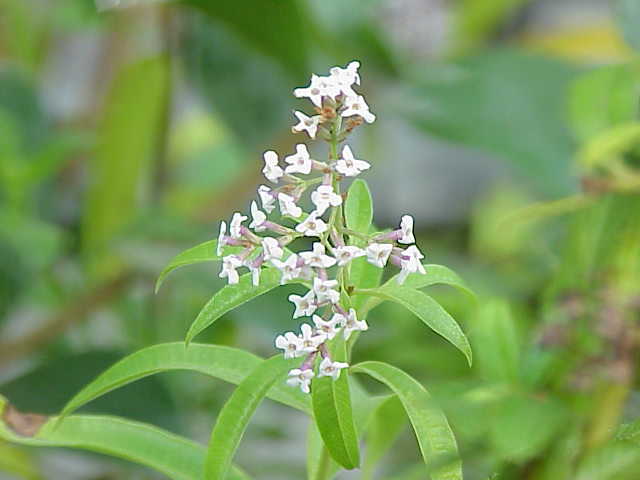
Photo: Kurt Stüber [1], CC BY-SA 3.0 · source

Herb · Verbenaceae
Lemon verbena
Aloysia citrodora
In other languages: Citroenverbena (Nederlands) · Verveine citronnelle (Français)
Lemon verbena comes from South America, including Argentina, Chile and Peru, and was brought to Europe by the Spanish in the 17th century. It is a deciduous shrub that reaches 1–1.5 m in a pot, with narrow, rough leaves in whorls of three. Brush past it and you smell an intense, pure lemon scent, one of the strongest in the herb garden. From July to September panicles of tiny white to lilac flowers appear. The leaves are delicious in tea, syrups, ice cream and desserts, but the plant tolerates only a few degrees of frost.
Light
Full sun
warm and bright
Moisture
Normal
no wet feet
Legal basis
Sand or loam
acid to neutral
Hardiness
down to -5 °C
protect in harsh winters
Size
1.5 m
tall, 1 m wide
Flowering
July–September
| Pruning months | April |
|---|---|
| Height | 1.5 m |
| Native to Belgium | No, planted |
| Good for bees, butterflies and birds | Yes, for bees |
| Poisonous to people and pets | Not known to be poisonous |
| Flowering | July–September |
Identify
Lemon verbena: how do you recognise it?
- Habit
- Deciduous, loose shrub; in a pot 1–1.5 m tall and 0.8–1 m wide.
- Leaf
- Lance-shaped, 7–10 cm, pale green and rough, in whorls of three or four around the stem.
- Flower
- Slender panicles of tiny white to pale lilac flowers at the tips, from July to September.
- Scent
- A strong, pure lemon scent as soon as you touch the leaf; it lasts a long time when dried.
- Roots
- Finely branched; they cannot cope with cold, wet soil.
Flowering: July–September · Harvest and fruit: June–September · Plants: May–June · Pruning: April
In your garden
Why grow it?
- An intense, pure lemon scent in leaves and stems.
- Fresh or dried leaves for tea, syrups, desserts and ice cream.
- Panicles of small flowers in summer that attract bees.
- A fragrant pot plant for a sunny terrace, where you brush past it often.
- The dried leaves keep their scent for a long time.
Lemon verbena: where does it grow best?
- Full sun, in a warm, sheltered spot: a south-facing terrace or against a warm wall.
- Light, well-drained soil: sand or loam, acid to neutral. In a pot: compost with some sand or fine grit.
- Moderately moist in summer; never waterlogged, especially not in winter.
- Easiest in a pot that you can move somewhere frost-free in winter.
- In the ground: allow 80–100 cm, at the foot of a south-facing wall.
- Light
- Sun
- Soil type
- Sand or loam
- Acidity
- Acid or neutral
- Moisture
- Normal
- Size
- 1.5 m tall, 1 m wide
- Hardiness
- Half hardy (to -5 °C): protect it in harsh winters
Goes well with
- Lavender: A fragrant pair in pots on the sunny terrace.
- Rosemary: Another Mediterranean shrub that likes the same sun and dry roots.
- Lemon balm: A hardy second lemon-scented herb for tea.
- Scented geranium: Another pot plant with fragrant leaves, overwintered in the same way.
Maintenance
Lemon verbena: when and how to plant it?
Plant in May–June.
- Put it outside or plant it after mid-May, once night frosts are over, until June.
- Choose a pot of at least 30–40 cm with drainage holes and put a layer of gravel in the bottom.
- Fill with potting compost mixed with some sand or fine grit for good drainage.
- Set the plant at the same depth as in its old pot and firm the compost well.
- Water straight away, then let the top few centimetres dry before watering again.
Care
- Water
- Regularly in summer, whenever the surface is dry. Do not leave water standing in the saucer.
- Feeding
- From May to August, a little liquid organic feed every two or three weeks in a pot.
- Harvesting
- Pick the leaves all summer; the scent is strongest just before flowering. Dry in bunches in an airy, shady place.
- Pinching out
- In May–June, pinch out the tips of young shoots for a bushier plant.
- Repotting
- Every two or three years in April, into a slightly larger pot with fresh compost.
Tip: Stand it in a pot right next to your seat: every time you brush past it, you smell lemon. Only prune in April, when you can see which buds are breaking.
Lemon verbena: when to prune it?
Pruning months: April.
When: In April, when the first buds visibly swell. It is late to leaf up, so wait until you can see which stems are alive.
How:
- Cut all stems back to two or three buds above the old wood, or to 20–30 cm for a compact plant.
- Remove dead and frost-damaged wood back to green wood; scratch the bark with a fingernail to see whether a stem is alive.
- In summer, pinch out the tips for a bushier plant; every harvest is a small prune too.
Caution: Do not throw out a bare plant too soon in spring: lemon verbena sometimes only reshoots in May or even June.
Propagation
- Softwood cuttings
- In May–June, take 8–10 cm tip cuttings from young shoots, remove the lower leaves and root them in moist cutting compost under plastic in a warm place. Roots form within a few weeks.
- Semi-ripe cuttings
- In July–August, take cuttings with a heel; overwinter the young plants indoors, frost-free.
Lemon verbena: how does it get through the winter?
Hardy to −5 °C: protect in harsh winters.
- Not hardy: it tolerates only about −5 °C, and then only with dry roots.
- In October, before the first frost, move the pot to a cool, frost-free place at 5–10 °C, such as a cold greenhouse, garage or cool hallway.
- It loses its leaves in winter: that is normal. Give a very little water now and then so the root ball does not dry out completely.
- In the ground only against a warm south-facing wall, with a thick mulch over the base; expect losses after a hard winter.
Diseases and pests
- Red spider mite: Finely mottled, dull leaves and fine webbing, especially in hot, dry weather or indoors. Mist the leaves and move the plant outside to an airy spot.
- Whitefly: Small white flies under the leaves, especially in a greenhouse. Hang up yellow sticky traps and move the plant outside.
- Root rot: A limp plant and a wet, musty-smelling root ball. Use a free-draining pot and water very sparingly in winter.
- Late to leaf up: In spring the plant looks dead. Scratch a stem: if the wood is green, it is still alive. Give it light and warmth and wait.
Through the year
- March: Move the overwintered plant to a brighter, slightly warmer spot. Water a little more.
- April: Prune as soon as the buds swell. Repot.
- May: After mid-May, put outside or plant. Take softwood cuttings.
- June: Planting. Pinch out tips. Feed.
- July: Flowering begins. Harvest and dry leaves.
- August: Flowering. Water and feed. Take semi-ripe cuttings.
- September: Last harvest. Stop feeding.
- October: Bring in before the first frost, cool and frost-free.
- December: Dormant: bare, cool and almost dry.
Use
Edible and useful
- Leaves (June–September)
- Cut leafy sprigs from June to September; the aroma is strongest just before and during flowering in July–August. Always cut above a leaf node so the shrub branches. The leaves smell intensely of lemon and keep their scent for a long time when dried: for tea (the French ‘verveine’), cordial, ice cream, panna cotta and with fish.
- Storing
- Dry the leaves loose on a rack or in a paper bag somewhere airy and dark; after a week they rustle. In a tightly closed jar they keep their scent for a year. Pick a good supply in September: the plant is not hardy and drops its leaves outdoors in autumn.
Caution: In normal amounts as a tea, lemon verbena is safe for most people; do not drink litres of it, and take care during pregnancy and with kidney problems. Do not confuse it with vervain (Verbena officinalis), a different plant with a bitter taste. Lemon verbena tolerates little frost: overwinter it in a pot somewhere cool and light.
Eating and using is at your own risk: see the terms of use.
Recipes
- Lemon verbena tea (Tea · 1 teapot (± 750 ml) · 10 min)
- Lemon verbena cordial (Syrup · ± 1 litre · 20 min + overnight steeping)
- Lemon verbena panna cotta (Dish · 6 people · 20 min + 4 hrs setting)
Good for wildlife
- Bees
- Nectar and pollen for honeybees and wild bees.
You and this species
Did you know?
- The genus Aloysia is named after Maria Luisa of Parma, wife of King Charles IV of Spain.
- In France, verveine is a well-known herbal tea made from the leaves of this plant.
- The lemon scent comes mainly from citral, a fragrance compound also found in lemongrass and lemon peel.