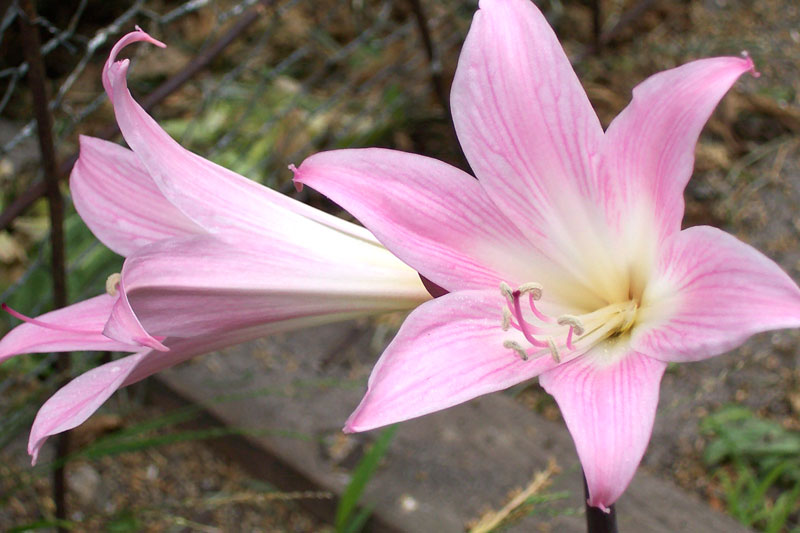
Photo: Wikimedia Commons, CC BY-SA 3.0 · source

Bulb or tuber · Amaryllidaceae
Belladonna lily
Amaryllis belladonna
In other languages: Belladonnalelie (Nederlands) · Amaryllis belladone (Français)
Belladonna lily comes from the Western Cape in South Africa, where it grows on rocky slopes with wet winters and dry summers. In September and October purplish-red stems 50–60 cm tall shoot up from bare soil, carrying a cluster of large, trumpet-shaped flowers in soft to deep pink with a sweet scent. Only after flowering do the strap-shaped leaves appear; they stay green through winter and die back in late spring. Gardeners love it for this late, exotic display, at a time when most garden plants are past their best. It is not fully hardy here: plant it against a warm south-facing wall or in a large pot.
Caution: All parts are poisonous, especially the bulb. Swallowing them can cause vomiting and other signs of poisoning in children, dogs, cats and grazing animals. The sap can irritate the skin. Wear gloves when planting, moving and cutting back, keep loose bulbs out of reach of children and pets, and do not put cut flowers where cats can nibble them.
Light
Full sun
warm and bright
Moisture
Dry
tolerates drought
Legal basis
Sand or loam
neutral to chalky
Hardiness
down to -5 °C
protect in harsh winters
Size
0.6 m
tall, 0.3 m wide
Flowering
September–October
| Pruning months | June and November |
|---|---|
| Height | 0.6 m |
| Native to Belgium | No, planted |
| Poisonous to people and pets | Yes, take care with children and pets |
| Flowering | September–October |
Identify
Belladonna lily: how do you recognise it?
- Habit
- Bulb with leafless flower stems 50–60 cm tall; an old clump reaches 30 cm across or more.
- Leaves
- Strap-shaped and glossy green, 30–40 cm long. They appear after flowering, stay through winter and die back in late spring.
- Flower
- A cluster of 6–12 trumpet-shaped flowers at the top of a sturdy, purplish-red stem, in September and October.
- Colour and scent
- Soft to deep pink, sometimes almost white, with a sweet scent.
- Bulb
- Large and pear-shaped, often 10 cm across or more, with a long neck.
Flowering: September–October · Plants: June–July · Pruning: June and November
In your garden
Why grow it?
- A spectacular late display in September and October, when the garden is already turning towards autumn.
- Large, pink trumpet flowers with a sweet scent.
- An excellent cut flower that lasts a long time in a vase.
- Long-lived: left undisturbed it grows into a full clump that flowers more freely each year.
- An eye-catcher at the foot of a warm wall or in a large pot on the terrace.
Belladonna lily: where does it grow best?
- Full sun in the warmest spot in the garden, ideally at the foot of a south-facing wall.
- Sandy or loamy, very free-draining soil, neutral to chalky.
- Dry, especially in summer: the bulb needs a warm, dry summer rest to form flowers.
- Allow 25–30 cm between bulbs, or grow it in a large, deep pot.
- Light
- Sun
- Soil type
- Sand or loam
- Acidity
- Neutral or chalky
- Moisture
- Dry
- Size
- 0.6 m tall, 0.3 m wide
- Hardiness
- Half hardy (to -5 °C): protect it in harsh winters
Goes well with
- Nerine: Flowers at the same time, also in pink, and loves the same warm wall foot.
- African lily: Also from South Africa; blue flowers in summer, before the belladonna lily flowers.
- Lavender: Grey leaves and a low shape at the foot of the bare flower stems.
- Fountain grass: Soft plumes in autumn, lovely next to the pink trumpets.
Maintenance
Belladonna lily: when and how to plant it?
Plant in June–July.
- Plant the bulbs in June or July, while they are dormant and leafless.
- Choose a spot at the foot of a south-facing wall and make sure drainage is good; mix grit or gravel into heavy soil.
- Set the bulb so deep that the neck just sticks out above the soil.
- Allow 25–30 cm between bulbs.
- Water once after planting, then let the soil dry out again.
- In a pot: choose a deep pot of at least 25–30 cm, with potting compost mixed with one third grit.
Care
- Watering
- Keep dry in summer. From flowering onwards and while the leaves are growing, water moderately in dry spells; in a pot, regularly but sparingly.
- Feeding
- After flowering, while the leaves grow, a little bulb fertiliser now and then. Too much nitrogen gives leaves but few flowers.
- Mulching
- In November, a thick layer of straw, leaves or wood chips over the bulbs and around the leaves, against frost.
- Deadheading
- Cut off the stems in November, unless you want to collect seed.
- Foliage
- Leave it until it turns yellow and dry on its own in May–June; then remove it.
- Moving
- Best avoided: it hates disturbance and sometimes does not flower for a few years afterwards.
Tip: Leave it undisturbed for years in the warmest spot in the garden: the fuller the clump and the warmer and drier the summer, the more freely it flowers in September.
Belladonna lily: when to prune it?
Pruning months: June and November.
When: Pruning in the usual sense is not needed. Cut off the faded flower stems in November and clear the withered leaves in June.
How:
- After flowering, cut the flower stem off just above the bulb, wearing gloves.
- Leave the green leaves through winter and spring: they allow the bulb to build up reserves for the next flowering.
- Only pull the leaves away once they are completely yellow and dry, usually in June.
Caution: Wear gloves: all parts are poisonous and the sap can irritate the skin.
Propagation
- Offsets
- In June–July, while the plant is dormant, lift a full clump and carefully detach the offsets. Replant straight away with the neck just above the soil; they flower after a few years.
- Seed
- The fleshy seeds ripen after flowering and must be sown fresh, on sandy seed compost, indoors in a cool, light spot. A seedling only flowers after several years.
Belladonna lily: how does it get through the winter?
Hardy to −5 °C: protect in harsh winters.
- Not fully hardy, to about −5 °C. At the foot of a warm south-facing wall and under a thick mulch it survives many Belgian winters.
- The leaves grow in winter and can be frosted in hard frost; cover them with extra straw or fleece during cold spells.
- Cold, wet soil makes the bulbs rot: make sure drainage is good.
- In a pot: from November to March, keep it in a cool, light, frost-free place (5–10 °C) and water sparingly.
Diseases and pests
- No flowers: Usually a spot that is too cool or shady, planting too deep, recent moving or a cool, wet summer. Give it the warmest spot and leave it undisturbed.
- Bulb rot: The bulb goes soft and smells unpleasant in soil that is too wet. Plant in a better-drained spot and keep it dry in summer.
- Slugs: They eat the young leaves in autumn and winter. Pick them off in the evening.
- Frost damage: Brown, glassy leaves after hard frost. Cut off the damaged leaves and protect the plant better; a healthy bulb usually grows again.
Through the year
- January: In hard frost, cover the leaves with straw or fleece.
- March: Gradually remove the mulch. The leaves keep growing.
- May: The leaves turn yellow. Let them die back.
- June: Clear withered leaves. Plant bulbs or replant offsets.
- July: Plant bulbs. Summer rest: keep dry.
- August: In late August the first flower stems may shoot up.
- September: In flower. Cut flowers for the vase.
- October: Last flowers. The leaves appear.
- November: Cut off faded stems. Apply a thick mulch. Move pots somewhere frost-free.
- December: Check the mulch. Keep pots cool and light.
Use
Edible and useful
Not edible. Belladonna lily, crinum, nerine, Aztec lily (sprekelia) and winter daffodil (sternbergia) belong to the daffodil family and, like daffodils, are poisonous in all their parts, especially the bulbs: they contain alkaloids such as lycorine, which cause vomiting, drooling, stomach ache and diarrhoea, in children as well as in dogs, cats and grazing animals. The bulbs look like onions or shallots but do not smell of onion when cut: never store them with the kitchen onions, not even the bulbs you keep dry over winter, such as sprekelia, and label them. The sap can irritate the skin: wear gloves when planting, dividing and cutting flower stems, and wash your hands afterwards. Keep a vase of nerines or belladonna lilies out of reach of cats, and call your vet if your dog or cat has chewed a bulb. If any is swallowed, call a poison centre (in Belgium 070 245 245) or your doctor at once.
You and this species
Did you know?
- It is also called ‘naked lady’, because the flowers stand on bare stems, without leaves.
- The genus Amaryllis has only two species. The large ‘amaryllis’ sold in pots around Christmas is actually a Hippeastrum from South America.
- Belladonna is Italian for ‘beautiful lady’.