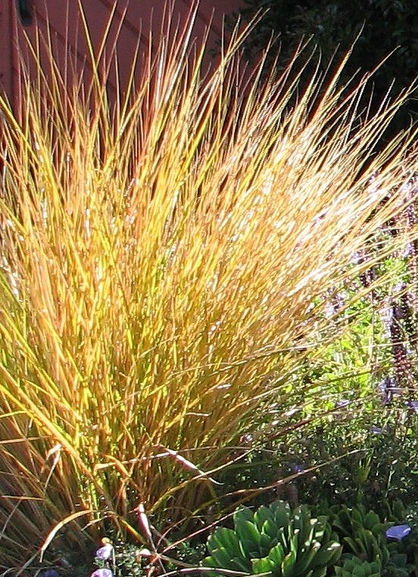
Photo: Photo by Flickr user hortulus; heavily cropped by Hesperian, so don't blame hortulus for the poor fr, CC BY 2.0 · source

Ornamental grass · Poaceae
Pheasant's tail grass
Anemanthele lessoniana
In other languages: Anemanthele lessoniana (Nederlands) · Anemanthele lessoniana (Français)
Pheasant’s tail grass (Anemanthele lessoniana) is an evergreen ornamental grass found in the wild only in New Zealand, where it grows in open woodland and along forest edges. It forms a loose, gracefully arching clump of narrow leaves, about 80 cm tall and 1 m wide. The foliage is green with a bronze sheen in summer and turns orange, copper and red in autumn and winter. From July to September, airy reddish-brown flower panicles hang over and between the leaves and move in the slightest breeze. It is still often sold under its old name, Stipa arundinacea.
Caution: In a favourable spot it self-seeds freely. Weed out unwanted seedlings while they are small or cut off the panicles before the seed ripens.
Light
Sun or partial shade
preferably some sun
Moisture
Normal
no wet feet
Legal basis
Sand, loam or clay
any pH
Hardiness
down to -12 °C
protect in harsh winters
Size
0.8 m
tall, 1 m wide
Flowering
July–September
| Pruning months | March–April |
|---|---|
| Height | 0.8 m |
| Native to Belgium | No, planted |
| Poisonous to people and pets | Not known to be poisonous |
| Flowering | July–September |
Identify
Pheasant's tail grass: how do you recognise it?
- Habit
- Loose, arching clump about 80 cm tall and 1 m wide; the leaves curve outwards like a fountain.
- Leaves
- Narrow, linear and glossy; green with bronze tints in summer, orange, copper and red in autumn and winter, especially in sun.
- Flowers
- Airy, finely branched panicles from July to September, reddish brown to purplish, hanging over the foliage.
- Seed
- Small seeds that ripen in autumn; in a suitable spot it self-seeds readily.
- Roots
- A fibrous clump without runners: it does not spread by rhizomes.
Flowering: July–September · Plants: April–May · Pruning: March–April
In your garden
Why grow it?
- Evergreen: a graceful clump all year round, with its best colours in autumn and winter.
- The orange and coppery winter foliage brings warmth to the garden when most perennials have disappeared.
- The airy, arching panicles add movement to a border from July into autumn.
- Grows in sun or partial shade, on sand, loam or clay: an easy, versatile plant.
- Little work: no cutting back, just comb out the dead leaves now and then.
- Looks good in a large pot, on a bank or as a loose group between shrubs.
Pheasant's tail grass: where does it grow best?
- Sun or partial shade; in sun the leaves colour the brightest orange, in partial shade they stay green for longer.
- Ordinary, well-drained garden soil: sand, loam or clay, acid to chalky.
- Normally moist: not too dry in summer, but no wet feet in winter.
- A sheltered spot helps it through hard winters; avoid a cold, wet hollow.
- Allow 0.8–1 m between plants, as the clump becomes wider than it is tall.
- Light
- Sun and partial shade
- Soil type
- Sand, loam or clay
- Acidity
- Not fussy
- Moisture
- Normal
- Size
- 0.8 m tall, 1 m wide
- Hardiness
- Half hardy (to -12 °C): protect it in harsh winters
Goes well with
- Sneezeweed: Orange and red late-summer flowers that echo the colour of the foliage.
- Ice plant: Broad, fleshy leaves and pink flower heads in autumn, a contrast with the fine grass.
- Coral bells: Dark or lime-green foliage at its feet, also in partial shade.
- Spurge: Evergreen kinds give winter structure together with the grass.
- Michaelmas daisy: Purple and blue flowers beside the foliage as it turns orange in October.
Maintenance
Pheasant's tail grass: when and how to plant it?
Plant in April–May.
- Plant in April or May, when the soil has warmed up, so it can root well before winter.
- Dig a hole twice as wide as the root ball and loosen the bottom.
- In heavy clay, work in some coarse sand or gravel and compost, so that water can drain away in winter.
- Set the plant at the same depth as it was in the pot and firm the soil well; leave 0.8–1 m between plants.
- Water generously straight away, then weekly in dry spells during the first summer.
Care
- Watering
- After the first summer it needs little; water only in long dry spells. Water plants in pots regularly.
- Feeding
- Not needed in ordinary garden soil. In a pot, a little organic fertiliser or compost in April.
- Tidying
- In March–April, comb the dead leaves out of the clump with your fingers (wear gloves) or a small rake.
- Spent panicles
- Leave them: they stay attractive for a long time. Remove them in spring along with the dead leaves.
- Seedlings
- It self-seeds; keep the seedlings you want and weed out the rest while they are small.
Tip: Plant it in sun for the best orange winter colour, and never cut it back: in spring, just comb out the dead leaves.
Pheasant's tail grass: when to prune it?
Pruning months: March–April.
When: It is not cut back. In March–April, simply comb the dead leaves out of the clump.
How:
- Run gloved hands or a small rake through the clump to remove loose, dead leaves.
- Cut off old, spent panicles once they no longer look good.
- Never cut an evergreen grass down hard: it recovers poorly and may even die.
Caution: The orange winter foliage is not dead: leave it, as it is the main ornamental feature of the plant.
Propagation
- Seedlings
- The easiest way: in spring, lift young seedlings with a little soil and pot them up or move them to their new spot.
- Seed
- Sow ripe seed in spring in pots of seed compost; barely cover it and keep it moist.
- Division
- In April–May, cut an older clump into pieces with a spade; water the divisions well until they grow away.
Pheasant's tail grass: how does it get through the winter?
Hardy to −12 °C: protect in harsh winters.
- Hardy to about −12 °C: no problem in most Belgian winters, but it can be damaged in a severe one.
- Wet soil in winter is more dangerous than frost: make sure the soil drains well.
- Leave the clump and the panicles standing; they protect the heart of the plant and look lovely with frost on them.
- In a pot: in hard frost move it against a wall and wrap the pot in hessian or bubble wrap.
Diseases and pests
- Root rot: The clump turns brown and limp after a wet winter. Plant in free-draining soil and improve heavy clay with gravel.
- Brown, dead leaves: Normal for an evergreen grass. Comb them out in spring; do not cut the plant down.
- Too many seedlings: In a favourable spot it self-seeds freely. Weed out seedlings while young or cut off the panicles before the seed ripens.
- Frost damage: Lots of brown foliage after a hard winter. Wait until May: it often regrows from the centre.
Through the year
- January: Orange and red winter colour. Protect pots in hard frost.
- February: Leave standing. Do not prune.
- March: Comb out dead leaves. Look for seedlings.
- April: Plant or divide. Remove the last dead leaves.
- May: Plant. Water after planting.
- July: First panicles. Water in long dry spells.
- August: Flowering. Water pots regularly.
- September: Flowering. The seed ripens.
- October: The foliage starts to turn orange.
- December: Winter colour. Leave the clump standing.
You and this species
Did you know?
- Anemanthele is the only species in its genus. The name comes from the Greek anemos (wind) and anthele (plume).
- It grows wild only in New Zealand and was long classed with the feather grasses (Stipa).
- The name pheasant’s tail grass refers to the arching, orange-brown leaves, which recall the tail feathers of a pheasant.