Photo: Wikimedia Commons, CC BY-SA 3.0 · source

Perennial · Asteraceae
Sneezeweed
Helenium autumnale
In other languages: Zonnekruid (Nederlands) · Hélénie d’automne (Français)
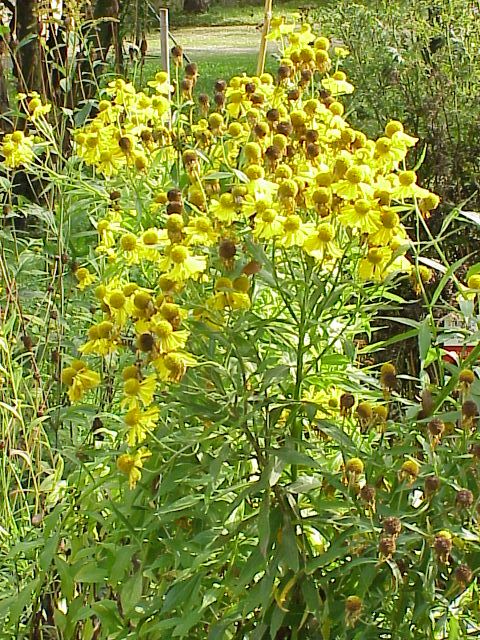
Sneezeweed comes from North America, where it grows in damp meadows and along stream banks. It is an upright perennial of 1–1.5 m with sturdy, winged stems and, from July to October, masses of daisy-like flowers with a domed, velvety centre. The petals often hang down slightly and are yellow, orange, copper or red, depending on the variety. There are many garden varieties, often hybrids involving this species, such as the copper-red ‘Moerheim Beauty’ and the early ‘Sahin’s Early Flowerer’. Gardeners love its warm late-summer colours, its value as a cut flower and the bees and butterflies it attracts well into autumn.
Caution: Poisonous: all parts are poisonous if eaten, for people, pets and livestock. In sensitive people the sap may irritate the skin; wear gloves when pruning and dividing.
Light
Full sun
warm and bright
Moisture
Normal to wet
must not dry out
Legal basis
Loam or clay
any pH
Hardiness
Fully hardy
down to -35 °C
Size
1.2 m
tall, 0.6 m wide
Flowering
July–October
| Pruning months | March and May |
|---|---|
| Height | 1.2 m |
| Native to Belgium | No, planted |
| Good for bees, butterflies and birds | Yes, for bees and butterflies |
| Poisonous to people and pets | Yes, take care with children and pets |
| Flowering | July–October |
Identify
Sneezeweed: how do you recognise it?
- Habit
- Upright, clump-forming perennial 1–1.5 m tall and 50–60 cm wide; garden varieties often stay shorter.
- Leaves
- Lance-shaped, 5–15 cm long, toothed; the leaf base runs down the stem, making it look winged.
- Flowers
- Daisy-like heads 3–5 cm across with a domed centre and slightly drooping petals toothed at the tip, from July to October.
- Colour
- Yellow, orange, copper, red or bicoloured, with a yellow to brown centre.
- Roots
- A shallow, fibrous clump that becomes bare in the middle after a few years.
Flowering: July–October · Plants: March–May · Pruning: March and May
In your garden
Why grow it?
- Warm colours from July to October, when many other perennials have finished.
- An important nectar source for bees and butterflies in late summer.
- An excellent cut flower that lasts well in a vase.
- One of the few sun-loving perennials that likes moist, heavy soil.
- Easy and fully hardy.
Sneezeweed: where does it grow best?
- Full sun; in shade it flops and flowers less.
- Fertile loam or clay, acid to chalky.
- Moist to damp: the soil must not dry out in summer.
- Sheltered from strong wind, especially for tall varieties.
- Allow 40–50 cm between plants, about 5 plants per m².
- Light
- Sun
- Soil type
- Loam or clay
- Acidity
- Not fussy
- Moisture
- Normal or wet
- Size
- 1.2 m tall, 0.6 m wide
- Hardiness
- Hardy (to -35 °C)
Goes well with
- Michaelmas daisy: Flowers at the same time; blue and purple beside orange and red.
- Switchgrass: An ornamental grass that also tolerates moist soil and colours well in autumn.
- Black-eyed Susan: Yellow flowers with a dark centre, in the same sunny border.
- Joe Pye weed: Tall pink heads for moist soil, also a butterfly plant.
- Phlox: Scented flower heads in summer, in the same moisture-retentive soil.
Maintenance
Sneezeweed: when and how to plant it?
Plant in March–May.
- Plant from March to May.
- Dig a hole twice as wide as the root ball and mix in a few spadefuls of compost.
- Set the plant at the same depth as in the pot and firm the soil well.
- Space plants 40–50 cm apart.
- Water well straight away and regularly for the first few weeks.
- Spread a layer of compost or leaf mould around the plants to keep the soil moist.
Care
- Water
- Water generously in dry spells: when short of water the lower leaves turn brown.
- Feeding
- A layer of compost or some organic fertiliser in March or April.
- Mulching
- A layer of compost in spring keeps the soil cool and moist.
- Support
- Tall varieties are best staked in May, unless you cut them back at the end of May.
- Deadheading
- Cut faded flowers back to the next bud: it will keep flowering for longer.
- Division
- Divide the clump every 3–4 years in spring to keep it young and free-flowering.
Tip: Plant lower plants in front, such as asters or lady’s mantle: that way you won’t see the lower leaves, which often turn brown in dry summers.
Sneezeweed: when to prune it?
Pruning months: March and May.
When: At the end of May cut back the stems, and in March remove last year’s dead stems.
How:
- At the end of May, cut all stems back by a third, just above a leaf: the plant stays shorter and sturdier and flowers a little later and for longer.
- If you cut back only half the stems, the plant flowers in two successive waves.
- In summer, cut faded flowers back to the next bud.
- Leave the dead stems over winter or cut them down in autumn; in March at the latest, before the new shoots appear.
Caution: Wear gloves: in sensitive people the sap can irritate the skin.
Propagation
- Division
- In March–April, lift the clump, cut off the young outer parts with a spade or knife and replant them. Discard the bare centre.
- Basal cuttings
- In April, take 5–8 cm cuttings from young shoots at the base and root them in moist cutting compost.
Sneezeweed: how does it get through the winter?
Hardy to −35 °C.
- Very hardy, to about −35 °C: in Belgium it needs no protection.
- The dead stems can stand through winter; cut them down by March at the latest.
- In a large pot it also survives winter, as long as the compost isn’t waterlogged.
- A layer of compost in early spring gives the clump a good start.
Diseases and pests
- Brown lower leaves: A result of drought in summer. Water generously, mulch and plant lower plants in front to hide the bare base.
- Flopping stems: Too much shade, soil too rich or not cut back. Cut back at the end of May and stake tall varieties in time.
- Bare clump: The centre of old plants dies out. Divide in spring and replant the young outer pieces.
- Slugs: Eat the young shoots in spring. Pick them off in the evening.
- Powdery mildew: White powder on the leaves in dry late summers. Watering and spacing plants well help.
Through the year
- March: Cut off dead stems. Divide and plant. Add compost.
- April: Plant. Take basal cuttings.
- May: At the end of May, cut stems back by a third. Watch for slugs.
- June: Water in dry spells. Top up the mulch.
- July: Flowering begins. Cut for the vase.
- August: Full flower. Deadhead. Water in dry spells.
- September: In flower, with bees and butterflies.
- October: Last flowers.
- November: Leave the dead stems or cut them down.
Use
Edible and useful
Not edible. All parts of sneezeweed are poisonous: they contain bitter compounds (including helenalin) that cause vomiting, stomach ache and diarrhoea if eaten. Its name comes from the dried flowers and leaves once being used as snuff: do not sniff or eat any of it. Grazing livestock, especially sheep, can become seriously ill from related species: do not plant it in or beside a field, and do not throw trimmings near the feed. Keep children and pets away, and wear gloves when cutting back and dividing, as the sap can irritate the skin. If any is swallowed, call a poison centre (in Belgium 070 245 245) or your doctor at once.
Good for wildlife
- Bees
- Nectar and pollen for honeybees and wild bees.
- Butterflies
- Nectar for butterflies.
You and this species
Did you know?
- The name sneezeweed comes from the old use of the dried, powdered leaves as snuff to make people sneeze.
- According to tradition, Linnaeus named the genus after Helen of Troy.
- The well-known variety ‘Moerheim Beauty’ was raised in the last century at the Moerheim nursery in Dedemsvaart, in the Netherlands.