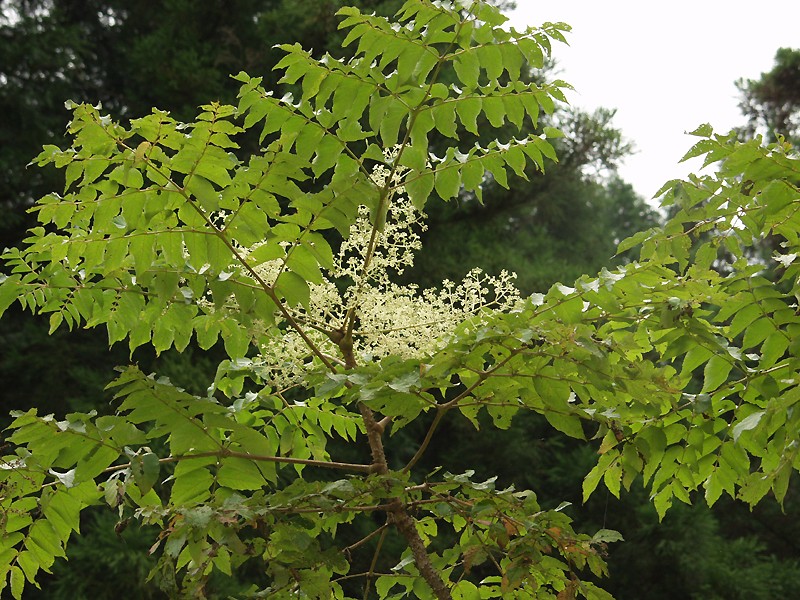
Photo: ‘Uncle Carl’ (カールおじさん)., CC BY-SA 3.0 · source

Shrub · Araliaceae
Japanese angelica tree
Aralia elata
In other languages: Aralia (Nederlands) · Aralia du Japon (Français)
The Japanese angelica tree comes from Japan, Korea, north-eastern China and eastern Russia. It is a large deciduous shrub or small tree of 3–5 m with sparsely branched, spiny stems. At the tips sit enormous, twice-divided leaves, sometimes more than a metre long, which together form a kind of parasol. In August–September large sprays of tiny cream-white flowers appear above them, followed by small black berries and yellow to purplish-red autumn colour. There are variegated forms such as ‘Variegata’, with a white leaf margin, and ‘Aureovariegata’, with a yellow one.
Caution: This shrub produces suckers and can spread several metres this way; in parts of North America it has escaped into the wild and is considered invasive. Do not plant it next to a border or against the boundary with the neighbours unless you fit a root barrier. Also mind the sharp prickles, especially where children play.
Light
Sun or partial shade
preferably some sun
Moisture
Normal
no wet feet
Legal basis
Sand, loam or clay
any pH
Hardiness
Fully hardy
down to -30 °C
Size
4 m
tall, 3 m wide
Flowering
August–September
| Pruning months | March |
|---|---|
| Height | 4 m |
| Native to Belgium | No, planted |
| Good for bees, butterflies and birds | Yes, for bees |
| Poisonous to people and pets | Not known to be poisonous |
| Flowering | August–September |
Identify
Japanese angelica tree: how do you recognise it?
- Habit
- Multi-stemmed shrub or small tree 3–5 m tall and about 3 m across, with sparsely branched stems.
- Stem
- Covered in sharp prickles, also on the leaf stalks and the midrib of the leaf.
- Leaves
- Twice pinnate, up to more than 1 m long, held like a parasol at the stem tips; yellow, orange or purplish red in autumn.
- Flower
- Large sprays of tiny cream-white flowers in rounded umbels, in August–September.
- Fruit
- Small black berries in autumn.
- Roots
- Widely spreading, with many suckers, especially when the roots are damaged.
Flowering: August–September · Plants: March–April and October–November · Pruning: March
In your garden
Why grow it?
- An exotic, tropical-looking outline with huge leaves, yet fully hardy.
- Late in summer, in August–September, large sprays of white flowers full of bees.
- Small black berries in autumn, which are eaten by birds.
- Fine autumn colour from yellow to purplish red.
- In winter, a graphic picture of bare, spiny stems.
Japanese angelica tree: where does it grow best?
- Sun to partial shade; a sheltered spot stops the large leaves from tearing in the wind.
- Fertile, free-draining sandy, loamy or clay soil, acid to chalky.
- Normal moisture, not too wet in winter.
- Choose a spot where suckers do no harm: not in the middle of a border and not against the boundary with the neighbours.
- Allow 3 m width and keep it away from paths and play areas because of the prickles.
- Light
- Sun and partial shade
- Soil type
- Sand, loam or clay
- Acidity
- Not fussy
- Moisture
- Normal
- Size
- 4 m tall, 3 m wide
- Hardiness
- Hardy (to -30 °C)
Goes well with
- Japanese forest grass: Golden-green, arching leaves at the base, also in partial shade.
- Hosta: Large leaves beneath the parasol, in the same partial shade.
- Ferns: A green, woodland-style underplanting.
- Barrenwort: A ground cover beneath the shrub that also tolerates dry shade.
Maintenance
Japanese angelica tree: when and how to plant it?
Plant in March–April and October–November.
- Plant in March–April or October–November.
- Wear sturdy gloves: the stems are covered in prickles.
- Dig a hole twice as wide as the root ball and mix in compost.
- Set the plant at the same depth as in the pot; with a grafted variegated form, keep the graft union above the soil.
- Keep 2–3 m from other shrubs and paths.
- Water in well and mulch the base.
Care
- Watering
- Regularly in dry spells in the first year; after that only in long droughts.
- Feeding
- Some compost in spring.
- Suckers
- Remove suckers while they are young. Do not hoe or dig deeply around the shrub: damaged roots produce more suckers.
- Variegated forms
- Cut out green shoots coming from the rootstock or roots straight away.
- Mulching
- A layer of leaf mould keeps the soil moist and the weeds down, so there is no need to hoe.
Tip: Do not hoe or dig around the angelica tree: every damaged root can produce a new sucker. Spread a thick mulch instead, or plant a ground cover at its feet.
Japanese angelica tree: when to prune it?
Pruning months: March.
When: Little needed. Remove dead wood and unwanted stems in March; remove suckers as often as needed from May to September.
How:
- Saw dead or damaged stems off at the base.
- To keep the shrub lower, saw old stems off at ground level; new ones grow from the base.
- Remove suckers to below ground level.
- On variegated forms: cut green shoots out as low as possible.
Caution: Protect your hands and arms with sturdy gloves and long sleeves: the prickles are sharp.
Propagation
- Root cuttings
- In December–February, lay 8–10 cm pieces of root in a pot of gritty compost; they sprout in spring. Variegated forms give green-leaved plants this way.
- Suckers
- In spring or autumn, detach a rooted sucker with a spade and replant it.
- Seed
- In autumn, clean the seed from ripe berries and sow it in a tray outdoors; germination is slow.
Japanese angelica tree: how does it get through the winter?
Hardy to −30 °C.
- Very hardy, to −30 °C: no protection is needed in Belgium.
- Young shoots can be damaged by late night frost; they usually sprout again.
- In winter only the bare, spiny stems remain: a strong graphic picture.
Diseases and pests
- Suckers: New stems appear metres from the shrub. Remove them young, do not dig deeply around the plant and fit a root barrier if needed.
- Reversion: Green shoots appear on variegated forms. Cut them out straight away, or they will take over.
- Wind damage: Torn or snapped leaves. Choose a sheltered spot.
- Frost damage: Black, limp shoots after a late night frost. Cut them off; the plant will sprout again.
Through the year
- January: Take root cuttings.
- February: Take root cuttings.
- March: Saw out dead wood and old stems. Planting.
- April: Planting. Add compost. The leaves unfurl.
- May: Remove suckers. Cut out green shoots on variegated forms.
- June: Remove suckers.
- July: Water during prolonged drought.
- August: Flowering begins; bees visit.
- September: Flowering and first black berries.
- October: Autumn colour. Planting.
- November: Planting. The leaves fall.
Use
Good for wildlife
- Bees
- Nectar and pollen for honeybees and wild bees.
You and this species
Did you know?
- In Japan the young shoots are picked in spring and eaten as tempura; they are called tara-no-me.
- It is related to ivy: both belong to the ivy family, Araliaceae, with flowers in rounded umbels.
- The variegated forms are usually grafted, because from seed or root cuttings they come back green-leaved.