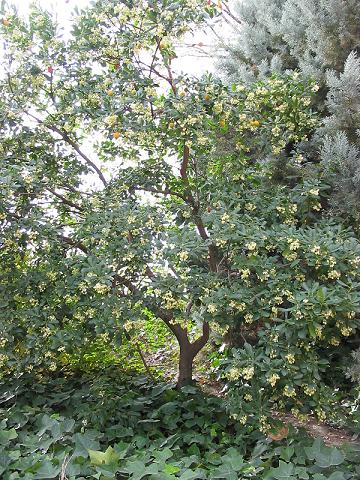
Photo: The original uploader was Hans B. at Dutch Wikipedia. (Original text: P40p), CC BY-SA 3.0 · source

Shrub · Ericaceae
Strawberry tree
Arbutus unedo
In other languages: Aardbeiboom (Nederlands) · Arbousier (Français)
The strawberry tree is an evergreen shrub or small tree from the Mediterranean region, which in the west reaches as far as Ireland. It has glossy, dark green, leathery leaves, red-brown peeling bark and an often slightly twisted, multi-stemmed habit. In autumn it flowers with hanging clusters of white bells, while at the same time the round, red fruits from the previous year ripen. These fruits are edible, but more mealy than tasty. Well-known cultivars include ‘Rubra’, with pink flowers, and ‘Compacta’, which stays smaller.
Light
Sun or partial shade
preferably some sun
Moisture
Dry to normal
no wet feet
Legal basis
Sand, loam or clay
any pH
Hardiness
down to -15 °C
protect young plants
Size
4 m
tall, 3 m wide
Flowering
October–December
| Pruning months | April |
|---|---|
| Height | 4 m |
| Native to Belgium | No, planted |
| Good for bees, butterflies and birds | Yes, for bees |
| Poisonous to people and pets | Not known to be poisonous |
| Flowering | October–December |
Identify
Strawberry tree: how do you recognise it?
- Habit
- Evergreen shrub or small tree, here usually 3–4 m tall and 3 m wide, often multi-stemmed and slightly twisted.
- Leaf
- Elliptic, 5–10 cm, leathery, glossy dark green with a finely toothed edge and often a reddish leaf stalk.
- Bark
- Red-brown; on older trunks it peels off in strips.
- Flower
- Small, hanging, urn-shaped bells, white or pale pink, in clusters from October to December.
- Fruit
- Round, warty berries of 1.5–2 cm, turning from yellow through orange to red; they ripen in autumn, a year after flowering.
Flowering: October–December · Harvest and fruit: October–December · Plants: April–May and September · Pruning: April
In your garden
Why grow it?
- Flowers and red fruits at the same time, from October to December: colour in a season when little else blooms.
- Evergreen, with glossy leaves and a handsome red-brown trunk, all year round.
- A late source of nectar for bees and bumblebees on mild autumn days.
- Edible fruits for jam, jelly or liqueur.
- Tolerates chalky, fairly dry soil, unlike most members of the heather family.
Strawberry tree: where does it grow best?
- Sun to partial shade; the more sun, the better the flowering and fruiting.
- Any well-drained soil: sand, loam or clay, acid to chalky. It does not like wet feet in winter.
- Sheltered from cold east and north winds, for example in front of a wall or among other shrubs.
- Allow 3 m of space: it grows slowly, but becomes a small tree over the years.
- Light
- Sun and partial shade
- Soil type
- Sand, loam or clay
- Acidity
- Not fussy
- Moisture
- Dry or normal
- Size
- 4 m tall, 3 m wide
- Hardiness
- Hardy (to -15 °C)
Goes well with
- Winter heath: Also flowers in winter and also tolerates chalk: a low, pink carpet beneath the shrub.
- Lavender: Likes the same sunny, dry spot and adds a Mediterranean feel.
- Rock rose: Another Mediterranean shrub for a dry, sunny border.
- Laurustinus: Evergreen and also flowers in winter, for a sheltered group of evergreens.
- Rosemary: An evergreen herb that, like the strawberry tree, loves sun and free-draining soil.
Maintenance
Strawberry tree: when and how to plant it?
Plant in April–May and September.
- Plant in April–May, so it is well rooted before winter, or in September.
- Choose a young, pot-grown plant: older plants establish poorly after moving.
- Dig a planting hole twice as wide as the root ball and loosen the bottom; on heavy clay, improve drainage with coarse sand or grit.
- Set the plant at the same depth as in the pot, backfill and firm the soil well.
- Water generously straight away, and weekly in dry spells during the first year.
- Spread a mulch of wood chips or leaf mould around the base.
Care
- Watering
- Regularly in dry spells during the first year; after that it is fairly drought-tolerant.
- Feeding
- Little needed: some compost or organic shrub feed in April.
- Mulching
- A layer of mulch in spring keeps the soil moist and protects young roots in winter.
- Fruit
- Pick the fruits when they are fully red and soft. Fallen fruit stains a patio.
- Young plants
- Protect them with horticultural fleece in hard frost for the first 2–3 winters.
Tip: Plant it where you can see it well in autumn, for example from a window: that way you get the most out of the flowers and red fruits together. Wait until April to prune, so you can first see which twigs have survived the winter.
Strawberry tree: when to prune it?
Pruning months: April.
When: Pruning is rarely needed. If it is, do it in April, once the worst frosts are over.
How:
- Cut frost-damaged and dead twigs back to healthy wood.
- Remove branches that cross or grow inwards.
- To show off the beautiful trunk, gradually remove the lower branches and create a multi-stemmed small tree.
- Hard renovation pruning is usually tolerated well, but you then lose a year of flowers and fruit.
Caution: Flowers and young fruits hang on the shrub at the same time, so every pruning cut costs you both. Prune as little as possible.
Propagation
- Seed
- In autumn, take the seeds from ripe fruits, rinse them clean and sow them in a pot left outside over winter. They germinate in spring; the young plants grow slowly.
- Semi-ripe cuttings
- In late summer, take 10 cm heel cuttings and put them in moist cutting compost under plastic. Rooting is slow and does not always succeed.
- Layering
- In spring, lightly wound a low branch, bend it into the soil and pin it down; sever it after a year.
Strawberry tree: how does it get through the winter?
Hardy to −15 °C: protect young plants.
- Hardy to about −15 °C: no problem in most Belgian winters in a sheltered spot.
- Young plants are more sensitive: protect them in hard frost during their first winters with fleece and a layer of mulch.
- After a severe winter the leaves may brown or twigs may die back; the plant usually reshoots in spring.
- In a pot: place it against a wall, wrap the pot in hessian and raise it on pot feet so water can drain away.
Diseases and pests
- Leaf spot: Brown or black spots on the leaves, especially in wet years. Clear up fallen leaves and keep the shrub airy.
- Frost damage: Brown leaves and dead shoot tips after a hard winter. Cut them back to healthy wood in April.
- Root rot: On wet, poorly drained soil the leaves turn yellow and branches die. Plant in a well-drained spot.
- Few fruits: Too much shade, or the plant is still young. Give it a sunnier spot and some patience.
Through the year
- January: Cover young plants with fleece in hard frost.
- March: Add compost. Mulch.
- April: Plant. Cut back frost-damaged twigs and prune lightly if needed.
- May: Plant. Water in dry spells.
- June: Water young plants in dry spells.
- August: Take semi-ripe cuttings.
- September: Plant. The fruits turn orange and red.
- October: Flowering begins. Pick ripe fruit.
- November: Flowers and red fruits together. Make jam or jelly.
- December: Last flowers. Protect young plants from hard frost.
Use
Edible and useful
- Fruit (October–December)
- The round, warty fruits ripen a full year after flowering, from October to December, at the same time as the new flowers. Pick them when they are deep red and soft. The flesh is gritty and sweet, a little like apricot and guava; many people find them rather bland fresh, but they come into their own in jam, jelly or liqueur (in Portugal they are made into the brandy medronho).
- Storing
- Ripe fruits keep for a few days in the fridge; they soon turn mushy. Use them straight away or freeze them.
Caution: Eat them in moderation: overripe fruits can ferment slightly, and eating a lot at once sometimes causes stomach ache (the Latin name unedo is said to mean I eat only one). Only eat fully ripe, red fruits.
Eating and using is at your own risk: see the terms of use.
Recipes
- Strawberry tree jam (Jam · ± 3 jars · 40 min)
- Strawberry tree liqueur (Liqueur · ± 750 ml · 15 min + 6 weeks steeping)
Good for wildlife
- Bees
- Nectar and pollen for honeybees and wild bees.
You and this species
Did you know?
- According to the Roman writer Pliny, the name unedo comes from ‘unum edo’, ‘I eat only one’: the fruits are a bit of a let-down.
- A bear eating from a strawberry tree appears on the coat of arms of Madrid; a statue of it stands in the Puerta del Sol.
- In Portugal, the fruits are distilled into a strong spirit called medronho.