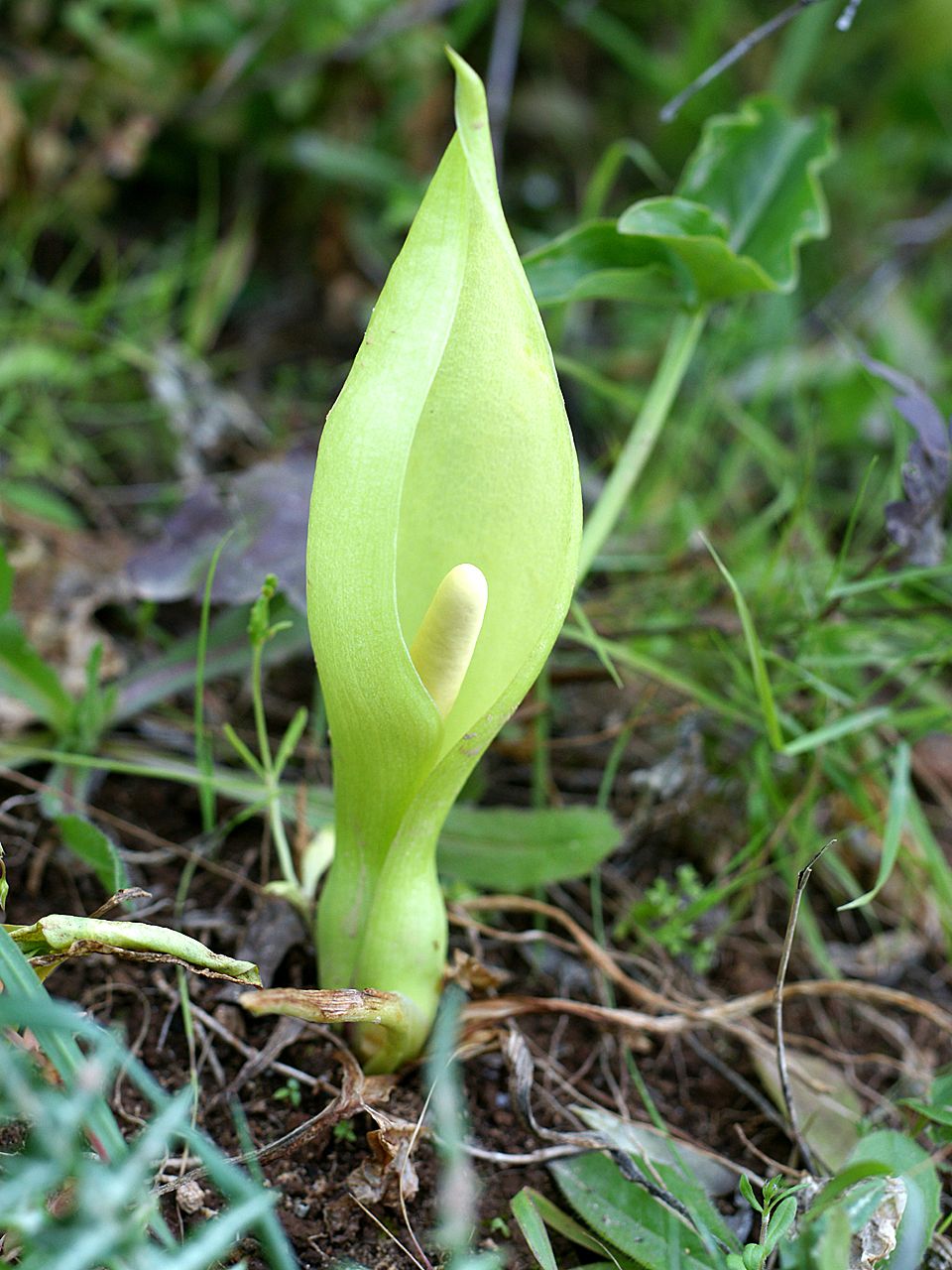
Photo: Orchi, CC BY-SA 3.0 · source

Bulb or tuber · Araceae
Italian lords-and-ladies
Arum italicum
In other languages: Italiaanse aronskelk (Nederlands) · Gouet d’Italie (Français)
Italian lords-and-ladies grows wild in southern and western Europe, around the Mediterranean and in North Africa, in woods, hedgerows and verges. Its arrow-shaped, glossy leaves, marbled with white or cream, appear in autumn and stay all winter, just when the garden is bare. In April–May a pale greenish-white spathe appears around a yellowish spadix. In summer the leaves die back, leaving a stalk with a cluster of shiny berries, first green and then orange-red. The best-known form is ‘Marmoratum’, with strongly marbled leaves.
Caution: All parts are toxic: the sap contains needle-like crystals that irritate the mouth and skin. The bright red berries are a particular danger to children; dogs and cats are also at risk. Cut off the berries if small children use the garden and wear gloves. It spreads via birds and its tubers and is hard to get rid of: do not plant it near natural areas.
Light
Partial shade or shade
tolerates little sun
Moisture
Normal
no wet feet
Legal basis
Loam or clay
neutral to chalky
Hardiness
Fully hardy
down to -20 °C
Size
0.4 m
tall, 0.3 m wide
Flowering
April–May
| Height | 0.4 m |
|---|---|
| Native to Belgium | No, planted |
| Good for bees, butterflies and birds | Yes, for birds |
| Poisonous to people and pets | Yes, take care with children and pets |
| Flowering | April–May |
Identify
Italian lords-and-ladies: how do you recognise it?
- Habit
- Low, leafy clump 30–40 cm tall and wide, which disappears completely in summer.
- Leaves
- Arrow- to spear-shaped, glossy dark green with white or cream veins and blotches; they appear in autumn.
- Flower
- A pale greenish-white spathe around a yellow spadix, in April–May, half hidden among the leaves.
- Fruit
- A dense cluster of berries on a bare stalk, first green, glossy orange-red in August–September.
- Tuber
- A fleshy, horizontal tuber that slowly branches and spreads.
Flowering: April–May · Plants: September–October
In your garden
Why grow it?
- Winter interest: the white-marbled leaves stand from autumn to spring, when most borders are empty.
- Grows in shade and partial shade, under trees and shrubs, where few other plants stand out as much.
- The orange-red berry clusters in late summer give a second moment of colour.
- Blackbirds and thrushes eat the ripe berries.
- Little work: once established, it returns every year without care.
Italian lords-and-ladies: where does it grow best?
- Partial shade to shade, for example under deciduous trees or on the north side of a hedge.
- Humus-rich loam or clay, neutral to chalky.
- Moist; it tolerates summer drought while dormant.
- Plant 25–30 cm apart, in groups or as underplanting between shrubs.
- Light
- Partial shade and shade
- Soil type
- Loam or clay
- Acidity
- Neutral or chalky
- Moisture
- Normal
- Size
- 0.4 m tall, 0.3 m wide
- Hardiness
- Hardy (to -20 °C)
Goes well with
- Snowdrop: White bells among the marbled leaves in February.
- Hellebore: Flowers in winter, in the same partial shade.
- Ivy-leaved cyclamen: Small pink flowers and patterned leaves in autumn, under trees.
- Ferns: They fill the summer gap while the arum is dormant.
- Hosta: Large summer leaves that cover the empty space.
Maintenance
Italian lords-and-ladies: when and how to plant it?
Plant in September–October.
- Plant in September–October, as the new leaves get ready to emerge.
- Loosen the soil well and mix in some leaf mould or well-rotted compost.
- Set the tubers 10–15 cm deep, with the bud facing up.
- Keep 25–30 cm between tubers.
- Firm the soil and water if the ground is dry.
- Mulch with a thin layer of leaf mould and mark the spot, as there is nothing to see in summer.
Care
- Watering
- Rarely needed. Only water in a very dry autumn, when the new leaves emerge.
- Feeding
- A layer of leaf mould in autumn is enough.
- Mulching
- Leaf mould or fallen leaves keep the soil rich in humus, as in a woodland.
- Summer rest
- Let the leaves die back naturally in June; the plant rests until autumn.
- Gloves
- Always wear gloves when touching the plant, the tubers or the berries.
Tip: Combine it with plants that emerge late in spring, such as hostas or ferns: in winter you have the marbled leaves, in summer they fill the empty space.
Italian lords-and-ladies: when to prune it?
When: Italian lords-and-ladies is not pruned. You only clear dead leaves and, if needed, cut off the berry clusters.
How:
- Remove the dried leaves in June–July.
- Cut off the berry clusters in August, before they ripen, if children play in the garden or if you do not want seedlings.
- Put cut berries in the household waste, not on the compost heap, where the seeds can germinate.
Caution: Wear gloves: the sap irritates the skin and all parts are toxic.
Propagation
- Division
- Lift a clump in August–September, while it is dormant, and break the tubers into pieces with a bud each. Replant straight away.
- Seed
- In autumn, wearing gloves, take the seed from ripe berries, rinse off the pulp and sow it in a pot left outdoors. It takes several years for seedlings to flower.
Italian lords-and-ladies: how does it get through the winter?
Hardy to −20 °C.
- Hardy to about −20 °C: in Belgium it simply stays outdoors.
- In hard frost the leaves collapse, but they usually stand up again as soon as it thaws.
- A layer of fallen leaves around the clump protects the tubers in a cold, exposed spot.
Diseases and pests
- Slugs: They eat holes in the young leaves in autumn. Pick them off in the evening.
- Limp leaves after frost: Not a disease: the leaves usually recover after a thaw. Only cut off leaves that are truly brown.
- Scorched leaves: Brown, dry patches in sun. Move it to a shadier spot.
- Too many seedlings: Birds spread the seeds and the tubers spread. Cut off the berry clusters and weed out seedlings while young, wearing gloves.
Through the year
- January: The marbled leaves decorate the garden.
- March: Give a thin layer of compost.
- April: In flower: pale spathes among the leaves.
- May: End of flowering.
- June: Foliage dies back. Tidy up.
- August: Orange-red berries. Cut them off if needed, wearing gloves.
- September: Plant or divide. New leaves appear.
- October: Plant. Mulch with leaf mould.
- December: Winter interest: leaves patterned with white.
Use
Edible and useful
Not edible. All parts of Italian lords-and-ladies are poisonous: the sap contains needle-shaped crystals that make the mouth and throat swell painfully at once. The bright red berries in summer attract children, and the young arrow-shaped leaves are sometimes mistaken for sorrel or wild garlic. Wear gloves when moving it. If any is swallowed, call a poison centre (in Belgium 070 245 245) or your doctor at once.
Good for wildlife
- Birds
- Berries, seeds or insects as food, or a place to nest.
You and this species
Did you know?
- During flowering the spadix can become a few degrees warmer than the air. This spreads a scent that attracts small midges and flies.
- As in the native lords-and-ladies, these insects are briefly held in the swollen base of the spathe until they can crawl out again covered in pollen.
- Its rhythm is reversed: it grows in autumn and winter and rests in summer, an adaptation to the dry Mediterranean summers.