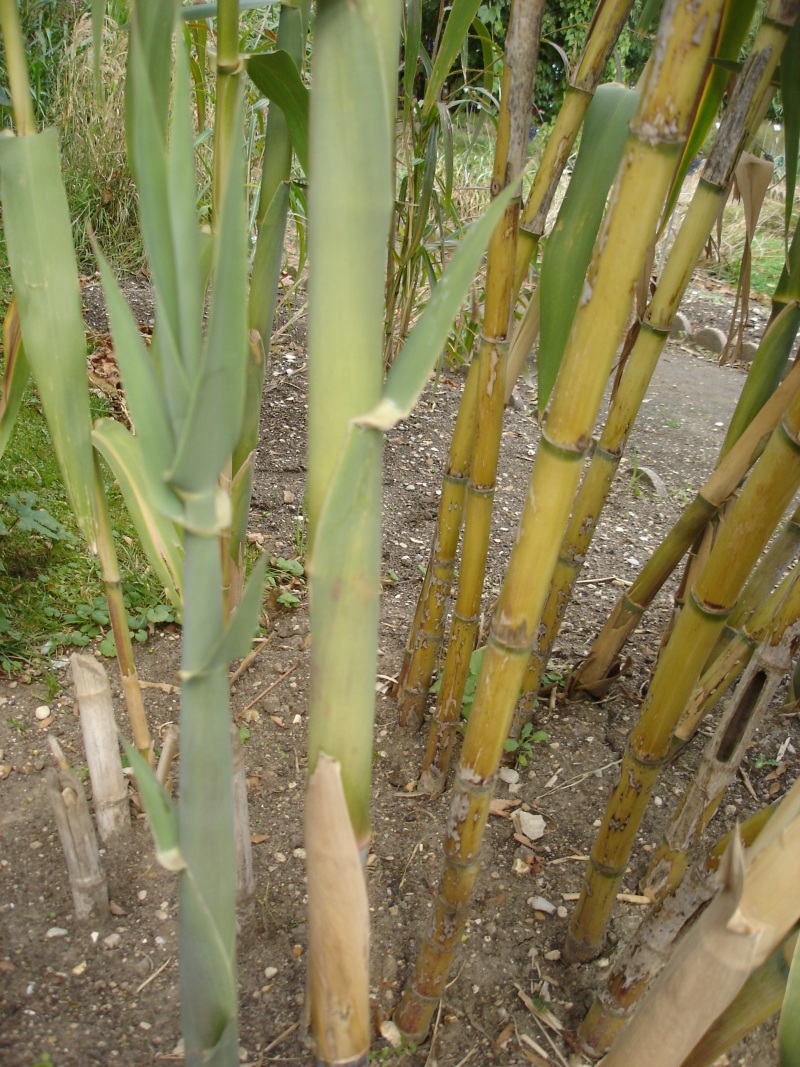
Photo: Bouba at French Wikipedia, CC BY-SA 3.0 · source

Ornamental grass · Poaceae
Giant reed
Arundo donax
In other languages: Pijlriet (Nederlands) · Canne de Provence (Français)
Giant reed (Arundo donax) is a huge grass that originally comes from Asia and has been naturalised around the Mediterranean since ancient times, where it forms large stands along rivers and ditches. Thick, creeping rhizomes send up sturdy, bamboo-like canes up to 4 m tall, clothed in broad, blue-green leaves arranged in two rows. In our climate it rarely flowers because the summers are too short, so it is grown for its foliage and tropical look. In a single season it goes from nothing to a green wall, ideal as a summer screen or focal point. The variegated ‘Versicolor’ (also sold as ‘Variegata’) has white-striped leaves but is less hardy.
Caution: Giant reed spreads by thick rhizomes; keep it in check with a root barrier or by chopping off the edges every year. In warm regions it is a feared invasive plant along rivers: never plant it near natural water and never dump pieces of rhizome or cane in the wild.
Light
Full sun
warm and bright
Moisture
Normal to wet
must not dry out
Legal basis
Loam or clay
neutral to chalky
Hardiness
down to -15 °C
protect young plants
Size
4 m
tall, 1.5 m wide
| Pruning months | March |
|---|---|
| Height | 4 m |
| Native to Belgium | No, planted |
| Poisonous to people and pets | Not known to be poisonous |
Identify
Giant reed: how do you recognise it?
- Habit
- Upright, dense clumps of sturdy canes up to 4 m tall; after a few years a clump is 1.5 m wide or more.
- Stem
- Thick, hollow and woody, with nodes like bamboo; blue-green, later straw-coloured.
- Leaves
- Broad and strap-shaped, a few centimetres wide, blue-green, in two rows along the cane; striped cream to white in ‘Versicolor’.
- Flowers
- Rare in our climate; in warm regions large, plume-like flower heads in autumn.
- Roots
- Thick, knobbly rhizomes that spread slowly but surely.
Plants: April–May · Pruning: March
In your garden
Why grow it?
- One of the largest grasses for the garden: up to 4 m tall in one season.
- Broad, blue-green leaves that give the garden a southern or tropical feel.
- A fast green summer screen, for example to shelter a patio.
- It rustles in the wind and adds height and movement to a large border.
- Tolerates moist to wet soil: handsome beside a large ornamental pond.
Giant reed: where does it grow best?
- Full sun and warmth: the warmer the spot, the taller and fuller it grows.
- Rich, deep soil: loam or clay, neutral to chalky.
- Moist to wet soil; in dry soil it stays smaller.
- Sheltered from strong wind, as the tall canes can snap.
- Allow at least 1.5 m and do not plant it right next to a patio, path or pond edge: the rhizomes are powerful.
- Light
- Sun
- Soil type
- Loam or clay
- Acidity
- Neutral or chalky
- Moisture
- Normal or wet
- Size
- 4 m tall, 1.5 m wide
- Hardiness
- Hardy (to -15 °C)
Goes well with
- Banana: Together with the large banana leaves, a tropical picture.
- Canna: Bright flowers and broad leaves at the foot of the green wall.
- Dahlia: Colourful late-summer flowers in front of the tall canes.
- Miscanthus: Another large grass, with plumes in autumn, for a bold grass landscape.
Maintenance
Giant reed: when and how to plant it?
Plant in April–May.
- Plant in April or May, when the soil has warmed up: that is when it establishes fastest.
- Dig a large hole and mix in a few spadefuls of compost or well-rotted manure.
- To limit its spread, first set a strong root barrier about 60 cm deep around the planting hole.
- Set the plant at the same depth as it was in the pot and firm the soil well.
- Water heavily straight away and keep the soil moist throughout the first summer.
- Spread a layer of mulch around the base to keep the soil moist.
Care
- Watering
- Water generously in dry summers, especially in the first years and in pots: it needs plenty of water to grow so large.
- Feeding
- In May, add compost or organic fertiliser: it is a hungry plant.
- Mulching
- A thick mulch in spring keeps the soil moist; in autumn it protects the rhizomes.
- Spread
- Every spring, chop off runners beyond the desired area with a sharp spade.
- Variegated form
- In ‘Versicolor’, cut out all-green canes at the base, or they will take over.
Tip: If your garden is not large, put in a root barrier when you plant: digging out an established clump later is hard work.
Giant reed: when to prune it?
Pruning months: March.
When: Cut the old canes right down in March, before the new shoots appear.
How:
- Cut all of last year’s canes just above ground level with loppers.
- In our climate the old canes are usually frosted or untidy after winter; new growth comes from the rhizome.
- If you leave the canes over winter, you have a straw-coloured winter screen; then cut them away in March.
- Let cut canes dry out before composting them, and never throw them into or near water: pieces of cane can root.
Caution: The new shoots appear late, often at the end of April or in May: do not assume too soon that it has died.
Propagation
- Division
- In April, chop off a piece of rhizome with a few buds using a sharp spade or axe and plant it straight away.
- Cane cuttings
- In summer, lay sections of cane with at least one node in a tray of water; young shoots with roots grow from the nodes, which you then pot up.
Giant reed: how does it get through the winter?
Hardy to −15 °C: protect young plants.
- Hardy to about −15 °C: the rhizomes survive most Belgian winters, even if the canes are frozen.
- For the first few winters, cover the base with a thick layer of mulch or leaves.
- ‘Versicolor’ is more tender: give it a warm, sheltered spot and a thick mulch, or grow it in a large pot that you overwinter frost-free.
- In a pot: choose a large, heavy container, move it against a sheltered wall in frost and wrap the pot.
Diseases and pests
- Spreading: The rhizomes spread every year. Chop off the edges annually or plant with a root barrier.
- Frozen canes: After a hard winter all the canes are brown. Cut them off in March; the plant regrows late, in May.
- Snapped canes: Tall canes snap in storms. Choose a sheltered spot and cut out broken canes.
- Green canes: Variegated forms sometimes produce all-green canes. Remove them at the base straight away.
Through the year
- March: Cut old canes down to just above the ground.
- April: Plant or divide. Install a root barrier.
- May: New shoots appear. Add compost and mulch.
- June: Rapid growth. Water in dry spells.
- July: Water in dry spells. Remove green canes from variegated forms.
- August: Almost full height. Take cane cuttings in water.
- September: At its best. Water pots regularly.
- November: Mulch the base. Protect ‘Versicolor’ or bring it indoors.
- December: Dormant. Leave dry canes standing as a winter screen.
You and this species
Did you know?
- The reeds of clarinets, saxophones, oboes and bassoons are made from the canes of giant reed.
- Since ancient times the canes have been used for flutes, mats, fencing and plant supports.
- In warm regions such as California it is a problem plant: pieces of rhizome and cane carried by rivers grow into new stands.