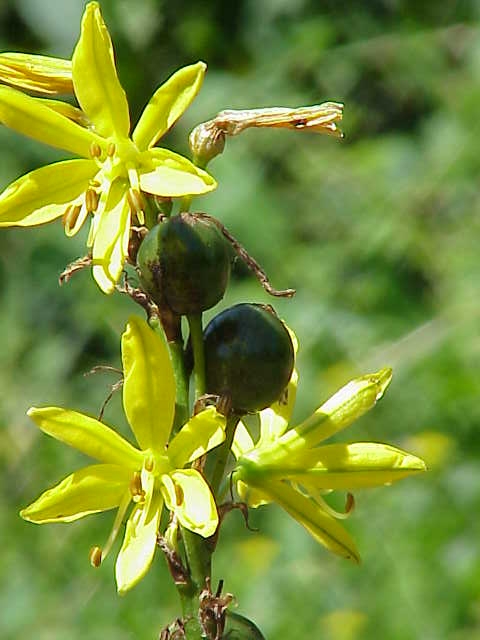
Photo: Wikimedia Commons, CC BY-SA 3.0 · source

Perennial · Asphodelaceae
King’s spear
Asphodeline lutea
In other languages: Jacobsstaf (Nederlands) · Asphodéline jaune (Français)
King’s spear, also known as yellow asphodel or Jacob’s rod, is a striking perennial from the asphodel family, native to dry, stony slopes in the eastern Mediterranean. From a clump of narrow, grooved, blue-grey leaves, a sturdy stem of about 1 m rises in May–June, itself clothed in leaves. At the top sits a dense spike of starry yellow flowers that open from the bottom upwards and are lightly scented. After flowering come round seed capsules that look lovely in dried arrangements. Gardeners choose it for gravel gardens and sunny borders, where it shrugs off heat and drought.
Light
Full sun
warm and bright
Moisture
Dry
tolerates drought
Legal basis
Sand or loam
neutral to chalky
Hardiness
Fully hardy
down to -20 °C
Size
1 m
tall, 0.3 m wide
Flowering
May–June
| Pruning months | March and July |
|---|---|
| Height | 1 m |
| Native to Belgium | No, planted |
| Good for bees, butterflies and birds | Yes, for bees |
| Poisonous to people and pets | Not known to be poisonous |
| Flowering | May–June |
Identify
King’s spear: how do you recognise it?
- Habit
- Clump of grassy leaves with upright, leafy flower stems up to 1 m tall; about 30 cm wide.
- Leaves
- Narrow, grooved and blue-grey, in a dense clump at the base and also along the flower stem.
- Flower
- Dense spikes of starry yellow flowers 2–3 cm across with prominent stamens, in May–June.
- Fruit
- Round, green capsules that dry to brown, containing dark seeds.
- Roots
- A short rhizome with thick, fleshy roots that store water and food.
Flowering: May–June · Plants: March–April and September–October · Pruning: March and July
In your garden
Why grow it?
- Striking yellow spires of about 1 m in May–June: a strong vertical accent in the border.
- Blue-grey, grassy foliage that suits a gravel garden or a Mediterranean border.
- Drought tolerant: once established, it hardly ever needs watering.
- The flowers attract bees and bumblebees.
- The round seed capsules are decorative in the garden and in dried arrangements.
King’s spear: where does it grow best?
- Full sun, in a warm, sheltered spot.
- Sandy or loamy soil, neutral to chalky, that drains very well.
- Dry: wet feet in winter are its worst enemy.
- Ideal in a gravel garden, on a bank, in a rock garden or a Mediterranean border.
- Plant 30–40 cm apart, ideally in groups of three to five.
- Light
- Sun
- Soil type
- Sand or loam
- Acidity
- Neutral or chalky
- Moisture
- Dry
- Size
- 1 m tall, 0.3 m wide
- Hardiness
- Hardy (to -20 °C)
Goes well with
- Lavender: Purple next to yellow; both love dry, chalky soil.
- Catmint: A soft, lavender-blue haze at the base.
- Spurge: Grey-green or lime-green foliage for the gravel garden.
- Feather grass: Swaying stems that soften the stiff spires.
- Woodland sage: Deep blue spikes in June next to the yellow spires.
Maintenance
King’s spear: when and how to plant it?
Plant in March–April and September–October.
- Plant in March–April or in September–October; on heavier soil preferably in spring.
- On heavier soil, work coarse sand or gravel into the top layer, or plant on a raised bed.
- Dig a generous hole and spread out the fleshy roots carefully.
- Set the plant at the same depth as it was in the pot: the heart of the clump must not be buried.
- Water thoroughly once, then only during long dry spells.
- Mulch with gravel, not compost or bark, so the base stays dry.
Care
- Watering
- Rarely needed once established. Only in the first year during long droughts.
- Feeding
- Not needed: on poor soil it stays compact and sturdy.
- Faded flowers
- Cut the stem off after flowering if you do not want seed, or leave the capsules for decoration.
- Old leaves
- In March, remove withered leaves from the clump.
- Leave it be
- Disturb the clump as little as possible: it gets better every year if it can stay in the same place.
Tip: Plant it on a raised, gravelly spot or on a bank: winter water then drains away and the clump stays healthy for years.
King’s spear: when to prune it?
Pruning months: March and July.
When: After flowering, in July, cut off the flower stems; remove withered leaves in March.
How:
- Cut faded stems just above the leafy clump, or leave them until the capsules have dried.
- Cut dry stems with capsules for a dried arrangement.
- In March, gently pull withered leaves out of the clump or cut them short.
Propagation
- Division
- In September or March, carefully lift the clump and split it into pieces with a few buds and fleshy roots. Do not make the pieces too small.
- Seed
- In autumn, sow ripe seed in a pot of sandy seed compost and place it outdoors in a cold frame. Seedlings take a few years to flower.
King’s spear: how does it get through the winter?
Hardy to −20 °C.
- Hardy to about −20 °C: no problem in most Belgian winters.
- Wet soil in winter is more dangerous than frost: make sure drainage is excellent.
- A layer of gravel around the base keeps the heart dry.
- In a pot: stand it under a roof overhang or against a wall, so the compost does not get waterlogged.
Diseases and pests
- Root rot: The clump turns yellow and rots away in a wet winter or on heavy soil. Plant in free-draining soil with gravel.
- Slugs: They eat the young leaves in spring. Pick them off in the evening; a gravel mulch makes life harder for them.
- Few flowers: In shade, on soil that is too rich or just after moving, it flowers less. Give it sun and time.
- Aphids: On flower stems and buds in spring. Spray them off with water; ladybirds do the rest.
Through the year
- March: Remove withered leaves. Plant or divide.
- April: Planting. The flower stems appear.
- May: Flowering begins. Watch out for slugs and aphids.
- June: In flower, busy with bees.
- July: Cut off faded stems or leave them for the capsules.
- August: Pick dry capsules for a dried arrangement.
- September: Plant or divide. Sow seed in a cold frame.
- October: Planting. Top up the gravel around the base.
- December: Rest. Make sure the base stays dry.
Use
Good for wildlife
- Bees
- Nectar and pollen for honeybees and wild bees.
You and this species
Did you know?
- Unlike the true asphodel (Asphodelus), king’s spear carries leaves high up its flower stem.
- It belongs to the same family as aloe and the red hot poker (Kniphofia).
- The dried stems with their round capsules keep their shape for months in a dried arrangement.