Photo: Wikimedia Commons, CC BY-SA 3.0 · source

Fern · Aspleniaceae
Maidenhair spleenwort
Asplenium trichomanes
In other languages: Steenbreekvaren (Nederlands) · Capillaire des murailles (Français)
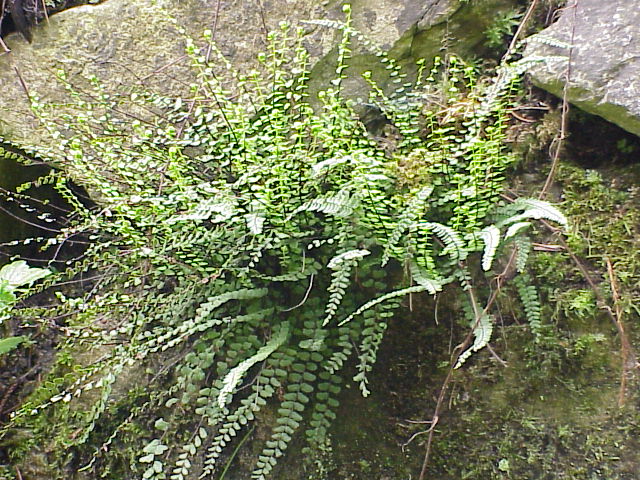
Maidenhair spleenwort is a small evergreen fern found in temperate regions over almost the whole world. In Belgium it is one of the most common wall ferns: you find it in the joints of old walls, quay walls and bridges, and on rocks. From a compact little tuft grow narrow fronds 5–20 cm long, with two rows of small, round to oblong leaflets along a glossy black-brown midrib. It is fully hardy, stays green all year and needs almost no care. Ideal for a rock garden, a trough or the joints of an old wall in the shade.
Light
Partial shade or shade
tolerates little sun
Moisture
Dry to normal
no wet feet
Legal basis
Sand or loam
neutral to chalky
Hardiness
Fully hardy
down to -30 °C
Size
0.15 m
tall, 0.2 m wide
| Height | 0.15 m |
|---|---|
| Native to Belgium | Yes |
| Poisonous to people and pets | Not known to be poisonous |
Identify
Maidenhair spleenwort: how do you recognise it?
- Habit
- Compact tuft 10–15 cm tall and up to 20 cm across, with spreading, often slightly drooping fronds.
- Fronds
- Narrow and once-pinnate, 5–20 cm long, with dozens of small, round to oblong leaflets in two rows.
- Midrib
- Thin, stiff and glossy black-brown; old fronds shed their leaflets and leave the bare black midrib behind.
- Spores
- Elongated spore clusters on the underside of the leaflets; ferns do not flower.
- Roots
- Fine, dense roots that anchor themselves in joints and crevices.
Plants: March–May and September–October
In your garden
Why grow it?
- Small and evergreen: fresh green all year in the joints of a wall or between stones.
- A native fern that suits a natural garden with old walls or a rock garden perfectly.
- Fully hardy, to about −30 °C.
- Copes with a fairly dry spot once it is well rooted.
- Hardly any work: no pruning and no feeding needed.
- Lovely in small troughs and bowls, where the fine fronds stand out.
Maidenhair spleenwort: where does it grow best?
- Partial to full shade, for example the north or east side of a wall; a little morning sun is fine.
- A joint, crevice or rock garden with a limy mix of sand and compost, or neutral to chalky, free-draining soil.
- Dry to moderately moist, but always free-draining: no standing water.
- Not among vigorous plants: it is easily smothered.
- One plant per crevice, or 15–20 cm apart in a rock garden.
- Light
- Partial shade and shade
- Soil type
- Sand or loam
- Acidity
- Neutral or chalky
- Moisture
- Dry or normal
- Size
- 0.15 m tall, 0.2 m wide
- Hardiness
- Hardy (to -30 °C)
Goes well with
- Rustyback: Another small wall fern, for the sunnier side of the wall.
- Ivy-leaved toadflax: Small lilac flowers in the same joints, from spring to autumn.
- Yellow corydalis: Flowers yellow for months on old walls and also likes partial shade.
- Mossy saxifrage: Low cushions with small flowers for a shady rock garden.
- Brittle bladder-fern: A delicate native fern for the same shady wall.
Maintenance
Maidenhair spleenwort: when and how to plant it?
Plant in March–May and September–October.
- Plant from March to May or in September–October, ideally during a damp spell.
- Choose a young plant: small root balls establish best in a wall crevice.
- Fill the crevice with a limy mix of coarse sand, compost and a little old mortar or limestone chippings.
- Slide the root ball in, with the crown just at the outer edge, and firm well; a small stone holds it in place.
- Water gently with a fine rose and keep the plant slightly moist for the first few weeks.
Care
- Water
- Only in the first year during dry spells. A well-rooted plant in a wall needs no extra water.
- Feeding
- Not needed: it grows best in a lean spot.
- Weeding
- Gently remove moss, grass and weeds if they start to smother the plant.
- Wall care
- When repointing or cleaning an old wall, spare the joints where ferns grow: pressure washing and new cement joints make it disappear.
- In a trough
- A limy, free-draining mix and a spot in partial shade.
Tip: Plant it in a crevice between stones, in a limy mix of sand and compost, with the crown just at the outer edge. Once it has rooted, new plants often appear from spores by themselves in a spot it likes.
Maidenhair spleenwort: when to prune it?
When: Not needed: maidenhair spleenwort is not pruned.
How:
- Now and then, gently pull out the bare black midribs of old fronds; they come away easily.
- Simply leave the green fronds: they stay attractive all winter.
Propagation
- Spores
- In summer or autumn, let a frond with ripe brown spore clusters dry on paper and sow the spores on a sterile, limy seed mix under glass. It takes a year or more to get plants ready to plant out.
- Division
- An old clump with several crowns can be carefully divided in spring.
- Self-sown
- On a suitable wall, new plants often appear by themselves from spores; you can leave them be.
Maidenhair spleenwort: how does it get through the winter?
Hardy to −30 °C.
- Fully hardy, to about −30 °C: no protection needed.
- The fronds stay green in winter, even after frost.
- In a trough: make sure water drains away well, as wet roots are more dangerous than frost in winter.
Diseases and pests
- Rotting: Brown, limp crown in wet, poorly drained soil. Replant in a drier, stonier mix.
- Smothered: Moss, grass or vigorous wall plants smother the little plant. Remove them carefully.
- Scorched fronds: Brown, withered fronds in full midday sun. Choose the shady side of the wall.
- Bare midribs: Old fronds shed their leaflets and keep only their black midribs: this is normal, not a disease.
Through the year
- March: Remove moss and weeds around the plant.
- April: Plant in a wall crevice, rock garden or trough.
- May: Plant. Keep young plants slightly moist.
- July: Water young plants in dry spells.
- August: Collect ripe spores.
- September: Plant during a damp spell.
- October: Plant.
- December: Rest. The fronds stay green.
You and this species
Did you know?
- When the leaflets of an old frond fall, the bare, glossy black midrib stays standing for a long time.
- There are several subspecies: one grows mainly on limestone and in lime mortar, another on acid rocks.
- It is found in temperate regions over almost the whole world, from Europe and Asia to North America and Australia.