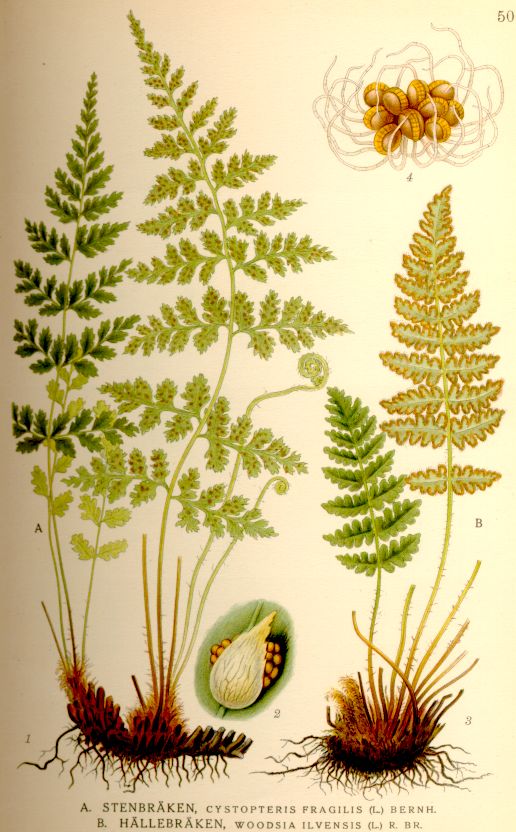
Photo: Carl Axel Magnus Lindman, Public domain · source

Fern · Cystopteridaceae
Brittle bladder-fern
Cystopteris fragilis
In other languages: Blaasvaren (Nederlands) · Cystoptéris fragile (Français)
Brittle bladder-fern is a small, delicate fern found in temperate and cold regions over almost the whole world. In Belgium it grows on shady rocks and old, damp walls, mainly in Wallonia; in Flanders it is rare. From a small clump rise fine, light green, twice-divided fronds 10–20 cm long on thin, brittle stalks. It comes into leaf early in spring and in drought may die back as early as summer, to sprout again later. A charming little plant for a shady rock garden, a wall or a trough in a wildlife garden.
Light
Partial shade or shade
tolerates little sun
Moisture
Normal
no wet feet
Legal basis
Sand or loam
neutral to chalky
Hardiness
Fully hardy
down to -35 °C
Size
0.2 m
tall, 0.25 m wide
| Pruning months | March |
|---|---|
| Height | 0.2 m |
| Native to Belgium | Yes |
| Poisonous to people and pets | Not known to be poisonous |
Identify
Brittle bladder-fern: how do you recognise it?
- Habit
- Small, loose clump 15–20 cm tall and 20–25 cm across.
- Fronds
- Lance-shaped, twice divided, finely cut and light green; thin and delicate.
- Stalk
- Thin and brittle: it snaps easily, hence the name fragilis.
- Spores
- Round spore clusters, each covered by a small, bladder-like membrane; ferns do not flower.
- Season
- Deciduous: early to emerge, sometimes dying back as early as summer in drought.
- Roots
- Short, creeping rhizome that anchors itself in crevices and between stones.
Plants: March–May and September–October · Pruning: March
In your garden
Why grow it?
- One of the earliest ferns: the fresh green fronds appear as early as March–April.
- Fine, airy fronds, lovely in shady crevices, rock gardens and troughs.
- A native fern for a natural wall or rock garden.
- Very hardy, to about −35 °C.
- Small and not invasive: ideal for small spots.
Brittle bladder-fern: where does it grow best?
- Partial to full shade, for example the north side of a wall or between stones in a shady rock garden.
- Loose, free-draining soil: sand or loam with some leaf mould, neutral to chalky.
- Moderately moist: a cool, damp crevice is ideal, but no standing water.
- Not among vigorous plants, which soon smother this delicate fern.
- Plant 20–25 cm apart.
- Light
- Partial shade and shade
- Soil type
- Sand or loam
- Acidity
- Neutral or chalky
- Moisture
- Normal
- Size
- 0.2 m tall, 0.25 m wide
- Hardiness
- Hardy (to -35 °C)
Goes well with
- Maidenhair spleenwort: An evergreen wall fern that fills the gap when the bladder-fern dies back.
- Yellow corydalis: Flowers yellow for months on the same shady walls.
- Mossy saxifrage: Low cushions with small flowers in spring.
- Dalmatian bellflower: Purple bells on walls and between stones in summer.
Maintenance
Brittle bladder-fern: when and how to plant it?
Plant in March–May and September–October.
- Plant from March to May or in September–October, ideally during a damp spell.
- Loosen the soil and mix in some leaf mould and limestone grit or coarse sand.
- In a wall or rock garden: fill a crevice with this mix, slide the root ball in and firm well.
- Set the plant at the same depth as in the pot and leave 20–25 cm between plants.
- Water gently and keep the soil moist for the first few weeks.
Care
- Water
- Keep young plants moist. Later water only in prolonged drought; this delays summer die-back a little.
- Feeding
- Not needed; at most a pinch of leaf mould in spring.
- Weeding
- Gently remove moss and weeds if they start to smother the plant.
- Summer rest
- If the fronds die back in a dry summer, simply leave the plant: the rhizome is still alive and will sprout again.
- In a trough
- A loose, limy mix and a cool, shady spot.
Tip: Plant it in a cool, shady spot in a wall or rock garden and do not worry if the fronds wither in a dry summer: the plant is resting and will sprout again later.
Brittle bladder-fern: when to prune it?
Pruning months: March.
When: It hardly needs pruning; just clear away the withered frond remains in March.
How:
- Carefully cut or pick off last year’s dead fronds before the new ones appear.
- Fronds that die back in summer can safely be cut off; new ones will come later.
Caution: The young fronds appear early and snap easily: work gently.
Propagation
- Spores
- In summer, collect ripe spores and sow them under glass on sterile, moist seed compost. In a suitable spot, young plants also appear by themselves.
- Division
- In March–April, gently pull old clumps apart and replant the pieces straight away.
Brittle bladder-fern: how does it get through the winter?
Hardy to −35 °C.
- Very hardy, to about −35 °C: no protection needed.
- The fronds die back in autumn; the rhizome overwinters in the soil.
- Leave some fallen leaves around the plant as natural protection, but not a thick layer that would smother this small fern.
Diseases and pests
- Summer die-back: Brown, withered fronds in July–August during drought. Normal behaviour; water in prolonged drought and choose a cooler spot.
- Smothered: Moss, grass or vigorous neighbours smother the plant. Weed carefully and give it space.
- Rot: In wet, compacted soil the rhizome rots. Replant in a looser, stonier mix.
- Slugs: Eat the young, tender fronds in spring. Pick them off in the evening.
Through the year
- March: Clear away dead frond remains. New fronds appear.
- April: Plant or divide. Spare the young fronds when weeding.
- May: Plant. Watch for slugs.
- June: Water in dry spells. Collect ripe spores.
- July: In drought the fronds may die back: water or let it rest.
- August: Water in dry spells.
- September: Plant.
- October: Plant. The fronds die back.
You and this species
Did you know?
- Cystopteris means ‘bladder fern’: from the Greek ‘kystis’ (bladder) and ‘pteris’ (fern), after the bladder-like membrane over the spore clusters.
- ‘Fragilis’ means brittle: the thin frond stalks snap very easily.
- It is one of the most widespread ferns in the world.