Photo: Wikimedia Commons, Public domain · source

Ornamental grass · Poaceae
Wavy hair grass
Avenella flexuosa
In other languages: Bochtige smele (Nederlands) · Canche flexueuse (Français)
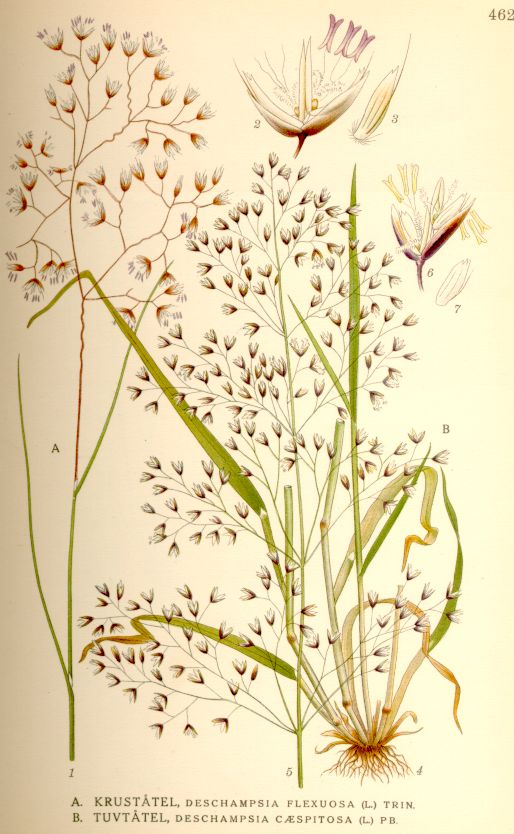
Wavy hair grass (Avenella flexuosa, also sold as Deschampsia flexuosa) is a native grass of dry, acid soils. In Belgium it grows on heathland, in oak and birch woods and along sandy woodland edges, for example in the Campine. It forms dense, low tufts of hair-fine, dark green leaves that stay green in winter. In June and July, airy, shining panicles in silver, purple and bronze appear above them on thin, wavy stalks, later turning straw-coloured. The cultivar ‘Tatra Gold’ has striking yellow-green leaves that brighten dark spots under trees.
Light
Sun to shade
not fussy
Moisture
Dry to normal
no wet feet
Legal basis
Sand or peat
acid
Hardiness
Fully hardy
down to -30 °C
Size
0.4 m
tall, 0.3 m wide
Flowering
June–July
| Pruning months | March and August |
|---|---|
| Height | 0.4 m |
| Native to Belgium | Yes |
| Poisonous to people and pets | Not known to be poisonous |
| Flowering | June–July |
Identify
Wavy hair grass: how do you recognise it?
- Habit
- Dense, low tuft about 30 cm wide; the flower stems reach about 40 cm.
- Leaves
- Hair-fine and bristly, dark green and evergreen; yellow-green in ‘Tatra Gold’.
- Flowers
- Loose, shining panicles in silver, purple and bronze on thin, wavy stalks in June and July; later straw-coloured.
- Seed
- On suitable acid soil it self-seeds moderately.
- Roots
- Fine, fibrous roots in a dense tuft; it is not invasive.
Flowering: June–July · Plants: March–April and September–October · Pruning: March and August
In your garden
Why grow it?
- A native grass for a wildlife or heath garden, on acid sandy soil where many other plants struggle.
- Grows in sun, partial shade and shade, even under oaks, birches and pines.
- Evergreen: a fine, green tuft, even in winter.
- In June–July a glittering cloud of panicles, at its best when backlit.
- The dense tufts give cover to insects and other small creatures in a wild corner.
- Little work: no feeding and, once established, no extra watering.
Wavy hair grass: where does it grow best?
- Sun, partial shade or light shade; in deep shade it flowers less.
- Acid, poor soil: sand or peaty soil. It does not tolerate lime.
- Dry to normally moist and well drained; no waterlogged soil.
- Ideal with heather, under oaks, birches and pines or along a woodland edge.
- Plant 25–30 cm apart, in groups of at least five for a natural effect.
- Light
- Sun, partial shade and shade
- Soil type
- Sand or peat
- Acidity
- Acid
- Moisture
- Dry or normal
- Size
- 0.4 m tall, 0.3 m wide
- Hardiness
- Hardy (to -30 °C)
Goes well with
- Heather: They grow together in the wild: a little piece of heathland in your garden.
- Bilberry: Likes the same acid soil, under oaks and birches.
- Broom: Yellow flowers in May on the same poor, sandy soil.
- Bluebell: Blue spring flowers under the trees, before the grass flowers.
Maintenance
Wavy hair grass: when and how to plant it?
Plant in March–April and September–October.
- Plant in March–April or September–October, when the soil is neither frozen nor too wet.
- Loosen the soil, but do not enrich it with manure or potting compost: it likes poor soil.
- On neutral soil, mix some leaf mould from oaks or conifer needles into the planting hole; on chalky soil, choose another grass instead.
- Set the tuft at the same depth as it was in the pot and leave 25–30 cm between plants.
- Water straight away and during dry spells in the first few weeks; after that it is rarely needed.
Care
- Watering
- Rarely needed once established; only in pots or in a long drought during the first year.
- Feeding
- Do not feed: fertiliser makes the tufts floppy and gives stronger competitors a chance.
- Tidying
- In March, comb the dead leaves out of the tuft with your fingers or a small rake.
- Spent panicles
- Cut them off in August if you do not want seedlings, or leave them for a wild look.
- Rejuvenating
- Old tufts go bare in the middle; divide them every few years.
Tip: Never give it fertiliser or lime: the tufts look best on poor, acid soil. ‘Tatra Gold’ brightens dark spots under trees.
Wavy hair grass: when to prune it?
Pruning months: March and August.
When: It is not cut back. In March, comb out the dead leaves and, if you like, cut off the spent panicles in August.
How:
- In March, remove dead leaves from the tuft with gloved hands or a small rake.
- From August, cut spent panicles off just above the foliage if you do not want seedlings.
- Do not cut the tuft itself short: the green foliage is its ornamental value in winter too.
Propagation
- Division
- In March–April or September, lift a tuft, pull or cut it into pieces with roots and replant straight away.
- Seed
- Sow ripe seed in late summer or spring in pots of sandy, acid seed compost; barely cover and keep moist.
Wavy hair grass: how does it get through the winter?
Hardy to −30 °C.
- Fully hardy, to about −30 °C: no protection needed.
- The leaves stay green; simply leave the tuft standing.
- In a pot it can stay outside over winter; make sure water drains away freely.
Diseases and pests
- Yellow leaves: On chalky or over-rich soil it turns yellow and fades away. Choose an acid, poor spot.
- Bare centre: Older tufts die out in the middle. Divide them and replant the young outer parts.
- Root rot: In waterlogged soil the tuft rots. Plant in free-draining sandy soil.
- Rust: Orange-brown spots on the leaves, especially in wet summers. Comb out affected leaves and give the tufts a little more space.
Through the year
- March: Comb out dead leaves. Plant or divide.
- April: Plant. Water after planting.
- May: New growth. Do not feed.
- June: Flowering: glittering panicles.
- July: Flowering. The panicles turn straw-coloured.
- August: Cut off spent panicles or leave them for seed.
- September: Plant or divide. Sow seed.
- October: Plant. Move self-sown seedlings.
- December: Green in winter. Leave standing.
You and this species
Did you know?
- The species name flexuosa, meaning wavy or bent, refers to the thin, twisting stalks of the flower panicles.
- It is one of the commonest grasses of dry, acid oak and birch woods and of the heaths of the Campine.
- Because of nitrogen deposition, grasses such as wavy hair grass and purple moor grass are taking over from heather on many heaths.