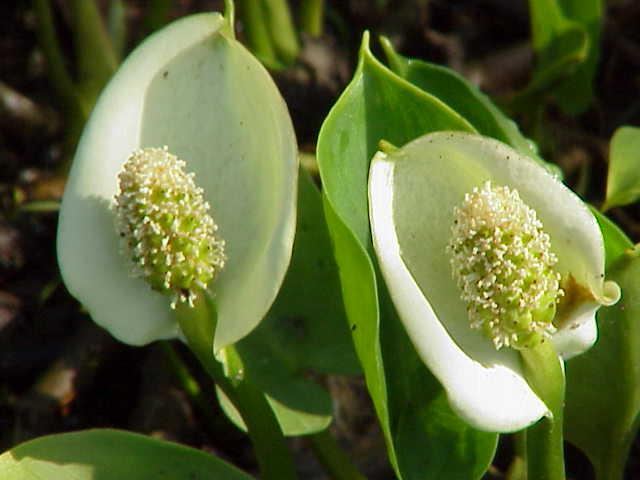
Photo: Kurt Stüber [1], CC BY-SA 3.0 · source

Water or marginal plant · Araceae
Bog arum
Calla palustris
In other languages: Slangenwortel (Nederlands) · Calla des marais (Français)
Bog arum is a small native member of the arum family, found in fens, wet alder woods and nutrient-poor pond edges in the cool regions of Europe, Asia and North America. It creeps over the mud on thick, green stems and reaches up to 10 cm deep into the water, forming a low mat of glossy, heart-shaped leaves about 25 cm tall. From May to July, peaking in June, white, open spathes appear around a short, yellow-green spadix, looking like a small calla lily. Clusters of red berries then ripen and stand out in late summer. Gardeners like to use it to soften the edge of a wildlife pond and hide the transition from water to land.
Caution: All parts, including the red berries, are poisonous and irritant if eaten. The berries are especially tempting to small children; cats, dogs and grazing animals are also at risk. Cut off the berries if children or pets come near the pond and wear gloves when handling the plant.
Light
Sun or partial shade
preferably some sun
Moisture
Moist to wet
must not dry out
Legal basis
Loam or peat
acid to neutral
Hardiness
Fully hardy
down to -30 °C
Size
0.25 m
tall, 0.5 m wide
Flowering
May–July
| Height | 0.25 m |
|---|---|
| Native to Belgium | Yes |
| Poisonous to people and pets | Yes, take care with children and pets |
| Flowering | May–July |
Identify
Bog arum: how do you recognise it?
- Habit
- A low, creeping mat about 25 cm tall, slowly spreading to 50 cm and more.
- Leaves
- Heart-shaped, glossy dark green, on long stalks; they die back in autumn.
- Flower
- A white, open spathe a few centimetres long around a short, yellow-green spadix covered in tiny flowers, from May to July.
- Fruit
- Dense clusters of glossy red berries in late summer.
- Stems
- Thick, green, creeping stems with nodes, growing on and just below the surface of the mud and rooting there.
Flowering: May–July · Plants: April–June
In your garden
Why grow it?
- Its creeping stems neatly hide the edge of the pond liner and create a natural transition from water to land.
- Glossy, heart-shaped leaves from spring to autumn.
- White spathes in late spring and early summer, followed by red berries.
- A native plant for a wildlife pond with soft, nutrient-poor water.
- The low mat gives frogs, newts and water insects a hiding place at the edge.
- Fully hardy and little work.
Bog arum: where does it grow best?
- Sun or partial shade.
- Wet, humus-rich loam or peat, acid to neutral; soft rainwater is ideal.
- Along the pond edge and up to 10 cm deep in the water.
- Allow 30–40 cm between plants.
- Light
- Sun and partial shade
- Soil type
- Loam or peat
- Acidity
- Acid or neutral
- Moisture
- Wet
- Size
- 0.25 m tall, 0.5 m wide
- Hardiness
- Hardy (to -30 °C)
Goes well with
- Marsh cinquefoil: Dark purple-red star-shaped flowers in the same acid, wet edge.
- Bogbean: Fringed white flowers in spring, also for acid, shallow edges.
- Marsh fern: Light, delicate fronds behind the low mat.
- Cotton grass: White tufts in early summer on wet, acid ground.
- Water forget-me-not: Small pale blue flowers weaving between the leaves.
Maintenance
Bog arum: when and how to plant it?
Plant in April–June.
- Plant from April to June, as the water warms up.
- Use a wide, shallow aquatic basket with low-nutrient aquatic soil, mixed with a little sand if you like; no fertiliser or compost.
- Lay the creeping stem horizontally on the soil and press it in lightly, without burying it completely.
- Set the basket so that its top is level with the water or up to 10 cm below it, or plant straight into the muddy edge of a wildlife pond.
- Keep 30–40 cm between plants.
- Then gently top up the water with rainwater.
Care
- Water
- Must never dry out. Top up with rainwater: it is less happy with hard tap water.
- Feeding
- Not needed: it likes nutrient-poor water.
- Dead leaves
- In autumn, remove yellowed and dead leaves from the water, so they do not rot there.
- Spread
- Grows fairly slowly. Cut off stems that go too far in spring and plant them elsewhere.
- Repotting
- Every 3–4 years, lift it from the basket and divide it once it gets too full.
Tip: Let the thick stems creep over the edge of the pond: that way it hides the liner and forms a natural transition. Top up with rainwater, because it likes soft water.
Bog arum: when to prune it?
When: Bog arum hardly needs pruning: just remove yellowed and dead leaves in autumn.
How:
- Cut or pull off yellow leaves as they die and remove them from the water.
- Leave the red berries for decoration, but cut them off if young children or pets can reach them.
- In spring, cut off stems that are too long and use them as cuttings.
Caution: Wear gloves when you cut it: all parts are poisonous and the sap can irritate the skin.
Propagation
- Cuttings
- From April to July, cut pieces of creeping stem with at least one node and lay them on wet mud or in a shallow pot standing in water. They root quickly.
- Seed
- In autumn, sow the seeds from ripe berries fresh in a pot of wet, acid soil standing in a saucer of water, and leave the pot outdoors over winter.
Bog arum: how does it get through the winter?
Hardy to −30 °C.
- Fully hardy, to about −30 °C: no protection needed.
- The foliage dies back in autumn; the thick stems overwinter in the mud.
- A basket at the pond edge may freeze solid without harm.
Diseases and pests
- Drying out: Limp, brown leaves when the edge dries out in summer. Keep the water level up with rainwater.
- Slugs and snails: They may eat holes in the leaves. The damage usually stays limited; frogs and toads help.
- Pale leaves: Pale, yellowish foliage in hard, chalky water. Top up with rainwater and replant in a more acid mix.
- Crowded out: Vigorous marginals grow over the low mat. Keep them in their own basket or cut them back.
Through the year
- April: Plant. The new leaves appear.
- May: Plant. The first white spathes.
- June: Full flower. Take cuttings of the creeping stems.
- July: Last flowers. Top up with rainwater in dry spells.
- August: The berries turn red. Top up the water in dry spells.
- September: Berries ripe: collect and sow the seed.
- October: Remove yellowed leaves from the water.
- December: Rest.
Use
Edible and useful
Not edible. All parts of bog arum are poisonous: as with lords-and-ladies, the sap contains needle-shaped crystals that make the mouth and throat swell painfully. The bright red berries at the pond edge in late summer tempt small children. Cut them off if children or pets can reach them, and wear gloves when cutting into the plant. Cats, dogs and grazing animals are at risk too. If any is swallowed, call a poison centre (in Belgium 070 245 245) or your doctor at once.
You and this species
Did you know?
- Calla palustris is the only species in the genus Calla. The florist’s ‘calla lily’ belongs to a different genus, Zantedeschia.
- It grows in cool regions all around the North Pole: in Europe, Asia and North America.
- In northern Scandinavia, bread used to be baked in times of famine from the dried and long-processed rhizome; raw, the plant is poisonous.