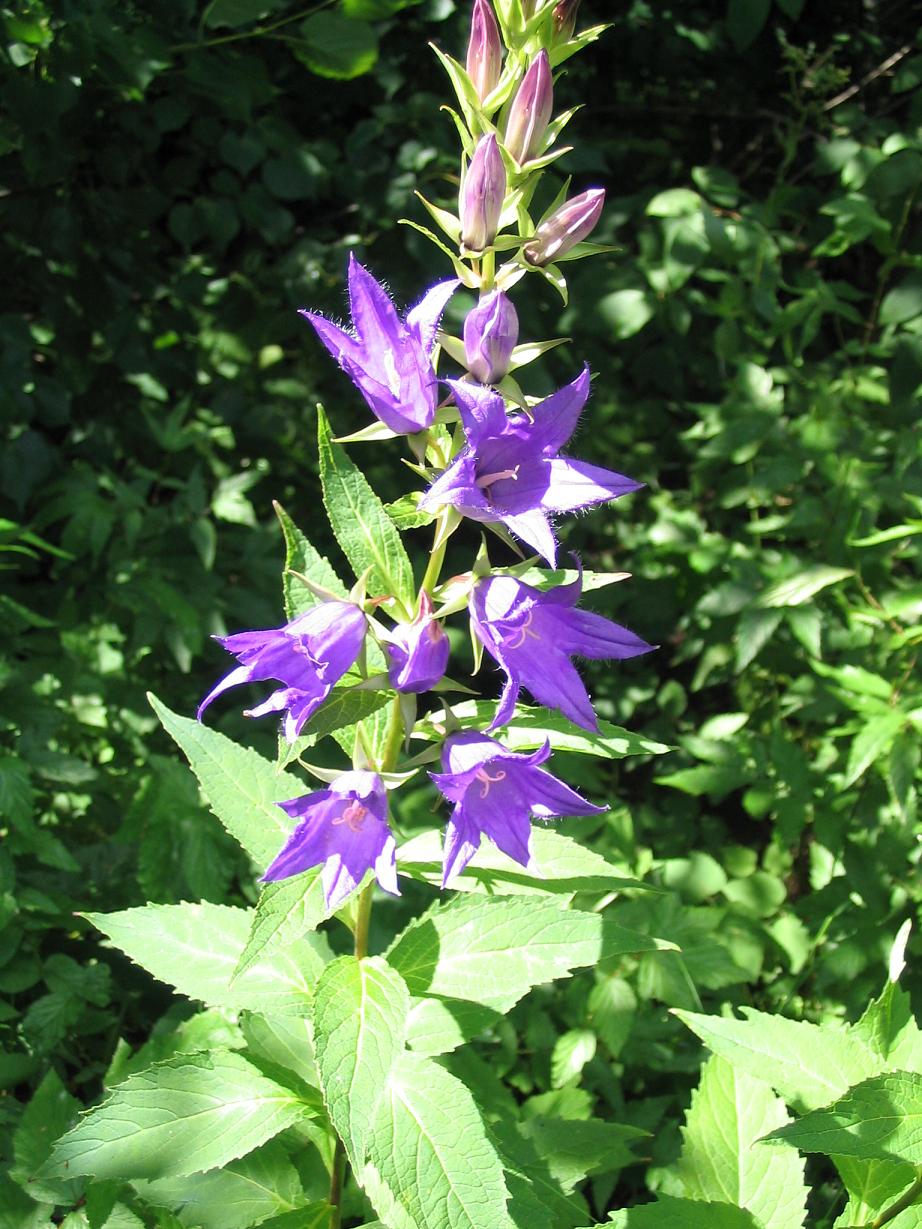
Photo: Sergey M. Sazhin – Sazhin64, GPL · source

Perennial · Campanulaceae
Giant bellflower
Campanula latifolia
In other languages: Breed klokje (Nederlands) · Campanule à larges feuilles (Français)
Giant bellflower comes from Europe and western Asia, where it grows in damp deciduous woodland, along woodland edges and in rough grassland. It is a robust perennial with sturdy, unbranched stems of 1–1.2 m and large, toothed leaves. In June and July the stems are covered in large, tubular bells 4–5 cm long, blue-violet or white, in a long, leafy spike. Gardeners value it because it flowers generously in partial and full shade, where few tall perennials do well. Well-known forms are the white ‘Alba’ and the large-flowered, deep purple var. macrantha.
Light
Partial shade or shade
tolerates little sun
Moisture
Normal
no wet feet
Legal basis
Loam or clay
any pH
Hardiness
Fully hardy
down to -35 °C
Size
1.2 m
tall, 0.6 m wide
Flowering
June–July
| Pruning months | July–August |
|---|---|
| Height | 1.2 m |
| Native to Belgium | No, planted |
| Good for bees, butterflies and birds | Yes, for bees |
| Poisonous to people and pets | Not known to be poisonous |
| Flowering | June–July |
Identify
Giant bellflower: how do you recognise it?
- Habit
- Robust clump 1–1.2 m tall and about 60 cm wide, with sturdy, upright and usually unbranched stems.
- Leaves
- Large, oval to oblong, toothed and softly hairy; largest at the base, smaller and stalkless higher up.
- Flowers
- Bells 4–5 cm long with five curled-back lobes; blue-violet or white, single or in pairs in the leaf axils along the upper half of the stem. In June and July.
- Fruit
- Nodding capsules holding many fine seeds.
- Roots
- Thick, fleshy roots; the clump widens over the years but does not run.
Flowering: June–July · Plants: March–April and September–October · Pruning: July–August
In your garden
Why grow it?
- One of the largest and finest bellflowers, for partial and full shade.
- Adds height and structure at the back of a shady border or along a woodland edge.
- Bumblebees crawl right inside the large bells; solitary bees visit the flowers too.
- Tough, hardy and rarely troubled by disease.
- Self-seeds and so forms a natural group within a few years.
Giant bellflower: where does it grow best?
- Partial shade or light shade under trees; in full sun it dries out too quickly.
- Humus-rich loam or clay, acid to chalky.
- Moderately moist: soil that holds moisture but does not stay waterlogged.
- At the back of the border or between shrubs, 50–60 cm apart.
- Ideally sheltered from strong wind, so the tall stems do not blow over.
- Light
- Partial shade and shade
- Soil type
- Loam or clay
- Acidity
- Not fussy
- Moisture
- Normal
- Size
- 1.2 m tall, 0.6 m wide
- Hardiness
- Hardy (to -35 °C)
Goes well with
- Foxglove: Tall spikes in the same light shade, in June.
- Hosta: Large leaves at the foot of the tall stems.
- Ferns: Fresh green foliage that shows off the blue-violet bells.
- Bugbane: White candles in late summer, in the same shady border.
- Wood anemone: A spring flower that fills the spot before the bellflower comes up.
Maintenance
Giant bellflower: when and how to plant it?
Plant in March–April and September–October.
- Plant in March–April or in September–October.
- Dig a generous hole and mix in a few spadefuls of compost or leaf mould.
- Set the plant at the same depth as it was in the pot and firm the soil well.
- Keep 50–60 cm between plants.
- Water well straight away and keep the soil moist during dry spells in the first year.
- Mulch with leaf mould to keep the soil cool and moist.
Care
- Water
- Water during long dry spells, especially in the first year and in a lighter spot.
- Feeding
- A layer of compost or leaf mould in March; nothing more is needed.
- Support
- In an open spot or rich soil the stems may fall over; put a plant support or twiggy sticks around the clump in May.
- Deadheading
- Cut the stems back after flowering if you do not want seedlings.
- Seedlings
- It self-seeds easily. Weed out surplus seedlings or move them while young.
Tip: Plant it at the back of a shady border, between shrubs or under trees, and cut the stems back after flowering if you do not want seedlings everywhere.
Giant bellflower: when to prune it?
Pruning months: July–August.
When: After flowering, in July–August, cut the spent stems back to the leaves at the base.
How:
- Cut spent stems to just above the basal leaves; a few late flowers sometimes follow.
- Leave one or two stems if you want to collect seed or have seedlings.
- In autumn or March, clear away the last dead leaves.
Caution: If you let every stem set seed, expect plenty of seedlings the following year.
Propagation
- Division
- In March–April or September, lift an older clump and divide it with a sharp spade into pieces, each with roots and buds.
- Seed
- Sow fresh seed in autumn or spring in a pot outdoors; do not cover the fine seed. Or simply let it self-seed and move the seedlings.
Giant bellflower: how does it get through the winter?
Hardy to −35 °C.
- Fully hardy, to about −35 °C: no protection needed.
- The top growth dies back and the plant regrows from the roots in spring.
- It can also grow in a large pot, as long as the pot is sheltered in winter and the compost never dries out.
Diseases and pests
- Slugs and snails: They eat the young shoots in spring. Pick them off in the evening and protect young plants.
- Falling stems: Mostly in rich soil or a windy spot. Support put in place in May and a sheltered position help.
- Rust: Orange pustules on the undersides of the leaves. Remove affected leaves and give the plants space for air.
- Drying out: Drooping, scorched leaves in a dry summer. Water and choose a shadier spot.
Through the year
- March: Add compost. Plant or divide.
- April: Plant. Watch for slugs.
- May: Put supports in place in an open spot.
- June: Flowering begins. Bumblebees in the bells.
- July: Full flower. Cut back spent stems.
- August: Cut back the last stems or let seed ripen. Water in dry spells.
- September: Plant or divide. Sow in a pot.
- October: Plant. Clear dead leaves.
Use
Good for wildlife
- Bees
- Nectar and pollen for honeybees and wild bees.
You and this species
Did you know?
- Latifolia means ‘broad-leaved’, after its large leaves.
- In Britain it grows wild in damp deciduous woodland, mainly in northern England and Scotland.
- The bells are so large that bumblebees disappear inside them completely; in the rain, small bees sometimes shelter in them.