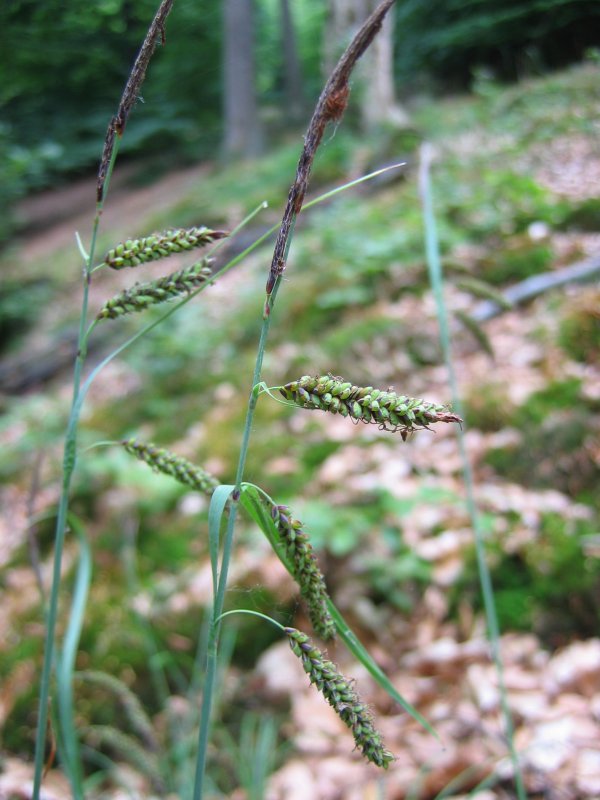
Photo: Kristian Peters -- Fabelfroh 09:16, 13 July 2006 (UTC), CC BY-SA 3.0 · source

Ornamental grass · Cyperaceae
Glaucous sedge
Carex flacca
In other languages: Zeegroene zegge (Nederlands) · Laîche glauque (Français)
Glaucous sedge is a native, evergreen sedge found throughout Europe, including Belgium. It is at home in the most varied places: from dry chalk grassland and dunes to wet hay meadows. It has narrow, blue-grey leaves about 20–30 cm long and spreads by runners into a low, dense mat. In May–June, dark brown to almost black spikes appear on slender stems. That makes it a tough ground cover for places where other plants struggle: it tolerates drought, wet soil and even being walked on now and then.
Caution: It spreads by runners into a mat; next to small, weak plants that can become too much. Plant it where it is allowed to spread, or keep it in check with a root barrier or by cutting back the edges every year.
Light
Sun or partial shade
preferably some sun
Moisture
Dry to wet
not fussy
Legal basis
Sand, loam or clay
neutral to chalky
Hardiness
Fully hardy
down to -30 °C
Size
0.3 m
tall, 0.3 m wide
Flowering
May–June
| Pruning months | March |
|---|---|
| Height | 0.3 m |
| Native to Belgium | Yes |
| Poisonous to people and pets | Not known to be poisonous |
| Flowering | May–June |
Identify
Glaucous sedge: how do you recognise it?
- Habit
- Low, creeping plant 20–30 cm tall that forms a dense mat by its runners.
- Leaves
- Narrow, flat and blue-grey, especially on the underside; evergreen.
- Flowers
- In May–June, slender stems with 1–3 dark brown male spikes at the top and a few female spikes below, often slightly nodding.
- Roots
- Creeping rhizomes with which the plant spreads and binds the soil well, even on a bank.
Flowering: May–June · Plants: March–May and September–October · Pruning: March
In your garden
Why grow it?
- Blue-grey leaves all year round: a cool colour that stays even in winter.
- A true ground cover that forms a low, dense mat by its runners and suppresses weeds.
- Very versatile: it grows on dry and wet soil, in sun and part shade.
- Tolerates occasional foot traffic: suitable for the edge of a path or as a lawn alternative in a little-used spot.
- Native and undemanding, ideal for a wildlife-friendly garden.
Glaucous sedge: where does it grow best?
- Sun or part shade; in deep shade the mat becomes thin.
- Any soil: sand, loam or clay, neutral to chalky.
- Dry, normal or wet: it tolerates both drought and waterlogged soil.
- As ground cover, plant 25–30 cm apart, which is about 11–16 plants per m².
- Light
- Sun and partial shade
- Soil type
- Sand, loam or clay
- Acidity
- Neutral or chalky
- Moisture
- Dry to wet
- Size
- 0.3 m tall, 0.3 m wide
- Hardiness
- Hardy (to -30 °C)
Goes well with
- Crocus: Crocuses grow up through the low mat and flower in spring.
- Wild marjoram: Pink summer flowers on the same chalky soil, loved by bees.
- Catmint: Blue flowers above the blue-grey leaves.
- Bloody cranesbill: Magenta flowers in summer; together they make a low, tough planting.
- Purple loosestrife: For a wet spot: purple spikes in summer above the mat.
Maintenance
Glaucous sedge: when and how to plant it?
Plant in March–May and September–October.
- Plant in March–May or in September–October.
- First remove all perennial weeds: couch grass or ground elder are hard to get out of a dense mat later.
- Set the clumps at the same depth as they were in the pot and firm the soil.
- Keep 25–30 cm between plants; after a few seasons they grow into a closed mat.
- Water in straight away and keep the soil moist for the first few weeks.
- A thin mulch of wood chips or leaf mould between the young plants keeps weeds down until the mat has closed.
Care
- Watering
- Only after planting and in the first year during long dry spells; after that it is no longer needed.
- Feeding
- Not needed; on poor soil it stays lower and more compact.
- Weeding
- Weed faithfully between the young plants in the first year, until the mat is dense.
- Refreshing
- In March, comb out the dead leaves, or cut or mow the mat once, fairly high, to rejuvenate it.
- Keeping it in check
- In spring, cut back the edges with a spade if it grows beyond its space.
Tip: Use it as an evergreen ground cover in an awkward spot, such as a bank, a wet corner or the edge of a path: it tolerates drought and wet soil and can be walked on now and then.
Glaucous sedge: when to prune it?
Pruning months: March.
When: Hardly needed, as it is evergreen. In March you can refresh the mat.
How:
- Comb out brown, dead leaves with gloved fingers or a rake.
- If the mat looks untidy after winter, cut or mow it once to 5–10 cm; new leaves grow back quickly.
- Cut off runners that go too far at the edge with a sharp spade.
Caution: Do not cut or mow in autumn: the old leaves protect the plant in winter.
Propagation
- Division
- In March–April or in September: cut out pieces of the mat with roots and runners and replant them straight away elsewhere. They establish readily.
- Seed
- Sow in autumn or early spring in a seed tray outdoors; germination is slow and erratic.
Glaucous sedge: how does it get through the winter?
Hardy to −30 °C.
- Very hardy, to about −30 °C: no protection needed.
- Evergreen: the blue-grey leaves stay all winter, although the tips may turn brown after hard frost.
- In a pot it can stay outside; do stand the pot against a wall.
Diseases and pests
- Spreading too far: It spreads by runners beyond its allotted space. Cut back the edges in spring or install a root barrier.
- Weeds in the young mat: Until the mat has closed, weeds spring up in between. Weed regularly in the first year and mulch between the plants.
- Brown leaf tips: After hard frost or drought. Comb out or cut off the brown leaves in March; new leaves grow back quickly.
- Bare patches: Caused by heavy foot traffic or deep shade. Fill them in spring with pieces cut from the edge.
Through the year
- March: Comb out dead leaves or cut the mat back fairly high. Plant. Divide.
- April: Plant. Cut back the edges where needed. Weed.
- May: Flowering with dark little spikes. Weed between young plants.
- June: Flowering. Water young plants in dry spells.
- July: The mat closes further. Pull out weeds.
- September: Plant. Divide. Fill bare patches.
- October: Plant.
- December: Blue-grey leaves in the winter garden.
You and this species
Did you know?
- An older scientific name is Carex glauca, which means ‘blue-grey sedge’.
- In the wild it grows in very different places, from dry chalk slopes and dunes to wet hay meadows and fens.
- Sedges are not true grasses: they belong to the sedge family, Cyperaceae, like papyrus.