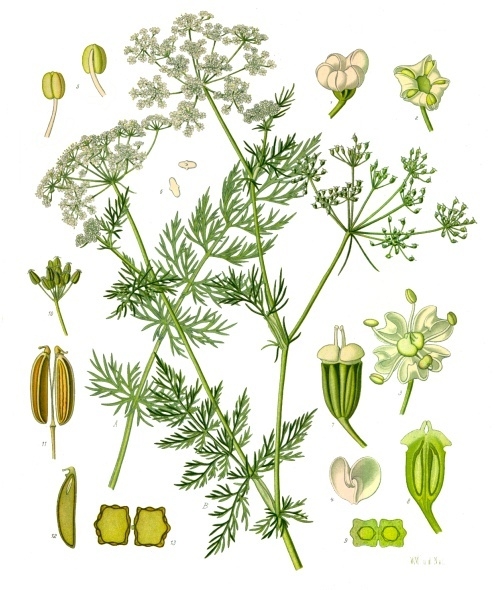
Photo: Franz Eugen Köhler, Köhler's Medizinal-Pflanzen, Public domain · source

Herb · Apiaceae
Caraway
Carum carvi
In other languages: Karwij (Nederlands) · Carvi (Français)
Caraway is a biennial herb of the carrot family that grows in grassland across much of Europe and Asia, including Belgium, although it has become rare in the wild. In its first year it forms a low rosette of finely divided leaves resembling carrot foliage; the following year, in May–June, stems of 30–60 cm appear with small umbels of white to pale pink flowers. Then the familiar curved, ribbed seeds ripen, with their typical spicy flavour. Caraway gives bread, cabbage, potatoes and cheese a distinctive taste, and the young leaves and root are edible too. Bees and hoverflies love the flowers.
Caution: Do not pick wild umbellifers to eat unless you are sure of the species: some, such as hemlock and fool’s parsley, are highly poisonous and resemble caraway.
Light
Full sun
warm and bright
Moisture
Normal
no wet feet
Legal basis
Sand, loam or clay
any pH
Hardiness
Fully hardy
down to -25 °C
Size
0.6 m
tall, 0.3 m wide
Flowering
May–June
| Height | 0.6 m |
|---|---|
| Native to Belgium | Yes |
| Good for bees, butterflies and birds | Yes, for bees |
| Poisonous to people and pets | In part: see Caution above |
| Flowering | May–June |
Identify
Caraway: how do you recognise it?
- Habit
- Biennial: a low leaf rosette in the first year, branched flower stems 30–60 cm tall and about 30 cm wide in the second.
- Leaf
- Fine, two to three times pinnate, resembling carrot foliage; fresh green.
- Flower
- Small white to pale pink flowers in loose umbels in May–June.
- Seed
- Elongated, slightly curved, ribbed seeds 3–6 mm long, turning brown when ripe.
- Roots
- A fleshy white taproot.
Flowering: May–June · Harvest and fruit: April–May and July–August · Sowing: April–May and August
In your garden
Why grow it?
- Home-grown herbs for the kitchen: seeds, young leaves and root are edible.
- The flowers attract bees, hoverflies and other beneficial insects.
- A native plant for the herb garden, vegetable plot or a wildflower meadow.
- Easy to sow and undemanding.
- Fine, airy leaves and graceful white umbels in May–June.
Caraway: where does it grow best?
- Full sun; in shade it flowers poorly and sets little seed.
- Any well-drained soil: sand, loam or clay, acid to chalky.
- Moist; it dislikes wet roots in winter.
- Choose a spot in the vegetable plot or herb garden where it can stay for two seasons.
- Allow 20–30 cm between plants.
- Light
- Sun
- Soil type
- Sand, loam or clay
- Acidity
- Not fussy
- Moisture
- Normal
- Size
- 0.6 m tall, 0.3 m wide
- Hardiness
- Hardy (to -25 °C)
Goes well with
- Pot marigold: Orange flowers and beneficial insects in the same sunny herb garden.
- Chives: Another easy kitchen herb, with purple pompoms in May–June.
- Cornflower: Blue flowers next to the white umbels in a wildflower meadow.
- Wild marjoram: Flowers after the caraway and keeps the bees in the garden.
Maintenance
Caraway: when and how to plant it?
- Sow where it is to grow in April–May or in August: because of its taproot, caraway transplants poorly.
- Rake the soil fine and weed-free and draw shallow drills about 30 cm apart.
- Sow thinly and cover the seed with about 1 cm of fine soil.
- Keep the soil moist until germination, which can take two to three weeks.
- Thin the seedlings to 20–30 cm.
- Weed regularly: the young plants grow slowly and are easily smothered.
Care
- Water
- After germination, only during long droughts.
- Feeding
- Not needed; on poor soil, work in some compost before sowing.
- Weeding
- Keep the rows weed-free in the first year.
- Harvesting seed
- Cut the umbels as soon as most seeds are brown, usually in July, and hang them upside down in a paper bag to dry; the seeds drop out by themselves.
- Leaves and root
- Pick young leaves sparingly for soups or salads. Lift the root in autumn of the first year and cook it as a vegetable.
- Kitchen
- Use the seed in rye bread, sauerkraut, cabbage dishes, potato dishes and cheese. Store it dry in a closed jar.
Tip: Sow in situ and give it two seasons: in the first year you only see a rosette, in the second you harvest the seed. Sow a new row every year and you will have a harvest every year.
Caraway: when to prune it?
When: Caraway is not pruned. You only cut the umbels for the seed harvest in July and remove the plant afterwards.
How:
- Cut off the umbels when most seeds are brown, before they drop.
- Leave a few umbels if you want it to self-seed.
- After the seed harvest the plant dies: pull it up and put it on the compost heap.
Propagation
- Seed
- The only good method: sow where it is to grow in April–May or in August. Seed you harvest yourself can be sown again the following spring.
- Self-sown seedlings
- Let a few umbels ripen; leave the seedlings where they come up and thin them out.
Caraway: how does it get through the winter?
Hardy to −25 °C.
- Very hardy, to about −25 °C: the leaf rosette overwinters without protection.
- Wet, heavy soil in winter is more dangerous than frost.
- Plants sown in August overwinter as small rosettes.
Diseases and pests
- Aphids: On stems and umbels in spring. Spray off with water; ladybirds help.
- Slugs: They eat young seedlings. Protect them for the first few weeks.
- Weeds: The slow seedlings are easily smothered. Sow in rows so you can recognise them, and weed regularly.
- Shed seed: If you wait too long, the seed drops. Harvest the umbels when most seeds are brown.
- Powdery mildew: White powder on the leaves in dry summers. Leave enough space between plants.
Through the year
- March: Last year’s rosettes start growing again. Weed.
- April: Sow in situ.
- May: Sow. Second-year plants flower.
- June: Flowering. Thin seedlings. Watch for aphids.
- July: Harvest seed as soon as it is brown. Remove spent plants.
- August: Sow for next year. Dry and store seed.
- September: Weed between the young rosettes.
- October: Lift roots of first-year plants.
- November: Dormant.
Use
Edible and useful
- Leaves (April–May)
- The fine, feathery leaves of the first year and of the second spring taste mildly of caraway and parsley: snip them over soup, salad, potatoes or soft cheese.
- Seeds (July–August)
- Caraway is biennial: the umbels flower in the second year, and in July–August the seeds turn brown. Cut the umbels as soon as the first seeds are brown, hang them upside down in a paper bag to finish drying and shake out the seeds. For rye bread, sauerkraut, cheese, cabbage and caraway liqueur (kümmel).
- Storing
- Let the seeds dry well in an open dish for a week, then keep them in a closed jar in the dark: they keep their flavour for two years. Grind or crush them just before use. The leaves are best fresh.
Caution: Caraway belongs to the carrot family, like the very poisonous hemlock, fool’s parsley and cowbane. So only pick caraway you have sown or planted yourself, never in the wild if you are unsure. Hemlock has purple blotches on the stem and smells of mice. In normal kitchen amounts caraway seed is safe; do not swallow the essential oil.
Eating and using is at your own risk: see the terms of use.
Recipes
- Rye bread with caraway (Dish · 1 loaf · 30 min + 3 hrs rising and baking)
- Caraway liqueur (kümmel) (Liqueur · ± 750 ml · 15 min + 3 weeks steeping)
Good for wildlife
- Bees
- Nectar and pollen for honeybees and wild bees.
You and this species
Did you know?
- What we call caraway seed is botanically a split fruit: when ripe, each fruit separates into two halves.
- Kümmel, a liqueur drunk mainly in northern and eastern Europe, is flavoured with caraway.
- Caraway and cumin are often confused, but they are different plants: cumin comes from warmer regions and tastes different.