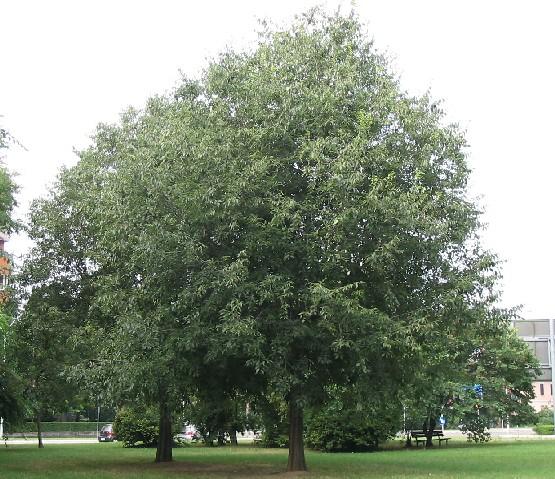
Photo: Photo by user:Fraxinus, CC BY-SA 3.0 · source

Tree · Cannabaceae
European nettle tree
Celtis australis
In other languages: Europese netelboom (Nederlands) · Micocoulier de Provence (Français)
European nettle tree comes from the Mediterranean region, from southern Europe to North Africa and western Asia. It is a tough, broad deciduous tree with a smooth grey trunk, a rounded crown and long-pointed, rough leaves that turn yellow in autumn. It is related to the elms but now belongs to the hemp family. In autumn the small round fruits ripen from green to dark purple and brown. They are edible and sweet, and birds love them. The tree is very drought-tolerant, which makes it suitable for town gardens and sunny spots.
Light
Full sun
warm and bright
Moisture
Dry to normal
no wet feet
Legal basis
Sand, loam or clay
neutral to chalky
Hardiness
Fully hardy
down to -20 °C
Size
15 m
tall, 12 m wide
Flowering
April–May
| Pruning months | February |
|---|---|
| Height | 15 m |
| Native to Belgium | No, planted |
| Good for bees, butterflies and birds | Yes, for birds |
| Poisonous to people and pets | Not known to be poisonous |
| Flowering | April–May |
Identify
European nettle tree: how do you recognise it?
- Habit
- Broad, rounded crown on a straight trunk; about 15 m tall and 12 m wide.
- Leaves
- Oval to lance-shaped, long-pointed, 6–15 cm, toothed edge, rough above; dark green, yellow in autumn.
- Flowers
- Small greenish flowers in April–May; not showy.
- Fruit
- Round drupes about 1 cm across; they ripen in autumn from green to dark purple and brown.
- Trunk
- Smooth and grey, lightly furrowed on old trees.
Flowering: April–May · Harvest and fruit: October–November · Plants: March–April and October–December · Pruning: February
In your garden
Why grow it?
- Very drought-tolerant and tough: a good choice for dry, sunny and warm spots.
- Large, rounded crown that gives plenty of shade in summer.
- Sweet, edible fruits that attract birds.
- Smooth grey trunk, reminiscent of a beech.
- Tolerates most soils, including chalky ones, and urban conditions.
European nettle tree: where does it grow best?
- Full sun; it grows best in a warm, bright spot.
- Well-drained soil: sand, loam or clay, neutral to chalky.
- Dry to normally moist; it tolerates drought but not permanently wet soil.
- Allow for a crown up to 12 m wide and plant at least 8 m from buildings and pipes.
- Light
- Sun
- Soil type
- Sand, loam or clay
- Acidity
- Neutral or chalky
- Moisture
- Dry or normal
- Size
- 15 m tall, 12 m wide
- Hardiness
- Hardy (to -20 °C)
Goes well with
- Lavender: Likes the same sunny, dry spot and adds scent.
- Rosemary: An evergreen, aromatic shrub for a warm, dry position.
- Rock rose: Flowers freely on poor, dry soil in the sun.
- Sage: An aromatic herb that tolerates sun and drought.
- Ornamental grasses: A light, swaying foreground under the broad crown.
Maintenance
European nettle tree: when and how to plant it?
Plant in March–April and October–December.
- Plant in March–April or from October to December, when the soil is neither frozen nor waterlogged.
- Dig a hole twice as wide as the root ball and just as deep.
- Set the tree at the same depth as in its pot or at the nursery and backfill with the soil you dug out.
- Add a stake and tie the trunk loosely with a tree tie; remove the stake after 2–3 years.
- Water generously straight away and spread a 5–8 cm layer of wood chips or bark mulch around the base.
Care
- Water
- In the first two summers, water thoroughly every week in dry spells. After that it is very drought-tolerant and looks after itself.
- Feeding
- Usually unnecessary. On poor soil, apply a layer of compost in spring.
- Mulching
- A mulch keeps the soil moist and suppresses weeds, especially around young trees.
- Staking
- Tie a young tree to a stake for 2–3 years and check the tie every year.
- Fruit
- Fallen fruit can get sticky on a terrace or path; sweep it up in autumn.
Tip: Put it in a warm, sunny spot with well-drained soil. In a cold, wet spot it grows poorly and young wood may freeze.
European nettle tree: when to prune it?
Pruning months: February.
When: It needs little pruning; if needed, in winter, in February, when it is bare.
How:
- Remove dead, damaged and crossing branches.
- Cut small branches just outside the branch collar, never flush with the trunk.
- On a young tree, remove competing leaders and keep a single main leader.
- It also tolerates hard pruning and is traditionally pollarded in southern Europe.
Propagation
- Seed
- Sow the seed outdoors in autumn in a tray of light soil, or after cold stratification in spring. It may lie dormant for a year before germinating.
- Nursery
- Seedlings grow slowly at first. For a handsome tree quickly, buy a young tree from a nursery.
European nettle tree: how does it get through the winter?
Hardy to −20 °C.
- Hardy to about −20 °C: in Belgium it is usually hardy, especially in a warm, sheltered spot.
- Young trees may freeze at the tip or dry out in cold wind in hard winters; give them a layer of mulch.
- In a cold, windy spot or a frost pocket, young wood may be cut back by frost.
Diseases and pests
- Frosted young shoots: Late spring frosts or hard winters can turn young twigs brown. Cut away the dead wood in spring.
- Aphids and honeydew: Sticky leaves and sooty mould in summer. Ladybirds and tits usually clear them up.
- Wet feet: Yellowing leaves and root rot on heavy, wet soil. Plant in well-drained soil.
- Powdery mildew: White powder on the leaves, mostly at the end of summer. Usually harmless.
Through the year
- February: Prune if needed. Remove dead branches.
- March: Plant. Apply mulch.
- April: Plant. The small flowers open.
- May: Leaves fully out. Water young trees in dry weather.
- June: Water young trees in dry weather.
- July: Water young trees during prolonged drought.
- September: Fruit begins to colour.
- October: Pick ripe fruit. Yellow autumn colour. Plant.
- November: Plant. Leave the leaves as mulch.
- December: Rest. Plant while the soil is open.
Use
Edible and useful
- Fruit (October–November)
- The European nettle tree is a large tree of around 15 m: only suitable for a large garden, a park or a wide street. In October and November its round fruits of about 1 cm ripen from green to dark purple and then brown; they hang on the tree for a long time and then shrivel like small raisins. Pick them when they are dark and slightly soft. Around a large, hard stone is a thin layer of sweet, slightly mealy flesh. Nibble them fresh and spit out the stone, or cook them into a cordial. Leave plenty on the tree for the birds, which love them.
- Storing
- Fresh fruits keep for a week in the fridge. Spread out on a rack, they dry in a few weeks into little raisins that keep for months in a closed jar; the stone stays inside.
Caution: Do not bite on the stone: it is large and rock-hard and can break a tooth. Do not give the fruits to young children: they could choke on the stone. Do not pick from trees along busy roads, and throw away mouldy fruits. If you are not sure you recognise the tree, eat nothing: other small dark berries, such as those of privet or alder buckthorn, are poisonous or laxative.
Eating and using is at your own risk: see the terms of use.
Recipes
- Nettle tree cordial (Syrup · ± 400 ml · 1 hr)
Good for wildlife
- Birds
- Berries, seeds or insects as food, or a place to nest.
You and this species
Did you know?
- The tree used to sit in the elm family but is now classed in the hemp family.
- In southern Europe the tough, flexible wood is used for things like tool handles, whips and pitchforks.
- It is also known as the ‘lotus tree’.