Photo: Wikimedia Commons, CC BY-SA 3.0 · source

Perennial · Onagraceae
Rosebay willowherb
Chamaenerion angustifolium
In other languages: Wilgenroosje (Nederlands) · Épilobe en épi (Français)
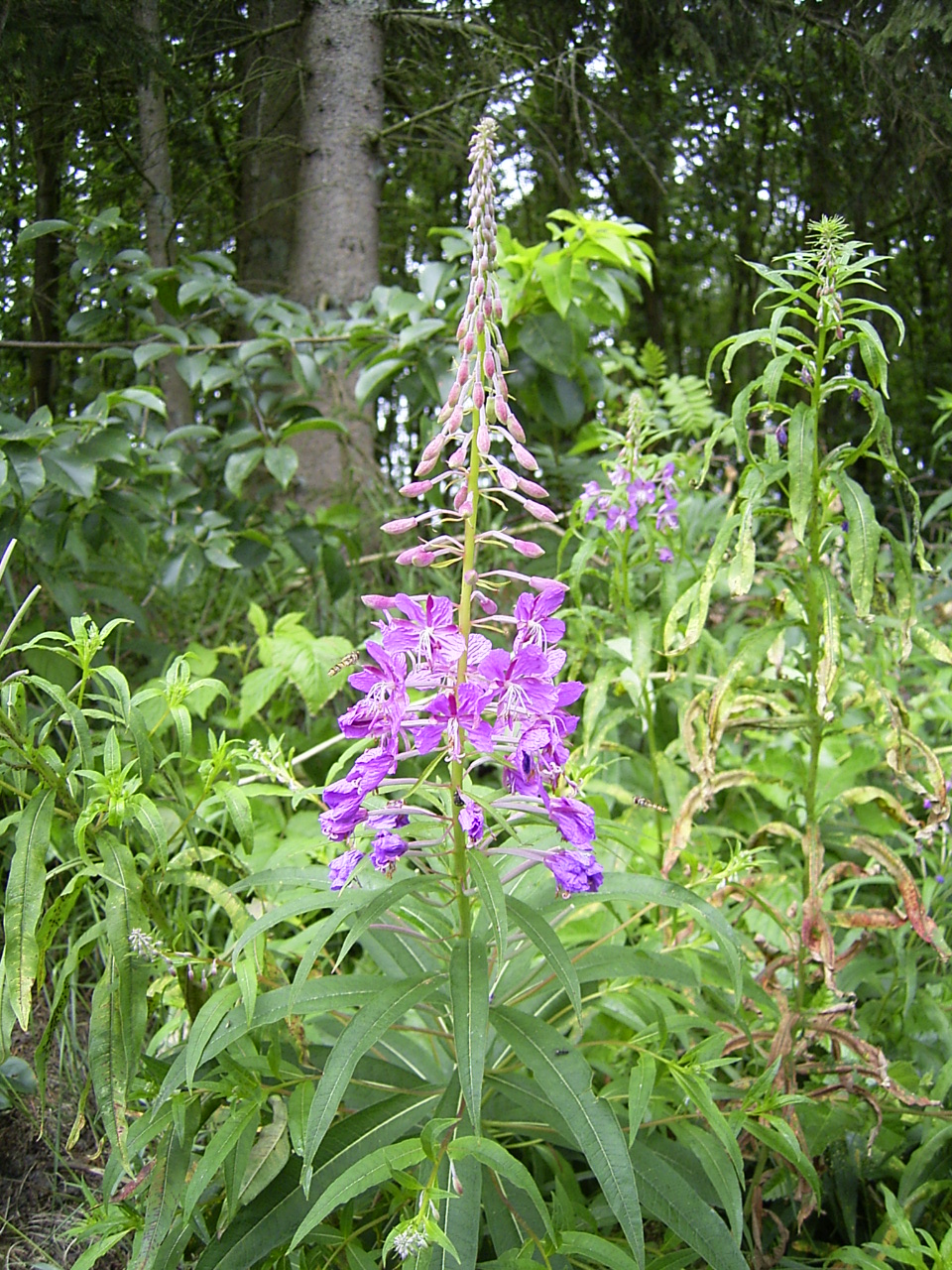
Rosebay willowherb is a tall, native perennial found naturally throughout Europe, Asia and North America. It is a true pioneer of open ground: clearings, woodland edges, railway banks and burnt land, where it quickly forms large stands with its rhizomes and fluffy seeds. Straight stems 1–1.5 m tall carry narrow, willow-like leaves and, from June to August, long, tapering spikes of vivid magenta-pink flowers. Bees and bumblebees find plenty of nectar, and the caterpillars of the elephant hawk-moth feed on the leaves. Because the species spreads so strongly, gardeners often choose the white form ‘Album’, which self-seeds less.
Caution: It spreads strongly by creeping rhizomes and by fluffy seeds that blow a long way. In a small garden it crowds out other plants and also turns up next door. Plant it behind a root barrier or only in a large wildlife garden, cut off the spikes before the seed turns fluffy, and never dump rhizomes in the countryside, on a verge or in woodland.
Light
Sun or partial shade
preferably some sun
Moisture
Normal to wet
must not dry out
Legal basis
Sand or loam
acid to neutral
Hardiness
Fully hardy
down to -40 °C
Size
1.5 m
tall, 1 m wide
Flowering
June–August
| Pruning months | March and August |
|---|---|
| Height | 1.5 m |
| Native to Belgium | Yes |
| Good for bees, butterflies and birds | Yes, for bees and butterflies |
| Poisonous to people and pets | Not known to be poisonous |
| Flowering | June–August |
Identify
Rosebay willowherb: how do you recognise it?
- Habit
- Straight, usually unbranched stems 1–1.5 m tall that spread by rhizomes into stands a metre or more across.
- Leaves
- Narrow and lance-shaped, 5–15 cm, willow-like, arranged in a spiral around the stem; the side veins join in loops just inside the edge.
- Flower
- Four magenta-pink petals, 2–3 cm across, in long, tapering spikes that open from the bottom upwards, from June to August. Pure white in ‘Album’.
- Fruit
- Long, narrow capsules that split open and release large numbers of seeds with white, silky hairs.
- Roots
- Creeping rhizomes that run far underground and send up new shoots everywhere.
Flowering: June–August · Harvest and fruit: April–August · Plants: March–April and September–October · Pruning: March and August
In your garden
Why grow it?
- Spectacular long spikes in magenta-pink or white from June to August.
- An excellent nectar plant for honeybees, bumblebees and butterflies.
- Food plant for the caterpillars of the elephant hawk-moth, a striking pink moth.
- Fully hardy and very easy, even on poor, acid, sandy soil.
- The white form ‘Album’ is an elegant, calmer garden plant for the back of the border.
Rosebay willowherb: where does it grow best?
- Sun to partial shade; it flowers most freely in sun.
- Sandy or loamy soil, acid to neutral. It also grows on poor, disturbed ground.
- Normally moist to wet soil; it also tolerates a spell of drought.
- Give it plenty of room in a large wildlife garden, or plant it in a large bottomless container or behind a root barrier.
- Allow at least 1 m of space per plant.
- Light
- Sun and partial shade
- Soil type
- Sand or loam
- Acidity
- Acid or neutral
- Moisture
- Normal or wet
- Size
- 1.5 m tall, 1 m wide
- Hardiness
- Hardy (to -40 °C)
Goes well with
- Hemp agrimony: Pink flat heads in the same summer, another butterfly plant for the wildlife garden.
- Foxglove: Flowers a little earlier on the same woodland edge and the same acid soil.
- Purple loosestrife: Purple spikes on wet soil, lovely with the magenta.
- Purple moor-grass: A fine, tall grass for moist, acid soil that loosens up the group.
Maintenance
Rosebay willowherb: when and how to plant it?
Plant in March–April and September–October.
- Plant in March–April or in September–October.
- First choose a spot where it may spread, or sink a root barrier 30–40 cm deep around the planting site.
- Dig a hole slightly larger than the pot and set the plant at the same depth as in the pot. No fertiliser or compost is needed.
- Leave at least 1 m between plants and keep it away from smaller, less vigorous border plants.
- Firm in and water well. Water in dry spells during the first year.
Care
- Water
- Only in the first year during dry spells. After that it looks after itself.
- Feeding
- Not needed. On rich soil it grows even more strongly and flops more easily.
- Spent flowers
- Cut off the spikes as soon as they have finished, before the capsules split and the seed blows away.
- Runners
- Every spring, pull out shoots that appear outside the intended spot, with as much rhizome as possible.
- Support
- In a windy spot or on rich soil the tall stems can fall over; plant it among other tall plants.
Tip: In an ordinary garden, choose the white form ‘Album’, which self-seeds less, and cut off the spikes before the seed turns fluffy. The wild species belongs in a large wildlife garden.
Rosebay willowherb: when to prune it?
Pruning months: March and August.
When: In August cut off the spent spikes, and in late February–March cut the old stems down to the ground.
How:
- In August, cut off the flower spikes as soon as the top flowers fade, before the seeds turn fluffy.
- Leave the leafy stems standing; they feed the rhizome for next year.
- In March, cut all old stems down to just above the ground.
- In spring, pull out runners outside the planting area.
Caution: Do not wait for the fluff to appear: a single plant can scatter thousands of seeds across the whole neighbourhood.
Propagation
- Division
- In March–April: cut off a piece of the stand with rhizomes and shoots and replant it elsewhere. This is also how to propagate ‘Album’.
- Root cuttings
- In February–March: cut 5 cm pieces of rhizome and lay them flat in a pot of cutting compost, 1–2 cm deep. Keep moist; they sprout in spring.
Rosebay willowherb: how does it get through the winter?
Hardy to −40 °C.
- Extremely hardy, to about −40 °C: no protection is needed in Belgium.
- The stems die back above ground; the rhizomes overwinter in the soil.
- If you cut off the seed fluff in time, leave the old stems until March: hollow stems shelter insects.
Diseases and pests
- Spreading: Rhizomes pop up metres away. Use a root barrier or a bottomless container and pull out runners every spring.
- Self-seeding: The fluffy seeds blow far and germinate on any bare patch. Cut off the spikes after flowering or choose ‘Album’.
- Powdery mildew: White powder on the leaves in dry late summers. Harmless; cut off affected stems after flowering.
- Elephant hawk-moth caterpillars: Large brown caterpillars with eye spots that eat the leaves. Leave them: they become beautiful pink moths and the plant recovers.
Through the year
- March: Cut off old stems. Plant, divide or put in a root barrier.
- April: Pull out runners outside the planting area.
- June: Flowering starts. Bees and bumblebees on the spikes.
- July: Full flower. Look out for elephant hawk-moth caterpillars.
- August: Cut off spent spikes before the seed turns fluffy.
- September: Plant or divide.
- October: Plant. Remove the last runners.
- December: Rest. Leave the old stems standing.
Use
Edible and useful
- Flowers (June–August)
- From June to August you can pick the open flowers from the spikes. They taste mild and slightly sweet: scatter them over a salad or a dessert. Cut off the spikes before the seed turns fluffy, or the plant will seed itself everywhere.
- Leaves (May–July)
- From May to July, pick the young, unblemished leaves from the upper half of the stems, before or at the start of flowering. Fresh, they make a mild, slightly grassy tea; fermented and dried, as in Russia, they make a dark, smooth tea with a fruity scent that is a little reminiscent of black tea but contains no caffeine. Older leaves are tough and bitter.
- Young shoots (April–May)
- In April and May, pick the young shoots when they are 10 to 20 cm tall: snap them off where they break easily. They taste mild, a little like asparagus or young spinach, and are boiled or wilted briefly. Taller and older, they soon become tough and bitter. Pick plenty: that way you keep this spreading plant in check at the same time.
- Storing
- Young shoots and flowers are used fresh: they keep for a day or two in the fridge. Keep dried or fermented leaves in a closed jar, dry and dark, for up to a year.
- Fermenting
- The leaves make Ivan chai: let them wilt, roll them between your hands until the juice comes out and leave them to ferment for a day before drying them. That way they turn dark and fragrant, like black tea.
Caution: Only pick from plants you recognise with certainty: in spring, the young shoots of many plants look alike, so pick them where you saw the plant flowering the year before. Do not pick along roads or on sprayed ground. Drink the tea in moderation, a cup now and then: little is known about large amounts. Throw away fermented leaves if they go mouldy or smell musty or rotten. Rosebay willowherb spreads by rhizomes and fluffy seed: never dump rhizomes or seeding spikes in the countryside.
Eating and using is at your own risk: see the terms of use.
Recipes
- Young willowherb shoots with butter (Dish · 2 people (as a side dish) · 15 min)
- Fermented willowherb tea (Ivan chai) (Tea · ± 60 g tea · 1 hr work + 2 to 3 days)
Good for wildlife
- Bees
- Nectar and pollen for honeybees and wild bees.
- Butterflies
- Nectar for butterflies.
You and this species
Did you know?
- In English it is also called fireweed, because it is one of the first plants to colour blackened ground after a forest fire. After the Second World War it grew in masses on the bomb sites of London.
- In Russia a tea has been made from the fermented leaves for centuries, known as ivan-chai.
- The flowers release their pollen first and only later is the stigma ripe. In this way the plant prevents a flower from pollinating itself.