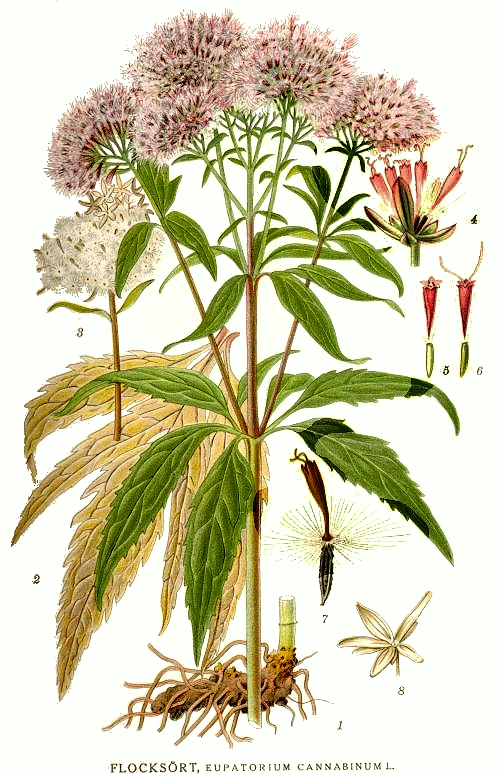
Photo: Carl Axel Magnus Lindman, Public domain · source

Perennial · Asteraceae
Hemp agrimony
Eupatorium cannabinum
In other languages: Koninginnekruid (Nederlands) · Eupatoire chanvrine (Français)
Hemp agrimony is a sturdy native perennial from the daisy family that grows throughout Europe along streams, ditches and woodland edges and in marshes. It forms dense clumps of often reddish stems up to 1.5 m tall, with leaves divided into three to five narrow segments that recall hemp. From July to September the stems carry broad, flat clusters of small, dusky pink flower heads. Gardeners grow it as a butterfly magnet: on a sunny late-summer day it is visited by peacocks, red admirals and other butterflies. There is a white form, ‘Album’, and a double form, ‘Flore Pleno’, which sets hardly any seed.
Caution: Poisonous: all parts contain pyrrolizidine alkaloids, which damage the liver if eaten. Grazing animals such as horses, cattle and sheep are most at risk, especially if the plant ends up in hay. Do not plant it next to a paddock, keep children and pets away from it and never eat it.
Light
Sun or partial shade
preferably some sun
Moisture
Normal to wet
must not dry out
Legal basis
Loam, clay or peat
any pH
Hardiness
Fully hardy
down to -35 °C
Size
1.5 m
tall, 0.8 m wide
Flowering
July–September
| Pruning months | March, May and September |
|---|---|
| Height | 1.5 m |
| Native to Belgium | Yes |
| Good for bees, butterflies and birds | Yes, for bees and butterflies |
| Poisonous to people and pets | Yes, take care with children and pets |
| Flowering | July–September |
Identify
Hemp agrimony: how do you recognise it?
- Habit
- Dense clump of upright, often reddish stems, 1–1.5 m tall and about 80 cm across.
- Leaves
- Opposite, divided into three to five lance-shaped, toothed segments, like hemp; slightly hairy.
- Flower
- Small, dusky pink to lilac flower heads in broad, flat to domed clusters, from July to September.
- Seed
- Small nutlets with a white tuft that are carried by the wind; this is why it self-seeds so easily.
- Roots
- Short, woody rootstock; the clump slowly widens.
Flowering: July–September · Plants: March–April and September–October · Pruning: March, May and September
In your garden
Why grow it?
- One of the best native butterfly plants for late summer.
- Bees, bumblebees and hoverflies also find plenty of nectar.
- Long flowering from July to September, when many other wild flowers are over.
- It grows where many plants struggle: wet soil, pond edges and partial shade.
- Tall and sturdy: a fine backdrop for a natural border or waterside planting.
- The faded stems give insects shelter in winter.
Hemp agrimony: where does it grow best?
- Sun or partial shade; it flowers best and draws most butterflies in sun.
- Moist to wet, fertile soil: loam, clay or peat. Acid, neutral and chalky are all fine.
- Ideal beside a pond or ditch or in a damp corner; in an ordinary border it does well if the soil does not dry out.
- It grows tall and wide: put it at the back and leave 60–80 cm between plants.
- Light
- Sun and partial shade
- Soil type
- Loam, clay or peat
- Acidity
- Not fussy
- Moisture
- Normal or wet
- Size
- 1.5 m tall, 0.8 m wide
- Hardiness
- Hardy (to -35 °C)
Goes well with
- Purple loosestrife: Purple spikes in the same wet soil and in the same months.
- Meadowsweet: Creamy, scented plumes in the same damp spot, a little earlier in summer.
- Yellow loosestrife: Yellow flowers next to the pink, also native and good for bees.
- Wild angelica: Large white umbels in late summer, also a magnet for insects.
- Common valerian: Pinkish-white, scented heads in June–July, before the hemp agrimony flowers.
Maintenance
Hemp agrimony: when and how to plant it?
Plant in March–April and September–October.
- Plant in March–April or in September–October.
- Dig a hole twice as wide as the root ball and mix in some compost, unless the soil is already rich.
- Plant at the same depth as in the pot and firm the soil well.
- Leave 60–80 cm between plants.
- Give a good can of water straight away and keep the soil moist for the first few weeks.
- A layer of leaf mould around the base keeps the soil cool and moist.
Care
- Water
- Not needed in a wet spot; in a border, water during long dry spells.
- Feeding
- Usually not needed; on poor soil, a little compost in spring.
- Deadheading
- Cut off the flower clusters in September, before the seed ripens, if you do not want seedlings.
- Support
- In a windy spot or rich soil the stems may flop; cutting back in late May makes the plant sturdier.
- Dividing
- Dividing every 3–4 years keeps the clump young and compact.
Tip: If you do not want seedlings all over the garden, cut off the flower clusters in September as soon as they fade: by then the butterflies will have had their fill.
Hemp agrimony: when to prune it?
Pruning months: March, May and September.
When: Cut the dead stems down in March, just before new growth starts. In September, remove the faded clusters if you do not want seedlings; in late May you can shorten the stems for a lower plant.
How:
- In March, cut all old stems down to about 10 cm above the ground.
- Leave the stems standing all winter: insects shelter in them and they look lovely with frost.
- In late May you can cut the stems back by a third: the plant stays lower, branches more and flowers a little later.
- In September, cut off the faded flower clusters before the fluffy seed appears.
Caution: Do not throw the clippings into a field with grazing animals or near hay: even dried plant parts are poisonous.
Propagation
- Division
- In March–April or in October, lift the clump and cut it into pieces with a spade, each with a few buds. Replant straight away and water in.
- Seed
- It self-seeds: move the seedlings in spring. You can also sow fresh seed in a pot in autumn and leave it outside.
- Cuttings
- In April–May, take cuttings of young shoots 8–10 cm long and insert them in moist cutting compost under plastic, in good light but out of direct sun.
Hemp agrimony: how does it get through the winter?
Hardy to −35 °C.
- Very hardy, to about −35 °C: no protection needed.
- The top growth dies back in autumn; the rootstock regrows in spring.
- Leave the stems until March as winter shelter for insects.
- In a large pot it stays hardy; in severe frost, stand the pot against a wall and do not let it dry out.
Diseases and pests
- Seedlings everywhere: It self-seeds freely. Cut off the flower clusters after flowering or choose the double form ‘Flore Pleno’.
- Flopping: Tall stems fall over after wind or rain. Cut back by a third in late May or give support.
- Aphids: On the shoot tips in spring. Ladybirds usually deal with them; otherwise hose them off.
- Powdery mildew: White powder on the leaves at the end of a dry summer. Water during drought and cut off affected leaves.
- Limp leaves: Drooping leaves in a spot that is too dry. Water, or move the plant somewhere moister.
Through the year
- March: Cut old stems down to 10 cm. Plant or divide.
- April: Plant. New shoots appear. Take cuttings.
- May: In late May, shorten by a third if you like.
- July: First flowers. Butterflies on the blooms.
- August: Full flower. Water during dry spells.
- September: Last flowers. Cut off faded clusters before the seed ripens.
- October: Plant or divide.
- December: Resting. Leave the stems as winter shelter.
Use
Edible and useful
Not edible. These plants contain pyrrolizidine alkaloids, like the common ragwort along the roadsides: they damage the liver, even in small amounts taken in over a long time, and the damage is permanent. Horses and cattle are the most sensitive, also to dried plants in hay or silage, because they can no longer taste them: do not plant them in or beside a field, never throw mowings or trimmings near the feed, and do not cut them with grass for hay. Never make teas or herbal remedies from them, not even from hemp agrimony, which was once a medicinal herb. Keep children, dogs and cats away from the plant and wear gloves when cutting back. If any is swallowed, call a poison centre (in Belgium 070 245 245) or your doctor at once.
Good for wildlife
- Bees
- Nectar and pollen for honeybees and wild bees.
- Butterflies
- Nectar for butterflies.
You and this species
Did you know?
- The species name cannabinum refers to the leaves, which look like those of hemp; the two plants are not related.
- The genus name Eupatorium is said to honour Mithridates VI Eupator, king of Pontus.
- Hemp agrimony is a favourite nectar plant of the Jersey tiger, a striking day-flying moth with black-and-white forewings and red hindwings.