Photo: Wikimedia Commons, CC BY-SA 3.0 · source

Annual · Onagraceae
Godetia
Clarkia amoena
In other languages: Atlasbloem (Nederlands) · Godétia (Français)
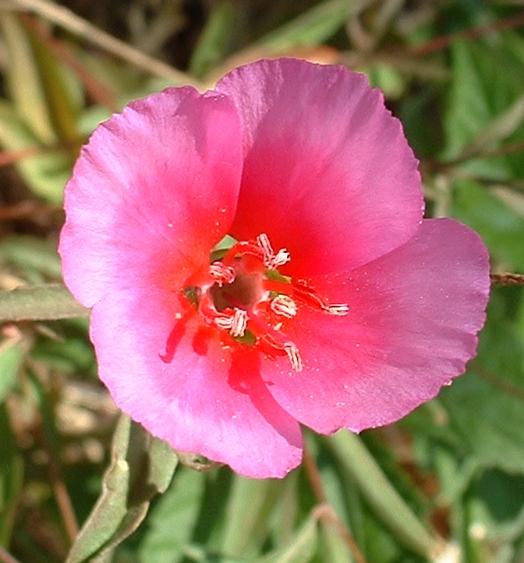
Godetia, Clarkia amoena, is an annual from western North America, from California to British Columbia. From June to September, upright stems of 30–50 cm carry satiny, cup-shaped flowers in pink, salmon, lilac, red or white, often with a dark blotch or a paler centre on each petal. The flowers are held in short spikes and open one after another, so flowering goes on for weeks. Gardeners love it because it is easy to sow where it is to flower, blooms freely on poor soil and lasts well in the vase. There are low varieties for the front of the border and taller, long-stemmed ones for cutting, some with double flowers.
Light
Sun or partial shade
preferably some sun
Moisture
Normal
no wet feet
Legal basis
Sand or loam
acid to neutral
Hardiness
down to -5 °C
protect in harsh winters
Size
0.5 m
tall, 0.3 m wide
Flowering
June–September
| Height | 0.5 m |
|---|---|
| Native to Belgium | No, planted |
| Good for bees, butterflies and birds | Yes, for bees |
| Poisonous to people and pets | Not known to be poisonous |
| Flowering | June–September |
Identify
Godetia: how do you recognise it?
- Habit
- Upright to slightly branching annual, 30–50 cm tall and 25–30 cm wide.
- Leaves
- Narrow and lance-shaped, fresh green, spaced along the stem.
- Flower
- Cup- to funnel-shaped, about 5 cm across, with four satiny petals, often with a dark blotch or a pale centre. Single or double.
- Inflorescence
- Short spikes at the stem tips, opening from the bottom upwards.
- Fruit
- Narrow capsules with plenty of fine seed, ripe in late summer.
Flowering: June–September · Sowing: March–May
In your garden
Why grow it?
- An abundance of satiny flowers from June into September.
- A fine cut flower: the buds keep opening in the vase.
- Bees visit the flowers.
- Easy: sow directly, and poor soil actually gives the most flowers.
- Ideal for quickly filling gaps in a border, a pot or a window box with colour.
Godetia: where does it grow best?
- Sun to light partial shade; in full sun it flowers most freely, but for a shorter time in great heat.
- Light, free-draining soil: sand or loam, slightly acid to neutral.
- Moderately moist: not parched, but never waterlogged. Poor soil gives the most flowers.
- Thin to 20 cm between plants.
- Light
- Sun and partial shade
- Soil type
- Sand or loam
- Acidity
- Acid or neutral
- Moisture
- Normal
- Size
- 0.5 m tall, 0.3 m wide
- Hardiness
- Tolerates light frost (to -5 °C)
Goes well with
- Love-in-a-mist: Airy blue flowers that bloom at the same time and are also sown in place.
- California poppy: Orange flowers that, like godetia, come from California.
- Cornflower: Bright blue next to the pink, and just as easy to sow in place.
- Cosmos: A taller annual as an airy backdrop.
Maintenance
Godetia: when and how to plant it?
- Sow in place from March to May; sowing in several batches gives a longer flowering season.
- Prepare a fine, weed-free seedbed without fertiliser.
- Sow the fine seed thinly in rows or small groups and cover with a very thin layer of soil.
- Keep the soil moist until the seedlings appear, usually after one to two weeks.
- Thin to 20 cm so the plants get space and air.
- Avoid transplanting: young plants dislike having their roots disturbed.
Care
- Water
- Water in dry spells, preferably in the morning at the base; keep the soil slightly moist but not wet.
- Feeding
- Not needed: fertiliser gives lots of leaves and few flowers.
- Support
- Support tall varieties with a few twiggy sticks or let neighbouring plants help, so they do not flop after rain.
- Deadheading
- Cut off faded spikes to prolong flowering.
- Cutting
- Cut a stem when the first flower is open and strip the lower leaves. The other buds will still open in the vase.
Tip: Sow in two or three batches, from March to May, a few weeks apart: you will have flowers for the garden and the vase from June into September.
Godetia: when to prune it?
When: Godetia is not pruned. As an annual, it is cleared away after flowering.
How:
- Cut off faded flower spikes to prolong flowering.
- At the end of summer, leave a few spikes if you want to collect seed.
- Pull up the plants after flowering or after the first frost and put them on the compost heap.
Propagation
- Seed
- In August–September, let a few capsules ripen until brown, shake out the seed and store it dry. Sow it in place in spring. Colours may differ from the parent plant.
Godetia: how does it get through the winter?
Hardy to −5 °C: protect in harsh winters.
- Annual: the plant dies after flowering and does not overwinter.
- In spring, young seedlings tolerate light night frosts down to about −5 °C, so you can sow as early as March.
- Store collected seed cool and dry until spring.
Diseases and pests
- Aphids: On shoot tips and buds. Hose them off with water or let ladybirds do the work.
- Root rot: Plants wilt and turn brown at the base on wet, heavy soil. Sow in a free-draining spot and do not overwater.
- Flopping: Tall plants fall over after rain. Give some support and thin in good time.
- Few flowers: Rich soil or too much fertiliser gives mainly leaves. Sow on poor soil and do not feed.
Through the year
- March: Sow in place in a fine seedbed.
- April: Sow. Thin the first sowings to 20 cm.
- May: Last sowings. Thin and weed.
- June: Flowering begins. Support tall varieties.
- July: Full flower. Cut flowers for the vase. Water in dry weather.
- August: Flowering. Remove faded spikes.
- September: Last flowers. Collect seed.
- October: Clear the plants and compost them.
Use
Good for wildlife
- Bees
- Nectar and pollen for honeybees and wild bees.
You and this species
Did you know?
- The genus Clarkia is named after William Clark, who with Meriwether Lewis led a famous expedition across western North America from 1804 to 1806.
- In its homeland it flowers at the end of spring, as the hills dry out; that is why it is also called farewell-to-spring.
- The old name godetia, still widely used in the trade, honours the Swiss botanist Charles Godet.