Photo: Artslave, CC BY 2.0 · source

Annual · Papaveraceae
California poppy
Eschscholzia californica
In other languages: Slaapmutsje (Nederlands) · Pavot de Californie (Français)
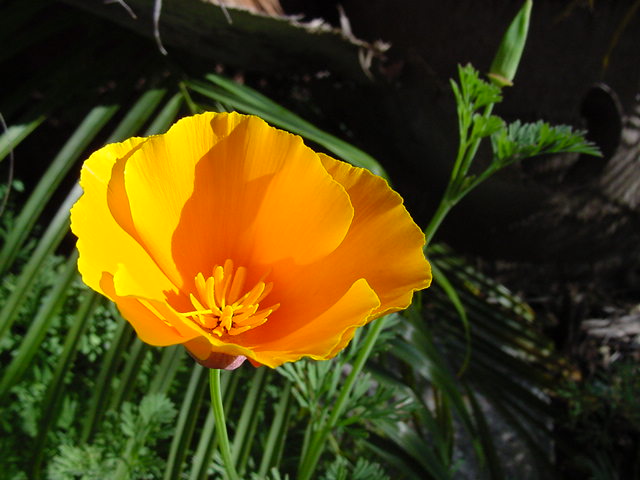
The California poppy comes from western North America, mainly California, where it is the official state flower. It is a low, loose plant with finely divided, blue-grey leaves and silky, cup-shaped flowers from June to September. The wild form is bright orange, but there are also seed mixes in yellow, cream, pink and red, sometimes with frilled or semi-double flowers. The bud wears a pointed little cap that falls off as the flower opens, and the flowers close in the evening and in cloudy weather. Gardeners love it because it is happy in dry, poor soil and self-seeds every year.
Light
Full sun
warm and bright
Moisture
Dry
tolerates drought
Legal basis
Sand or loam
any pH
Hardiness
down to -5 °C
protect in harsh winters
Size
0.3 m
tall, 0.3 m wide
Flowering
June–September
| Pruning months | July |
|---|---|
| Height | 0.3 m |
| Native to Belgium | No, planted |
| Good for bees, butterflies and birds | Yes, for bees |
| Poisonous to people and pets | Not known to be poisonous |
| Flowering | June–September |
Identify
California poppy: how do you recognise it?
- Habit
- Low, loose, somewhat spreading plant 20–30 cm tall and about 30 cm wide.
- Leaves
- Finely divided and ferny, blue-grey.
- Flower
- Four silky petals forming an open cup 5–7 cm across; they close in the evening and in dull weather.
- Colour
- Bright orange with a darker centre in the wild; selections in yellow, cream, pink, red and salmon.
- Fruit
- Long, narrow, ribbed seed pods up to 8 cm that split open when ripe and fling out the seed.
- Roots
- A long taproot: transplanting almost never works.
Flowering: June–September · Sowing: March–May and September · Pruning: July
In your garden
Why grow it?
- Flowers from June to September in the driest, poorest spots.
- Drought-tolerant: once established it hardly needs any water.
- Bees come for its plentiful pollen.
- Self-seeds every year: sow once and enjoy it for years.
- The fine, blue-grey foliage is attractive even without flowers.
- Ideal in a gravel garden, between paving or along a sunny edge.
California poppy: where does it grow best?
- Full sun: in shade the flowers stay closed.
- Poor, free-draining sandy or loamy soil, acid to chalky. In rich soil it grows lushly but flowers less.
- Dry: it dislikes wet feet.
- Thin to 20–30 cm between plants.
- Light
- Sun
- Soil type
- Sand or loam
- Acidity
- Not fussy
- Moisture
- Dry
- Size
- 0.3 m tall, 0.3 m wide
- Hardiness
- Tolerates light frost (to -5 °C)
Goes well with
- Cornflower: Blue next to orange, in the same poor, sunny spot.
- Feather grass: Airy stems among the orange flowers in a gravel garden.
- Catmint: A blue haze that goes beautifully with orange.
- Lavender: Grey leaves and purple spikes, also drought-tolerant.
Maintenance
California poppy: when and how to plant it?
- Sow where it is to flower in March–May or in September; autumn sowings flower earlier the following year.
- Rake the soil loose and fine, without manure or compost.
- Scatter the seed thinly and rake it in very lightly, or cover it with a thin layer of sand.
- Press down lightly and keep the seedbed moist until the seedlings appear, after one to three weeks.
- Thin the seedlings to 20–30 cm apart: they cannot be moved because of the taproot.
- After that, extra watering is rarely needed.
Care
- Water
- Only during germination and in an exceptionally dry spell.
- Feeding
- Not needed: feeding gives lots of leaves and fewer flowers.
- Spent flowers
- Remove faded flowers and green seed pods for longer flowering; leave a few at the end of the season for seed.
- Cutting back
- Shortening a sprawling plant by a third in July gives a new flush of flowers.
- Self-seeding
- It self-seeds readily; pull out seedlings in unwanted places while they are young.
Tip: Sow where it is to flower in a sunny, poor spot and never transplant it: the taproot will not tolerate it. Let a few seed pods ripen and it will come back by itself every year.
California poppy: when to prune it?
Pruning months: July.
When: Pruning is hardly needed. In July you can cut sprawling plants back by a third for a new flush of flowers.
How:
- Cut the stems back by about a third with scissors.
- Water afterwards if needed; a few weeks later it flowers again.
- In between, remove faded flowers and green seed pods.
- In September, let a few pods ripen if you want it to self-seed.
Propagation
- Seed
- Let seed pods ripen until they are brown and dry, collect them before they split and sow straight away where they are to flower, in September or in spring.
- Self-seeding
- Simply leave seedlings that come up in a good spot; they will flower the following year.
California poppy: how does it get through the winter?
Hardy to −5 °C: protect in harsh winters.
- Usually grown as an annual. Young plants from an autumn sowing tolerate frost down to about −5 °C.
- In a mild winter and on dry soil, a plant sometimes survives and flowers again the next year.
- Wet winters are a greater danger than cold: sow in a free-draining spot.
Diseases and pests
- Rot: Plants turn yellow and collapse on wet, heavy soil. Sow in a drier, free-draining spot.
- Aphids: On buds and stems. Spray them off with water.
- Slugs: They eat the seedlings. Protect young sowings and pick slugs off in the evening.
- Closed flowers: Normal in the evening and in cloudy weather. If they stay closed in fine weather too, the spot is too shady: sow somewhere sunnier.
- Powdery mildew: White powder on the leaves in late summer. Not very harmful; cut back affected stems.
Through the year
- March: Sow outdoors in a sunny, poor spot.
- April: Sow. Thin out.
- May: Last sowing. Thin to 20–30 cm.
- June: First flowers. Remove faded flowers.
- July: Full flower. Cut sprawling plants back by a third.
- August: Flowering. Remove seed pods or let them ripen.
- September: Last flowers. Collect seed and sow outdoors for next year.
- October: Clear the plants away, or leave them to self-seed.
Use
Good for wildlife
- Bees
- Nectar and pollen for honeybees and wild bees.
You and this species
Did you know?
- It has been the official state flower of California since 1903.
- The genus is named after Johann Friedrich von Eschscholtz, a Baltic German physician and naturalist who visited California with a Russian expedition in the early nineteenth century.
- In warm weather the ripe seed pods split open, sometimes audibly, and fling the seed some distance.