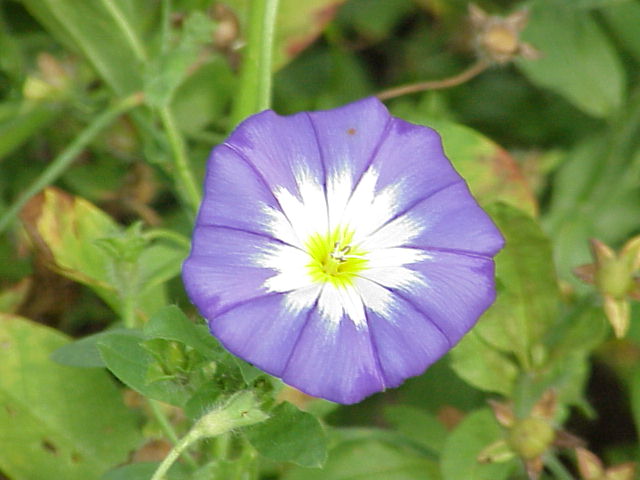
Photo: Kurt Stüber [1], CC BY-SA 3.0 · source

Annual · Convolvulaceae
Dwarf morning glory
Convolvulus tricolor
In other languages: Driekleurige winde (Nederlands) · Belle-de-jour (Français)
Dwarf morning glory is a low, bushy annual from the Mediterranean region, from southern Europe to North Africa. It forms a loose mound about 30 cm high and wide, covered in funnel-shaped flowers in three colours: a deep blue rim, a white band and a yellow throat. Each flower opens in the morning and closes in the evening, but the plant keeps producing new buds from June to September. Unlike its relatives field bindweed and hedge bindweed, it does not climb or spread through the garden. The best-known variety is ‘Royal Ensign’, a deep royal blue; there are also mixtures in pink, purple and white. It is ideal for a sunny edge, a rock garden or a container on the patio.
Light
Full sun
warm and bright
Moisture
Dry to normal
no wet feet
Legal basis
Sand or loam
any pH
Hardiness
down to -2 °C
protect in harsh winters
Size
0.3 m
tall, 0.3 m wide
Flowering
June–September
| Height | 0.3 m |
|---|---|
| Native to Belgium | No, planted |
| Good for bees, butterflies and birds | Yes, for bees |
| Poisonous to people and pets | Not known to be poisonous |
| Flowering | June–September |
Identify
Dwarf morning glory: how do you recognise it?
- Habit
- Bushy, slightly spreading mound 25–30 cm high and 30 cm wide, with branched stems that sometimes sprawl.
- Leaves
- Oblong to lance-shaped, 3–7 cm, dull green and slightly hairy, alternate along the stems.
- Flower
- Funnel-shaped, 3–4 cm across and open for a single day: it opens in the morning and closes in the evening. In dull weather it may stay shut.
- Colour
- Deep blue rim, white band and yellow throat. Pink, purple and white forms also exist.
- Fruit
- A small round capsule holding a few hard, angular seeds.
Flowering: June–September · Sowing: March–May · Plants: May
In your garden
Why grow it?
- An exceptional colour: deep blue flowers with a white ring and a yellow throat.
- Flowers for four months, from June to September.
- Bees and other pollinators visit the open flowers.
- Does not climb or spread: a compact plant for the front of a border, a rock garden or a container.
- Easy to sow where it is to flower, and happy in poor, dry soil.
- Fun for children: you can watch the flowers open every morning.
Dwarf morning glory: where does it grow best?
- Full sun: in shade the flowers stay closed and the plant becomes floppy.
- Light, free-draining soil: sand or loam, acid to chalky. Poor soil gives more flowers than rich soil.
- Dry to moderately moist; it dislikes heavy, waterlogged ground.
- A warm spot sheltered from cold winds, such as the edge of a patio or the foot of a south-facing wall.
- Plant or thin to 25–30 cm apart.
- Light
- Sun
- Soil type
- Sand or loam
- Acidity
- Not fussy
- Moisture
- Dry or normal
- Size
- 0.3 m tall, 0.3 m wide
- Hardiness
- Tolerates light frost (to -2 °C)
Goes well with
- California poppy: Orange and yellow beside the deep blue, on the same poor, sunny soil.
- Pot marigold: Warm orange as a contrast, and just as easy to sow in situ.
- Sweet alyssum: A low, white, scented edging at the front.
- Lavender: Grey leaves and purple spikes in a warm, dry spot.
- Thyme: A low, fragrant ground cover in a rock garden.
Maintenance
Dwarf morning glory: when and how to plant it?
Plant in May.
- Soak the seed overnight in lukewarm water: the hard seed coat softens and the seed germinates faster.
- Sow where it is to flower in April–May, 1 cm deep, in groups of two or three seeds every 25–30 cm.
- For earlier flowers, sow indoors in March–April in small pots at 15–20 °C. Sow straight into individual pots, as it dislikes being transplanted.
- Plant out the indoor-raised plants in May, after mid-May when frosts are over, without breaking up the root ball.
- Water after sowing and planting, then thin out, keeping the strongest seedling in each group.
- Do not enrich the soil: in rich ground it makes lots of leaves and few flowers.
Care
- Watering
- Little needed once established. Water only in prolonged drought, and in containers when the top few centimetres are dry.
- Feeding
- Not needed in the open ground. In pots or window boxes, a liquid feed for flowering plants every three to four weeks.
- Pinching out
- Pinch out the tips of young plants at 10 cm: they branch better and become bushier.
- Spent flowers
- The flowers drop by themselves. Snip off the seed capsules now and then in summer to prolong flowering.
- Weeding
- Keep the soil around young seedlings free of weeds; later the plant covers the ground itself.
Tip: Soak the seed overnight in lukewarm water and sow it straight where it is to flower: that way you avoid transplanting, which the plant dislikes.
Dwarf morning glory: when to prune it?
When: An annual that is not really pruned. Pinching out in June and removing seed capsules in July–August is enough.
How:
- Pinch out the tips of young plants at 10 cm for a fuller plant.
- From July, regularly snip off the green seed capsules to prolong flowering; let a few ripen at the end of summer for seed.
- Pull up the plant after the first frost and put it on the compost heap.
Propagation
- Seed
- Collect the brown, dry seed capsules in September. Store the seed somewhere cool and dry, and soak it overnight before sowing. It germinates in one to two weeks.
- Self-sowing
- In a warm, poor spot it sometimes self-seeds. Leave the seedlings where they are or move them while very young, with a small root ball.
Dwarf morning glory: how does it get through the winter?
Hardy to −2 °C: protect in harsh winters.
- Not hardy: it tolerates −2 °C at most and dies in Belgian gardens with the first frost.
- Grow it as an annual and sow again every spring; overwintering is not worth the effort.
- Seed that falls on the ground sometimes survives a mild winter and then germinates in spring.
- Keep collected seed in a paper bag in a cool, dry place until April.
Diseases and pests
- Slugs: They devour young seedlings in April–May. Check in the evening, pick them off or protect the seedlings with a collar.
- Aphids: Green or black aphids on the shoot tips. Hose them off with water; ladybirds and hoverflies usually deal with them.
- Few flowers: Too much shade, too rich a soil or too much fertiliser. Choose a sunny, poor spot and do not feed.
- Root rot: The plant wilts and yellows in heavy, wet soil. Sow in a well-drained spot or work sand into the soil.
- Closed flowers: The flowers close in dull weather and in the evening: that is normal, not a disease.
Through the year
- March: Sow indoors in small pots after soaking the seed overnight.
- April: Sow indoors or where it is to flower. Protect seedlings from slugs.
- May: Sow outdoors and plant out indoor-raised plants after mid-May. Thin to 25–30 cm.
- June: First flowers. Pinch out young plants.
- July: Full flower. Water in prolonged drought. Snip off seed capsules.
- August: Flowering. Water pots regularly and give a little feed.
- September: Last flowers. Collect dry capsules for next year.
- October: Clear the plants after the first frost.
Use
Good for wildlife
- Bees
- Nectar and pollen for honeybees and wild bees.
You and this species
Did you know?
- Each flower lives for just one day: it opens in the morning and closes or fades in the evening. That is why the French call it ‘belle-de-jour’, beauty of the day, as opposed to the ‘belle-de-nuit’ or marvel of Peru, which opens in the evening.
- It belongs to the same genus as field bindweed, a stubborn weed, but it does not climb or spread itself.
- Its name tricolor means ‘three-coloured’ and refers to the blue, white and yellow of the flower.