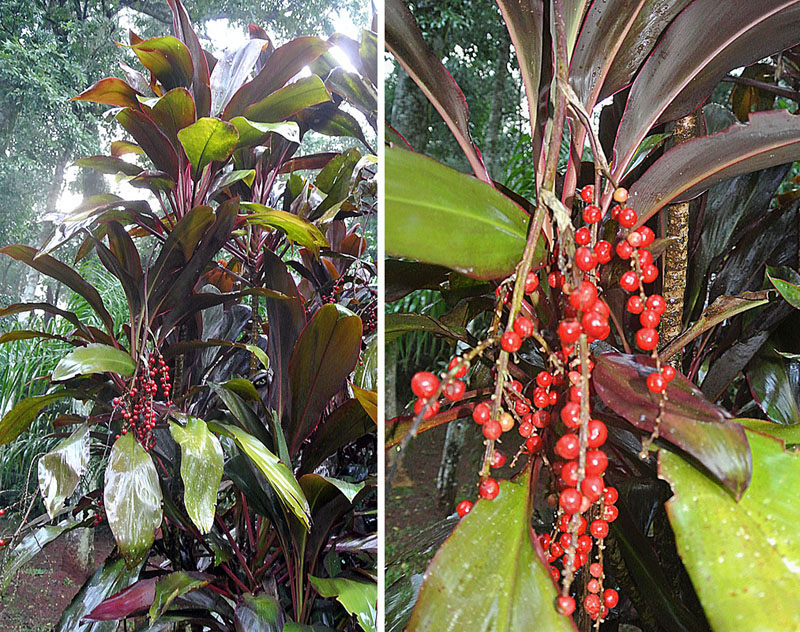
Photo: Dick Culbert from Gibsons, B.C., Canada, CC BY 2.0 · source

Houseplant · Asparagaceae
Ti plant
Cordyline fruticosa
In other languages: Cordyline (Nederlands) · Cordyline (Français)
Cordyline fruticosa, also known as the ti plant, comes from tropical Asia and the islands of the Pacific. On a straight, cane-like stem it carries a crown of long, lance-shaped leaves at the top, which can be green, pink, red, purple or striped in several colours. As a houseplant it reaches about 1.5 m tall and 60 cm wide. It is loved for its colourful foliage, which brightens a light corner of the room. It likes warmth, light without fierce sun and fairly humid air.
Caution: Toxic to cats and dogs: they can be upset if they chew the leaves or stem. Keep the plant out of reach of pets and small children.
Light
Partial shade
no harsh midday sun
Moisture
Normal
no wet feet
Legal basis
Potting soil
Hardiness
Houseplant
min. 13 °C
Size
1.5 m
tall, 0.6 m wide
| Pruning months | April |
|---|---|
| Height | 1.5 m |
| Poisonous to people and pets | Yes, take care with children and pets |
Identify
Ti plant: how do you recognise it?
- Habit
- Upright, cane-like plant with one or more stems, about 1.5 m tall and 60 cm wide; the lower leaves drop with age.
- Leaves
- Lance-shaped, 30–50 cm long and 5–10 cm wide, in a crown at the top of the stem; green, red-brown, pink or variegated.
- Colour
- Colour is strongest in a bright spot without fierce sun; in a spot that is too dark the leaves turn greener.
- Flower
- It rarely flowers indoors. In the wild it bears panicles of small white to purple flowers.
- Roots
- Thick, white roots. They dislike wet feet.
Plants: March–May · Pruning: April
In your garden
Why grow it?
- Colourful foliage in green, pink, red or purple, all year round.
- A striking, upright shape that makes an impression in a corner or beside a window without much work.
- Suits a bright room without direct sun.
- Evergreen: it looks good all year.
- Easy to propagate from stem or top cuttings.
Ti plant: where does it grow best?
- Bright light without fierce midday sun: right by an east or west window or set back from a south window.
- A light, airy compost: potting compost with a little loam or perlite; acid to neutral.
- Keep the compost lightly moist; avoid standing water in the pot or saucer.
- Warm and fairly humid: 18–24 °C, never below 13 °C. Keep it away from draughts and radiators.
- Give it space: the crown of leaves needs about 60 cm.
- Light
- Bright, out of direct sun
- Potting soil
- Multi-purpose compost or airy, humus-rich compost
- Acidity
- Acid or neutral
- Watering
- Moderately
- Size
- 1.5 m tall, 0.6 m wide
- Temperature
- Minimum 13 °C
Goes well with
- Calathea: Needs the same warmth and humidity, with patterned leaves beside the red-green crown.
- Dracaena: A related houseplant with neat leaves, with the same light and care.
- Ferns: They keep the air humid and give a soft, green backdrop.
- Swiss cheese plant (Monstera): Large, lobed leaves beside the narrow leaf crown of the cordyline.
Maintenance
Ti plant: when and how to plant it?
Plant in March–May.
- Repot in March–May, at the start of the growing season, as soon as the roots fill the pot.
- Choose a pot with a drainage hole that is 2–4 cm wider than the old one, preferably a heavy one so the plant does not tip over.
- Use an airy potting compost mixed with a third perlite or coarse sand; a thin layer of clay pebbles at the bottom helps drainage.
- Set the plant at the same depth as before and firm gently; do not bury the stem any deeper.
- Water straight away, let the excess drain and put the plant in a warm, bright place.
- Repot young plants every two years; older plants only need fresh compost on top.
Care
- Water
- During the growing season keep the compost lightly moist: water as soon as the top 2–3 cm is dry. Less in winter. Use rainwater or low-lime water.
- Feeding
- From April to September give half-strength foliage plant food every 2–4 weeks. None in winter.
- Humidity
- Mist the leaves now and then with tepid, low-lime water, or stand the pot on a tray of damp clay pebbles.
- Leaves
- Wipe the leaves with a damp cloth now and then; it helps against dust and pests. Remove yellow or brown lower leaves.
- Repotting
- Every two years in spring into a slightly larger pot, until it reaches the size you want.
Tip: It wants light without fierce sun and fairly high humidity; mist the leaves now and then. Keep the compost lightly moist and avoid draughts.
Ti plant: when to prune it?
Pruning months: April.
When: In spring (April), at the start of the growing season, when the plant gets too tall or bare.
How:
- Cut the stem through at the height you want with a sharp, clean knife or saw.
- New shoots appear below the cut within a few weeks.
- The cut-off top can be rooted as a cutting.
- Cut brown or yellow leaves off at the base.
Caution: Keep the trimmings away from pets: cut-off parts remain toxic.
Propagation
- Top cutting
- April–July: cut off the leaf crown with 10–15 cm of stem, let the cut dry for a day and set it in damp compost with perlite at 22–25 °C. Roots form in 4–8 weeks.
- Stem sections
- Cut a bare stem into 5–10 cm pieces and lay them horizontally on damp compost with perlite, in a warm, bright spot. New shoots grow from the nodes.
- Side shoots
- When repotting you can cut off rooted side shoots and pot them up separately.
Ti plant: how does it get through the winter?
- Not hardy: it needs at least 13 °C and is happiest at 15–20 °C.
- Water less: the compost may dry out a little between waterings, but never completely. Do not feed.
- Keep it away from cold windows, draughts and dry radiator air, and mist the leaves more often.
Diseases and pests
- Brown leaf tips: Dry air, lime-rich water or a pot that is too dry. Mist more often, use low-lime water and trim the brown tips with sharp scissors.
- Yellow or falling leaves: Loss of the lowest leaves is normal. If many drop or turn yellow, it is too wet, too cold or in a draught. Let the pot dry out and move it somewhere warmer.
- Loss of colour: In a spot that is too dark the red or pink leaves turn green. Move it nearer the light, but not into full sun.
- Spider mite, mealybug and scale: Fine webbing, white cottony patches or small brown shells. Rinse the plant or wipe the leaves and repeat weekly; raise the humidity.
Through the year
- January: Rest: little water, no feeding. Keep away from draughts and cold windows.
- February: Rest: little water. Mist the leaves against dry air.
- March: Repot if the roots fill the pot. Give more water.
- April: Cut back if needed. Take cuttings. Start feeding.
- May: Repotting is still possible. Feed every 2–4 weeks. Water.
- June: Growing season: water, feed and humid air.
- July: Growing season: shade from fierce midday sun.
- August: Growing season: water and feed.
- September: Last feed. Gradually water less.
- October: Water less. Wipe the leaves.
- November: Rest: little water, no feeding.
- December: Rest: keep warm and bright, away from radiators.
Use
Edible and useful
Not edible. These dragon trees, the snake plant, lucky bamboo and the ti plant are mildly poisonous: the leaves contain saponins, which cause drooling, vomiting and sometimes diarrhoea and lethargy in cats and dogs; cats can also get dilated pupils. They like to chew the long, narrow leaves, which look like blades of grass: keep the plant out of their reach and clear up fallen or trimmed leaves. Do not let animals drink from the vase or bowl of lucky bamboo. A bit of leaf gives a child an upset stomach at most, but do not let children chew it. Call your vet if an animal has eaten a lot or falls ill. If any is swallowed, call a poison centre (in Belgium 070 245 245) or your doctor at once.
You and this species
Did you know?
- The plant is also known by the scientific name Cordyline terminalis; that is a synonym.
- On the Pacific islands the leaves have been used for centuries to make skirts and to wrap food.
- The difference from the related Dracaena is underground: cordyline has thick white roots, dracaena has yellow to orange roots.