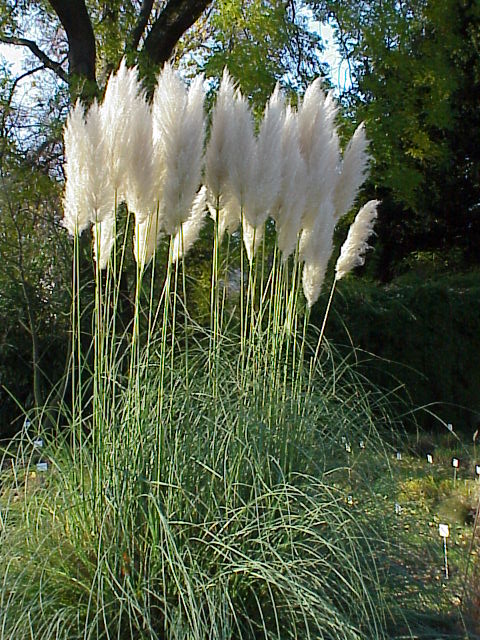
Photo: Wikimedia Commons, CC BY-SA 3.0 · source

Ornamental grass · Poaceae
Pampas grass
Cortaderia selloana
In other languages: Pampasgras (Nederlands) · Herbe de la pampa (Français)
Pampas grass comes from the grasslands of South America, mainly Argentina, Uruguay and southern Brazil. It forms a large, evergreen clump of long, arching leaves with razor-sharp edges. In September and October the famous silky plumes appear above it on sturdy stems up to 2.5 m tall, silvery white or tinged pink. It is a real eye-catcher as a specimen in a large lawn or a big border, and the plumes are popular in dried arrangements. Well-known cultivars are ‘Pumila’, compact at around 1.5 m, ‘Sunningdale Silver’, with loose silvery-white plumes, and ‘Rosea’, with pink-tinged plumes.
Caution: The leaf edges are razor-sharp and cut the skin: wear gloves and keep the plant away from paths and play areas. In southern Europe, including Spain and the French Atlantic coast, pampas grass is invasive and self-seeds massively. Never dump plumes or garden waste in the countryside, and pull out seedlings.
Light
Full sun
warm and bright
Moisture
Dry to normal
no wet feet
Legal basis
Sand, loam or clay
any pH
Hardiness
down to -15 °C
protect young plants
Size
2.5 m
tall, 2 m wide
Flowering
September–October
| Pruning months | March–April |
|---|---|
| Height | 2.5 m |
| Native to Belgium | No, planted |
| Poisonous to people and pets | Not known to be poisonous |
| Flowering | September–October |
Identify
Pampas grass: how do you recognise it?
- Habit
- Large, dense clump of arching leaves, up to 2 m wide; the flower stems reach 2–2.5 m.
- Foliage
- Long, narrow, grey-green and evergreen; the edges are finely toothed and razor-sharp.
- Flowers
- Large, dense, silky plumes half a metre long or more, silvery white or tinged pink, in September and October.
- Male and female
- There are male and female plants; the female plants have the finest, fullest plumes.
- Roots
- Deep and very tough; digging out an old clump is hard work.
Flowering: September–October · Plants: April–May · Pruning: March–April
In your garden
Why grow it?
- A spectacular eye-catcher: the plumes stand from September well into winter.
- Evergreen: the large clump gives structure all year round.
- A superb cut flower, fresh or dried in an arrangement.
- Copes with drought and wind once it is well established.
- Suits large gardens, as a specimen or as a loose, tall screen.
Pampas grass: where does it grow best?
- Full sun: in shade it flowers poorly or not at all.
- Sand, loam or clay, acid to chalky, but always well drained. It dislikes wet soil in winter.
- Dry to normal soil; once established it copes well with drought.
- Give it at least 2 m of space and do not plant it right next to a path or play area, because of the sharp leaves.
- Light
- Sun
- Soil type
- Sand, loam or clay
- Acidity
- Not fussy
- Moisture
- Dry or normal
- Size
- 2.5 m tall, 2 m wide
- Hardiness
- Hardy (to -15 °C)
Goes well with
- Purpletop vervain: Also from South America; small purple flowers among the tall stems, for bees and butterflies.
- Russian sage: Silver-grey leaves and lavender-blue spikes in the same sunny, dry spot.
- Ice plant: Broad pink flower heads in late summer, at the foot of the clump.
- Michaelmas daisy: Flowers at the same time, in blue and purple, against the white plumes.
Maintenance
Pampas grass: when and how to plant it?
Plant in April–May.
- Plant in April or May so it can root well before winter.
- Wear sturdy gloves and long sleeves.
- Dig a generous hole, twice as wide as the root ball. On heavy clay mix coarse sand or grit into the soil for better drainage.
- Set the plant at the same depth as in the pot, no deeper, and firm the soil well.
- Water generously straight away and in dry spells during the first summer.
- Keep at least 1.5–2 m from other plants.
Care
- Watering
- Only in dry spells during the first year; rarely needed after that.
- Feeding
- A spadeful of compost in spring is enough. Too much fertiliser gives lots of leaves and floppy stems.
- Safety
- Always work with sturdy gloves, long sleeves and safety glasses: the leaf edges cut.
- Winter preparation
- In late autumn tie the leaves loosely together with string so rain does not sit in the crown.
- Cutting plumes
- For a dried arrangement, cut the plumes as soon as they have just opened and hang them upside down to dry.
Tip: Always wear sturdy gloves: the leaf edges are razor-sharp. Cut away the old plumes and dead leaves in March–April, not in autumn, and tie the leaves loosely together in November against rain in the crown.
Pampas grass: when to prune it?
Pruning months: March–April.
When: In March or April, before the new leaves start growing. Not in autumn: the old leaves and plumes protect the crown in winter.
How:
- Put on sturdy gloves, long sleeves and safety glasses.
- Cut the old plumes off low, at the base.
- With gloved hands, pull the dead brown leaves out of the clump, or cut the whole clump back to 30–50 cm above the ground.
- Work carefully around the crown, where the new leaves emerge.
Caution: Never set fire to pampas grass to tidy it: it is dangerous and damages the crown.
Propagation
- Division
- In April–May: cut a rooted piece from the edge of the clump with a sharp spade or a saw. It is hard work, so wear gloves. Replant it at once and water generously.
Pampas grass: how does it get through the winter?
Hardy to −15 °C: protect young plants.
- Hardy to about −15 °C: it survives most Belgian winters without problems, but can be damaged in severe winters.
- Wet soil in winter is more dangerous than frost: plant it in a well-drained spot.
- Tie the leaves loosely together in late autumn and, in severe winters, put some straw or dry leaves around the base.
- Only compact cultivars such as ‘Pumila’ fit in a large pot. Keep it sheltered and wrap it in hessian in hard frost.
Diseases and pests
- No plumes: Young plants only flower after two or three years. Too much shade or a male seedling gives few or thin plumes.
- Crown rot: Caused by wet soil and water in the clump in winter. Ensure good drainage, tie the leaves together and only cut back in spring.
- Bare, brown clump: Lots of dead leaves in the centre. Pull them out in spring and rejuvenate an old clump by dividing it.
- Cuts: The leaf edges cut like paper. Always work with gloves and do not plant next to paths.
- Seedlings: Where male and female plants grow together it can self-seed. Pull out seedlings straight away.
Through the year
- January: The plumes decorate the winter garden.
- March: Cut away old plumes and dead leaves, wearing gloves.
- April: Finish pruning before the new leaves grow. Plant or divide.
- May: Plant or divide. Add compost.
- June: Growth. Water young plants in dry spells.
- July: Water in prolonged drought.
- September: The plumes appear. Cut some for drying as soon as they open.
- October: Full flower. The plumes fluff out.
- November: Tie the leaves loosely together against rain in the crown.
- December: Leave the plumes. Cover the base in hard frost.
You and this species
Did you know?
- The genus name comes from the Argentine Spanish word cortadera, cutter, because of the sharp leaf edges.
- Pampas grass is dioecious: there are male and female plants. The females have the fuller, silkier plumes, which is why they are the ones mostly sold.
- The species name selloana honours the German naturalist Friedrich Sellow, who collected plants in Brazil and Uruguay in the 19th century.