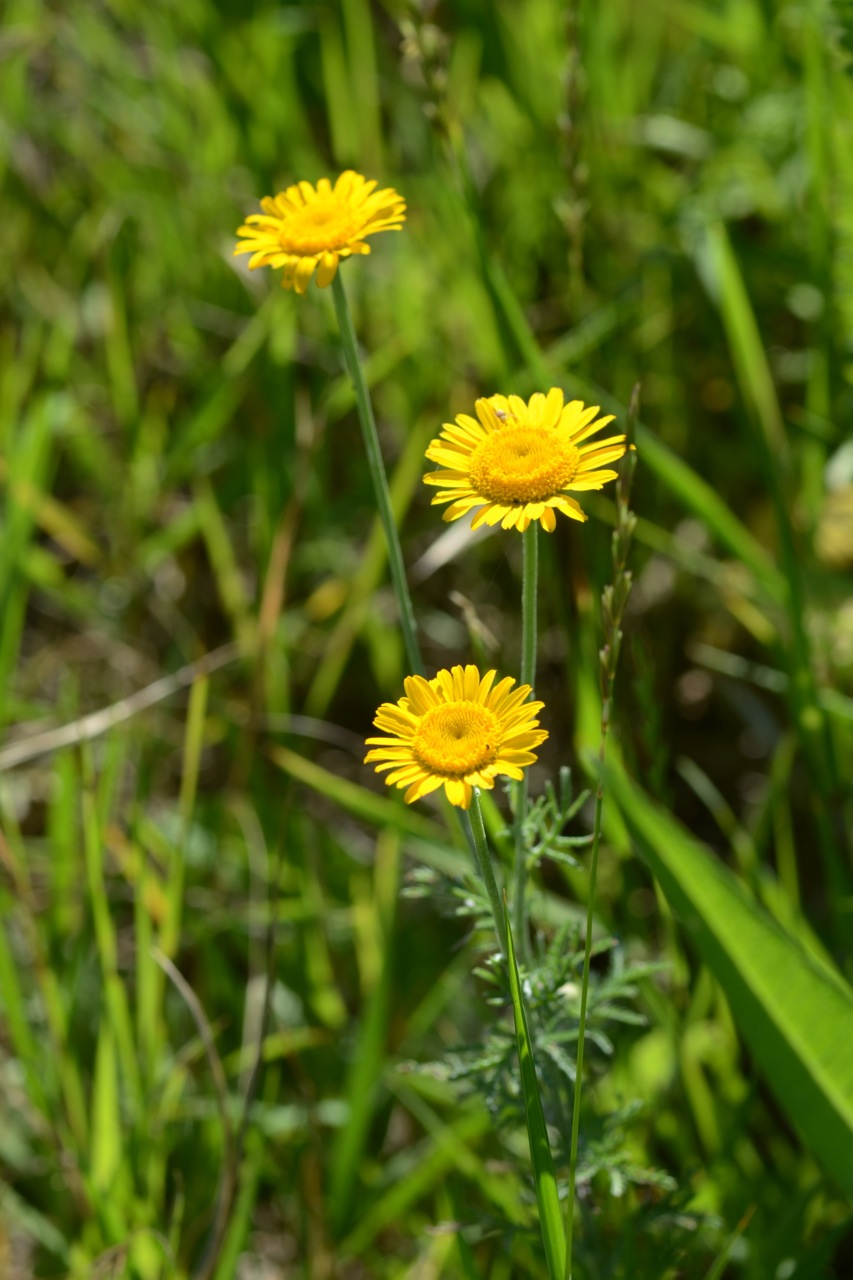
Photo: Radio Tonreg from Vienna, Austria, CC BY 2.0 · source

Perennial · Asteraceae
Golden marguerite
Cota tinctoria
In other languages: Gele kamille (Nederlands) · Anthémis des teinturiers (Français)
Golden marguerite, long known as Anthemis tinctoria, comes from Europe, the Caucasus and western Asia, where it grows on dry, stony slopes and roadsides. It is a bushy perennial of about 60 cm with finely divided, grey-green, faintly aromatic leaves. From June into September it is covered in golden-yellow daisies 3–4 cm across. Gardeners love it for its long flowering, its drought tolerance and the bees and butterflies it attracts. Well-known cultivars are ‘E.C. Buxton’ with lemon-yellow flowers and ‘Sauce Hollandaise’ with creamy-white flowers.
Light
Full sun
warm and bright
Moisture
Dry
tolerates drought
Legal basis
Sand or loam
any pH
Hardiness
Fully hardy
down to -30 °C
Size
0.6 m
tall, 0.6 m wide
Flowering
June–September
| Pruning months | March and July–August |
|---|---|
| Height | 0.6 m |
| Native to Belgium | No, planted |
| Good for bees, butterflies and birds | Yes, for bees and butterflies |
| Poisonous to people and pets | Not known to be poisonous |
| Flowering | June–September |
Identify
Golden marguerite: how do you recognise it?
- Habit
- Bushy, upright clump 40–60 cm tall and about as wide.
- Leaves
- Finely divided, grey-green and slightly woolly underneath; smells spicy when crushed.
- Flower
- Daisy-like heads 3–4 cm across with yellow rays around a golden centre, borne singly on firm stems.
- Colour
- Golden yellow in the species; cultivars in lemon, pale yellow and cream.
- Lifespan
- Often short-lived, but it lasts years longer if you cut it back after flowering and grow it in poor soil.
- Roots
- Fibrous and fairly shallow; it does not spread aggressively.
Flowering: June–September · Sowing: March–April · Plants: March–May and September · Pruning: March and July–August
In your garden
Why grow it?
- Flowers from June into September, especially if you cut it back after the first flush.
- A real bee and butterfly plant: the open flower centres are full of nectar and pollen.
- Drought-tolerant: ideal for a sunny, lean border, a gravel garden or a bank.
- A good cut flower that lasts well in the vase.
- The fine, grey-green foliage gives an airy effect even when it is not in flower.
- The flowers yield a yellow dye: a fun plant if you want to dye wool or fabric yourself.
Golden marguerite: where does it grow best?
- Full sun: in shade it flowers poorly and flops.
- Poor to moderately fertile, free-draining sandy or loamy soil; acid, neutral or chalky does not matter.
- Dry: wet feet in winter are fatal. Improve heavy clay first with coarse sand or gravel.
- In rich soil it becomes floppy and short-lived: do not feed it.
- Plant 40–50 cm apart, about 4–5 plants per m².
- Light
- Sun
- Soil type
- Sand or loam
- Acidity
- Not fussy
- Moisture
- Dry
- Size
- 0.6 m tall, 0.6 m wide
- Hardiness
- Hardy (to -30 °C)
Goes well with
- Woodland sage: Purple-blue spikes contrasting with the gold; it also likes it dry.
- Catmint: A soft blue haze at the base, for the same sunny, dry spot.
- Sea holly: Steel-blue heads and a bold shape beside the airy daisies.
- Feather grass: Swaying, fine stems that make the planting light and natural.
- Yarrow: Flat heads in other colours, with the same need for sun and dry soil.
Maintenance
Golden marguerite: when and how to plant it?
Plant in March–May and September.
- Plant from March to May or in September, on a dry day when the soil is easy to work.
- Dig a hole twice as wide as the pot; in heavy soil, mix in a few handfuls of gravel or coarse sand.
- Set the plant at the same depth as in the pot, not deeper: the base of the stems must not sit in wet soil.
- Leave 40–50 cm between plants.
- Water well at planting and during dry spells in the first weeks; after that hardly at all.
- If you like, mulch with gravel rather than compost: it keeps the crown dry.
Care
- Watering
- Only in the first year during long dry spells. After that it fends for itself.
- Feeding
- Not needed. Manure and compost make it floppy and short-lived.
- Deadheading
- Remove spent flowers regularly to prolong flowering, or leave a few if you want seed.
- Support
- Rarely needed on poor soil; in richer soil a low support or neighbouring plants help hold it up.
- Rejuvenating
- Dividing or taking cuttings every 2–3 years keeps the plant vigorous.
Tip: Cut it back to the leafy rosettes in July or August, straight after the first flowering: it will live for years longer and often flower a second time.
Golden marguerite: when to prune it?
Pruning months: March and July–August.
When: Cut it back hard straight after the first flowering, in July or August. In March, clear away the last dead stems.
How:
- Cut all flowering stems back to just above the leafy rosettes at the base, at 5–10 cm.
- This makes the plant form new rosettes, which overwinter better and help it live longer.
- A smaller second flush often follows in September.
- In March, remove dead stems and withered leaves; never cut deep into the living rosettes.
Caution: If you let it flower until it is exhausted, it often dies after two or three years.
Propagation
- Cuttings
- In April–May, or after cutting back in August–September: take 5–8 cm cuttings from non-flowering shoots at the base and root them in a sandy mix.
- Seed
- In March–April indoors, in a light spot at room temperature; barely cover the fine seed. Cultivars do not always come true from seed.
- Division
- In spring, split older clumps and replant the young outer pieces.
Golden marguerite: how does it get through the winter?
Hardy to −30 °C.
- Very hardy, to about −30 °C: cold is never the problem in Belgium.
- Waterlogged soil in winter is dangerous, though: roots and rosettes rot away.
- Leave the new rosettes after cutting back: they provide next year’s flowers.
- In a pot: use a free-draining mix and move the pot under cover, out of the rain, in winter.
Diseases and pests
- Flopping: In rich soil or shade the clump falls open. Plant in leaner, sunnier conditions and cut back after the first flush.
- Winter rot: The plant has gone after a wet winter. Improve drainage with gravel or plant on a raised spot.
- Powdery mildew: White powder on the leaves, mainly in late summer. Cutting back and giving enough space is usually enough.
- Aphids: On the stem tips in spring. Natural predators usually deal with them; otherwise hose them off.
Through the year
- March: Cut away dead stems and withered leaves. Plant, or sow indoors.
- April: Plant. Sow indoors. Take cuttings from young shoots.
- May: Last chance to plant. Water young plants in dry weather.
- June: Flowering starts. Cut flowers for the vase.
- July: Full flower. Deadhead; cut back after the first flush.
- August: Cut back hard to the rosettes, if not already done in July.
- September: Smaller second flush. Plant or take cuttings.
- October: Leave the new rosettes in place for winter.
- December: Rest. Make sure no water stands around the crown.
Use
Good for wildlife
- Bees
- Nectar and pollen for honeybees and wild bees.
- Butterflies
- Nectar for butterflies.
You and this species
Did you know?
- The name tinctoria comes from the Latin word for dyeing: its flowers were once used to dye wool and cloth yellow.
- Botanists long placed it in the genus Anthemis, which is why many catalogues still list it as Anthemis tinctoria.
- The poorer and drier the soil, the more compact the plant stays and the longer it lives.