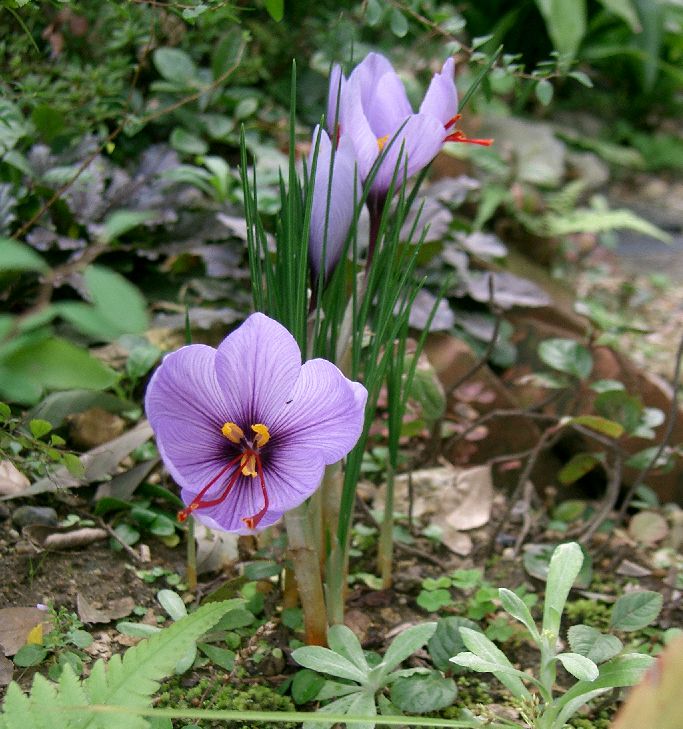
Photo: KENPEI, CC BY-SA 3.0 · source

Bulb or tuber · Iridaceae
Saffron crocus
Crocus sativus
In other languages: Saffraankrokus (Nederlands) · Safran (Français)
The saffron crocus is an autumn-flowering crocus that has been grown for thousands of years for saffron. It is not known in the wild: it probably arose from a wild crocus of the eastern Mediterranean. In October and November it produces lilac to purple flowers with darker veins, yellow stamens and three strikingly long red stigmas. Those stigmas are the saffron. Narrow, grassy leaves with a silver central stripe appear with the flowers and last until spring. In a warm, dry spot in the garden you can harvest your own saffron.
Caution: Do not confuse it with the highly poisonous meadow saffron (Colchicum), which also flowers in autumn. You can recognise the saffron crocus by its three yellow stamens and three long red stigmas; meadow saffron has six stamens and flowers without leaves. Only harvest saffron from corms you are sure of.
Light
Full sun
warm and bright
Moisture
Dry
tolerates drought
Legal basis
Sand or loam
neutral to chalky
Hardiness
down to -15 °C
protect young plants
Size
0.15 m
tall, 0.08 m wide
Flowering
October–November
| Height | 0.15 m |
|---|---|
| Native to Belgium | No, planted |
| Good for bees, butterflies and birds | Yes, for bees |
| Poisonous to people and pets | In part: see Caution above |
| Flowering | October–November |
Identify
Saffron crocus: how do you recognise it?
- Habit
- A corm 10–15 cm tall; the flowers appear with the leaves or just before them.
- Leaves
- Narrow and grassy with a silvery white central stripe; they keep growing through winter and die back in April–May.
- Flowers
- Goblet-shaped, with six lilac to purple petals with darker veins, three yellow stamens and a style that splits into three long red stigmas.
- Harvest
- The three red stigmas are the saffron, so you only pick three per flower.
- Corm
- Round and slightly flattened, with a brown, fibrous tunic; it forms new daughter corms every year.
- Seed
- It is sterile and does not set seed: it only multiplies by corms.
Flowering: October–November · Harvest and fruit: October–November · Plants: July–September
In your garden
Why grow it?
- You can harvest your own saffron, one of the most expensive spices in the world.
- Late flowers in October and November, as the garden goes quiet.
- Bees still find pollen in the open flowers on sunny autumn days.
- Drought-tolerant: in summer the corm rests and needs no water.
- Small and easy in a pot, a rock garden or at the edge of the vegetable plot.
Saffron crocus: where does it grow best?
- Full sun, in the warmest spot in the garden, for example in front of a south-facing wall.
- Very well-drained sandy or light loamy soil, neutral to chalky.
- Dry, especially in summer: the corm then needs to rest warm and dry.
- Avoid heavy, wet clay, where the corms rot. Plant in a raised bed or a pot instead.
- Allow about 10 cm between corms, in rows or small groups.
- Light
- Sun
- Soil type
- Sand or loam
- Acidity
- Neutral or chalky
- Moisture
- Dry
- Size
- 0.15 m tall, 0.08 m wide
- Hardiness
- Hardy (to -15 °C)
Goes well with
- Thyme: A low, fragrant mat that wants the same dry, sunny spot.
- Blue fescue: Fine, blue-grey tufts next to the lilac flowers.
- Ice plant: Also flowers in autumn and tolerates drought.
- Lavender: A silver-grey backdrop in a warm, dry border.
Maintenance
Saffron crocus: when and how to plant it?
Plant in July–September.
- Plant the corms from July to early September: the earlier, the better the chance of flowers the same year.
- Choose large, firm corms; small ones often do not flower in the first year.
- Loosen the soil and, on heavier ground, mix in coarse sand or fine gravel.
- Plant the corms 10 cm deep, pointed end up, 10 cm apart.
- Firm the soil. Watering is only needed if the ground is bone dry.
- In a pot: use a deep pot with a layer of gravel at the bottom and a mix of compost and sand.
Care
- Watering
- Rarely needed in open ground. In a pot, water when the compost is dry while the leaves are green; keep dry in summer.
- Feeding
- After flowering, a little high-potash fertiliser or compost, so the corms fatten up for next year.
- Harvesting
- Pick the three red stigmas with your fingers or tweezers on the day the flower opens. Leave the yellow stamens.
- Drying and storing
- Dry the stigmas for a few days on kitchen paper in a warm, dry place. Store them in a tightly closed jar, in the dark.
- In the kitchen
- Soak a few threads in a little warm water or stock and use them in paella, risotto, fish soup or saffron bread.
- Leaves
- Leave the leaves until they turn yellow by themselves in spring: they feed the corm.
Tip: Choose the warmest, driest spot in your garden, for example in front of a south-facing wall: the warmer and drier the corms rest in summer, the more freely they flower in autumn.
Saffron crocus: when to prune it?
When: The saffron crocus is not pruned. You only clear away the dead leaves in May–June.
How:
- Leave the leaves until they are completely yellow: they feed the corm for the next flowering.
- You can leave the faded flowers, as they do not set seed anyway.
- Never mow or cut the leaves while they are still green.
Caution: If you cut the leaves too early, the corms stay small and hardly flower the following year.
Propagation
- Daughter corms
- Each corm forms a few new corms every year. Every 3–4 years, in June–July, lift the clump, separate the corms and replant the largest straight away. Small corms need a year or two before they flower.
- Seed
- Sowing is not possible: the saffron crocus is sterile and produces no viable seed.
Saffron crocus: how does it get through the winter?
Hardy to −15 °C: protect young plants.
- Hardy to about −15 °C: in well-drained soil it survives most Belgian winters without protection.
- In winter, wet soil is a greater danger than frost: make sure drainage is good.
- In severe frost, lay some conifer branches or straw over the spot.
- In a pot: keep it against a south-facing wall under cover, and move it to a cold, light room in severe frost.
Diseases and pests
- Mice: Mice and voles eat the corms. Plant them in a basket of fine wire mesh or in a pot.
- Corm rot: The corms rot away in wet, heavy soil. Plant in a dry, well-drained spot.
- Few flowers: Corms too small, too much shade, a wet summer or overcrowded clumps. Lift the corms, divide them and replant in a sunnier spot.
- Slugs: In a wet autumn they eat the young flowers. Pick them off in the evening.
Through the year
- January: The leaves keep growing. In a pot, avoid wet feet.
- March: The leaves are fully grown. In a pot, water if the compost is dry.
- May: The leaves turn yellow: let them die back.
- June: Rest. Clear away dead leaves; every 3–4 years, lift the corms.
- July: Plant corms.
- August: Plant corms.
- September: Plant the last corms. The first leaves appear.
- October: In flower. Pick the red stigmas every day and dry them.
- November: Last flowers and harvest. Give a little high-potash fertiliser.
- December: The leaves are up. Cover lightly in severe frost.
Use
Edible and useful
- Flowers (October–November)
- The purple flowers appear in October and November. Pick them on the day they open, ideally in the morning, and at home pull out the three red stigmas (the saffron threads); the yellow stamens are not used. Each flower has only three threads: you need about 150 flowers for 1 g of saffron. Saffron colours and flavours risotto, paella, bouillabaisse, saffron bread and rice pudding.
- Storing
- Dry the threads at once: a few hours on a plate somewhere warm and dry, or 20 minutes in the oven at 50 °C with the door ajar, until brittle. Keep them in a small airtight jar in the dark: they keep their colour and aroma for two years.
Caution: Do not confuse saffron crocus with autumn crocus (Colchicum), which also flowers purple in autumn and is deadly poisonous: Colchicum has six stamens and no long red stigmas, and its leaves only appear in spring. Only use crocuses sold as Crocus sativus. Saffron is safe in kitchen amounts (a pinch); large amounts (a few grams) are toxic, especially during pregnancy.
Eating and using is at your own risk: see the terms of use.
Recipes
- Saffron risotto (risotto alla milanese) (Dish · 4 people · 35 min)
Good for wildlife
- Bees
- Nectar and pollen for honeybees and wild bees.
You and this species
Did you know?
- The saffron crocus is sterile and does not set seed: all plants descend from corms that people have been multiplying for thousands of years.
- Saffron is so expensive because every stigma is picked by hand: one gram of dried saffron takes more than a hundred flowers.
- In the past saffron was used not only in the kitchen but also to dye fabrics yellow.