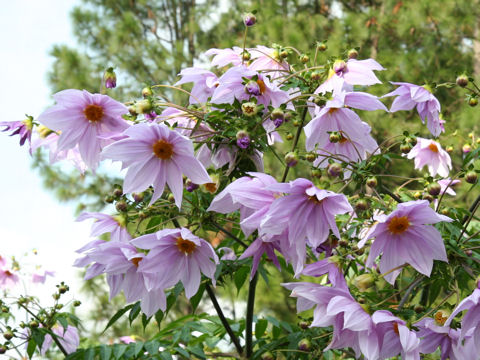
Photo: Shu Suehiro, CC BY 3.0 · source

Bulb or tuber · Asteraceae
Tree dahlia
Dahlia imperialis
In other languages: Boomdahlia (Nederlands) · Dahlia impérial (Français)
The tree dahlia comes from the mountain forests of Central America, from Mexico down to Colombia. It is a giant among dahlias: hollow, bamboo-like stems shoot up to about 3.5 m in a single season, carrying large, multiply divided leaves. The flowers appear only once the days get shorter, usually in October and November: graceful, pale lilac to pink blooms with a yellow centre, floating high above the rest of the garden. Because it does not tolerate frost, it is often grown in a large pot, or the tubers are lifted in autumn. A spectacular plant for anyone who loves tall, exotic accents.
Light
Full sun
warm and bright
Moisture
Normal
no wet feet
Legal basis
Sand, loam or clay
neutral to chalky
Hardiness
down to 0 °C
protect in harsh winters
Size
3.5 m
tall, 1.5 m wide
Flowering
October–November
| Pruning months | November |
|---|---|
| Height | 3.5 m |
| Native to Belgium | No, planted |
| Good for bees, butterflies and birds | Yes, for bees |
| Poisonous to people and pets | Not known to be poisonous |
| Flowering | October–November |
Identify
Tree dahlia: how do you recognise it?
- Habit
- A tuberous plant with hollow, bamboo-like stems, 3–3.5 m tall and about 1.5 m wide. The stems can snap in a storm.
- Leaves
- Large and multiply divided, up to about 50 cm long, opposite and fresh green.
- Flowers
- Single flowers up to about 10 cm across, pale lilac to pink (sometimes white) with a yellow centre.
- Flowering time
- October–November. It is a short-day plant: it only sets buds as the days shorten.
- Roots
- Thick, fleshy tubers. In the ground they do not overwinter reliably, so lift them before frost.
Flowering: October–November · Plants: May · Pruning: November
In your garden
Why grow it?
- A towering focal point of 3–3.5 m that reaches its full height in a single summer.
- Flowers only in October and November, when most summer flowers have finished.
- The open flowers are a late source of nectar and pollen for bees and bumblebees.
- The large, finely divided foliage gives the garden a tropical look.
- Also grows in a large pot, so it is easy to move indoors when frost threatens.
Tree dahlia: where does it grow best?
- Full sun and a warm, sheltered spot, for example against a south-facing wall: the warmer it is, the earlier it flowers.
- Ordinary garden soil (sandy, loamy or clay), neutral to chalky, well drained and rich in humus.
- Normally moist, but never wet: in waterlogged soil the tubers rot.
- Sheltered from wind, as the hollow stems break easily.
- Allow about 1.5 m per plant. In a pot, a volume of 40–50 litres is ideal.
- Light
- Sun
- Soil type
- Sand, loam or clay
- Acidity
- Neutral or chalky
- Moisture
- Normal
- Size
- 3.5 m tall, 1.5 m wide
- Hardiness
- Frost tender: lift the bulbs or tubers before the frost and store them frost-free
Goes well with
- Miscanthus: A tall grass with autumn plumes that moves gently along with the flowers.
- Michaelmas daisy: Flowers at the same time in purple and blue and fills the base of the dahlia.
- Canna: Just as exotic and just as tender; you store it in the same way.
- Japanese anemone: Pink and white flowers in the same autumn period, ideal as lower planting in front.
Maintenance
Tree dahlia: when and how to plant it?
Plant in May.
- Pot up the tubers in April in a bright, frost-free place: this gives you a head start on the late flowering.
- Plant out in May, after mid-May (the Ice Saints), when no more frost is expected.
- Dig a hole 30–40 cm deep and mix in compost and some coarse sand for good drainage.
- Set the tuber or the pre-grown plant 10–15 cm deep with the eyes facing up, and put in a sturdy 2–3 m stake straight away.
- Keep about 1.5 m away from other plants.
- Water thoroughly and spread a layer of compost or bark mulch around the base.
Care
- Watering
- Water generously in summer, especially in a pot: in dry weather the leaves droop. Water at the base.
- Feeding
- From June, every two weeks, give a potassium-rich feed, such as tomato feed. Too much nitrogen gives lots of leaf and few flowers.
- Mulching
- A layer of compost or bark keeps the soil moist and protects the tuber from late frost.
- Support
- Tie the stems to a sturdy stake as they grow. Without support it will blow over.
- Pot
- Use a heavy pot with drainage holes and a rich potting compost. A big, heavy pot keeps the plant stable in the wind.
Tip: Pot it up in April and start early: that way it flowers before the first frost. Move the pot into a frost-free conservatory or garage as soon as frost is forecast.
Tree dahlia: when to prune it?
Pruning months: November.
When: After the first night frost, usually in November, as soon as the stems have turned black.
How:
- Cut the stems back to about 15 cm above the tuber.
- Lift the tubers carefully, let them dry for a few days and store them dry and frost-free.
- If you leave the plant in its pot, cut the stems back as well and put the pot away dry and frost-free.
Caution: Do not cut before the first frost: the green stems still feed the tubers and flowering is late.
Propagation
- Dividing tubers
- In April, as the eyes swell: cut the tuber clump with a sharp knife into pieces, each with at least one eye and a bit of stem base. Let the cuts dry for a day and plant them in pots.
- Cuttings
- In May–June: take cuttings of young shoots 10–15 cm long with a few nodes and put them in moist cutting compost under plastic. They root within a few weeks.
Tree dahlia: how does it get through the winter?
Hardy to 0 °C: protect in harsh winters.
- Not hardy: the top growth dies at the first night frost and the tubers do not survive frost in the ground reliably (about 0 °C is the limit).
- Store the lifted tubers in a box of dry sand or compost in a cool, dark, frost-free place at 5–10 °C.
- In a pot: put it away dry in a frost-free cellar, garage or conservatory and hardly water at all.
- Check the tubers in January and February and cut away any rotten parts.
Diseases and pests
- Late or no flowering: It only flowers once the days get short. Give it a warm, sunny spot and start early in a pot. If frost comes early, a pot can still be moved indoors.
- Slugs: Young shoots are eaten in spring. Collect the slugs in the evening or put down a barrier of coarse sand or crushed shells.
- Aphids: Small aphids on young shoots and buds. Spray them off with water; ladybirds deal with the rest.
- Wind damage: Hollow stems snap in a storm. Tie them to a sturdy stake and choose a sheltered spot.
- Tuber rot: Soft, brown or mouldy tubers after winter. Store them dry and airy and cut away rotten parts.
Through the year
- January: Check stored tubers and cut away rotten parts.
- March: Take the tubers out of their winter spot and inspect them.
- April: Pot up the tubers in a bright, frost-free place. Divide or take cuttings if you wish.
- May: Plant out after mid-May and put in a stake.
- June: Feed every two weeks. Water in dry weather.
- July: Water generously and tie in the stems.
- August: Keep tying in. Watch for aphids and slugs.
- September: The flower buds form.
- October: Flowering begins. Bring pots indoors if frost is forecast.
- November: Flowers until the first frost. Then cut back and lift the tubers.
- December: Store the tubers dry and frost-free.
Use
Good for wildlife
- Bees
- Nectar and pollen for honeybees and wild bees.
You and this species
Did you know?
- The dahlia has been the national flower of Mexico since 1963.
- The name dahlia honours the Swedish botanist Anders Dahl, a pupil of Linnaeus.
- The tree dahlia is a short-day plant: it only sets flower buds once the nights are long enough.