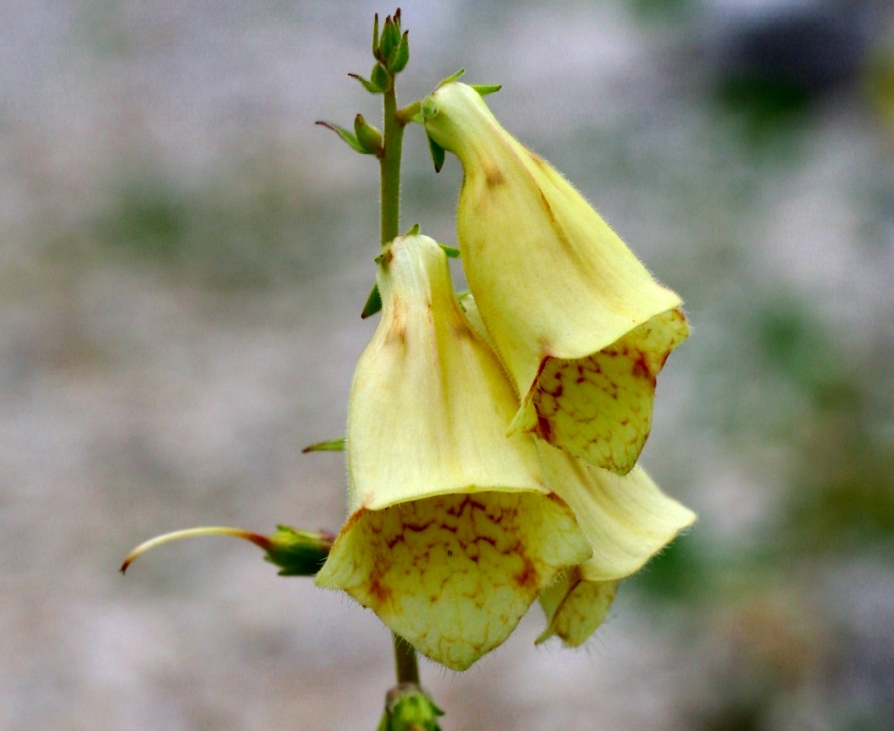
Photo: Enrico Blasutto, CC BY-SA 3.0 · source

Perennial · Plantaginaceae
Large yellow foxglove
Digitalis grandiflora
In other languages: Groot vingerhoedskruid (Nederlands) · Digitale à grandes fleurs (Français)
The large yellow foxglove comes from central and south-eastern Europe and western Asia, where it grows in open woodland, along woodland edges and in mountain meadows. Unlike the common foxglove, which dies after two years, it is a true perennial that lasts for years. From June to August it carries slender spikes up to 80 cm tall with large, pale yellow, bell-shaped flowers, veined brown inside. It forms a clump of glossy green, lance-shaped leaves and is happy in part shade or shade. Gardeners love its fresh, soft colour, which lights up a shady border and goes well with blue and purple.
Caution: All parts are highly poisonous if eaten, even in small amounts: a danger to children, cats, dogs and grazing animals such as horses and cattle. Do not plant it near the vegetable garden, as the leaves can be confused with edible leaves such as those of comfrey. Wear gloves and wash your hands after working with it.
Light
Partial shade or shade
tolerates little sun
Moisture
Normal
no wet feet
Legal basis
Sand, loam or clay
any pH
Hardiness
Fully hardy
down to -35 °C
Size
0.8 m
tall, 0.45 m wide
Flowering
June–August
| Pruning months | March and July–August |
|---|---|
| Height | 0.8 m |
| Native to Belgium | No, planted |
| Good for bees, butterflies and birds | Yes, for bees |
| Poisonous to people and pets | Yes, take care with children and pets |
| Flowering | June–August |
Identify
Large yellow foxglove: how do you recognise it?
- Habit
- Clump with upright flower spikes, 80 cm tall and 45 cm wide.
- Leaves
- Lance-shaped, glossy green, finely toothed and slightly hairy underneath.
- Flower
- Large tubular bells 4–5 cm long, pale yellow with brown veins and speckles inside, on one side of the spike, from June to August.
- Fruit
- Small capsules full of dust-fine seed; it self-seeds moderately.
- Toxicity
- All parts are highly poisonous.
Flowering: June–August · Sowing: March–June · Plants: March–April and September–October · Pruning: March and July–August
In your garden
Why grow it?
- A true perennial that lasts for years, unlike the biennial common foxglove.
- Pale yellow flowers that light up part shade and shade.
- Bumblebees crawl into the bells in search of nectar.
- A long season, from June to August, with a second flush if you cut off the faded spikes.
- Compact and sturdy: support is rarely needed.
Large yellow foxglove: where does it grow best?
- Part shade or light shade, for example at a woodland edge or under tall shrubs; full midday sun is too much.
- Ordinary, humus-rich garden soil: sand, loam or clay, acid to chalky.
- Moist: do not let it dry out in summer, and avoid soil that is too wet in winter.
- Plant 40–45 cm apart, in groups of three or more.
- Not near the vegetable garden or a play area, because it is poisonous.
- Light
- Partial shade and shade
- Soil type
- Sand, loam or clay
- Acidity
- Not fussy
- Moisture
- Normal
- Size
- 0.8 m tall, 0.45 m wide
- Hardiness
- Hardy (to -35 °C)
Goes well with
- Hardy geranium: Blue and purple flowers next to the soft yellow.
- Ferns: Fresh green foliage in the same part shade.
- Hosta: Large leaves at its feet for a calm contrast.
- Masterwort: Flowers at the same time and also likes part shade.
Maintenance
Large yellow foxglove: when and how to plant it?
Plant in March–April and September–October.
- Plant in March–April or in September–October, when the ground is not frozen.
- Dig a hole slightly wider than the pot and mix in compost or leaf mould.
- Set the plant at the same depth as in its pot, no deeper, so the crown does not rot.
- Leave 40–45 cm between plants.
- Water well and keep the soil moist for the first few weeks.
- Spread a mulch of leaf mould around the base.
Care
- Water
- Water in dry spells, especially in the first year.
- Feeding
- A layer of compost in spring.
- Mulching
- Leaf mould keeps the soil cool and moist.
- Spent flowers
- Cut faded spikes back to above the leaves: this often gives a second flush on side shoots.
- Gloves
- Wear gloves when handling the plant and wash your hands afterwards.
Tip: Cut off the faded spikes straight away, just above the leaves: you will get a second flush in August. Leave the last spikes if you want seedlings.
Large yellow foxglove: when to prune it?
Pruning months: March and July–August.
When: After the first flush, in July–August, cut off the faded spikes; in March clear away the old stems.
How:
- Cut the faded spike off just above the leaves or a side shoot: a second flush will follow.
- Leave the last spikes if you want it to self-seed.
- In March cut away the old, dry stems; the leaf clump stays.
Caution: Wear gloves: all parts are highly poisonous, including the sap.
Propagation
- Seed
- Indoors in March–April or outdoors in May–June: scatter the dust-fine seed on moist soil without covering it, as it needs light to germinate. Plant out the young plants in autumn or spring; they usually flower from their second year.
- Division
- In March–April or in September–October: cut a large clump into pieces with a spade, each with a few rosettes, and replant them straight away.
Large yellow foxglove: how does it get through the winter?
Hardy to −35 °C.
- Very hardy, to about −35 °C: no protection is needed in Belgium.
- The leaf rosette often stays partly green in mild winters.
- Make sure the soil is not too wet in winter, or the crown will rot.
Diseases and pests
- Slugs: They eat the young leaves in spring. Pick them off in the evening.
- Powdery mildew: White powder on the leaves in dry summer weather. Water at the base and cut off affected leaves.
- Leaf spot: Brown spots on the leaves in wet summers. Remove affected leaves and give the plant space.
- Rotting: The crown rots on soil that is too wet or when the plant is set too deep. Plant at the same depth as in the pot and improve drainage.
Through the year
- March: Clear old stems. Sow indoors. Plant or divide.
- April: Plant. Add compost. Watch for slugs.
- May: Sow outdoors. The flower spikes grow.
- June: Flowering begins. Bumblebees in the bells. Sow outdoors.
- July: Flowering. Cut off faded spikes for a second flush.
- August: Second flush. Cut off faded spikes or let them self-seed.
- September: Plant or divide. Move seedlings.
- October: Plant.
- December: Rest.
Use
Edible and useful
Not edible. All parts of foxglove are poisonous: its compounds act strongly on the heart. In spring its leaf rosettes are mistaken for those of comfrey or borage; foxglove has soft, finely hairy leaves without prickly hairs or a smell of cucumber. So do not pick herbs for tea near foxgloves unless you are sure. If any is swallowed, call a poison centre (in Belgium 070 245 245) or your doctor at once.
Good for wildlife
- Bees
- Nectar and pollen for honeybees and wild bees.
You and this species
Did you know?
- Digitalis comes from the Latin digitus, finger: the flowers fit over a fingertip like a thimble.
- The brown veins inside the flower guide bumblebees to the nectar.
- The strawberry-pink Digitalis × mertonensis is a cross between this foxglove and the common foxglove.