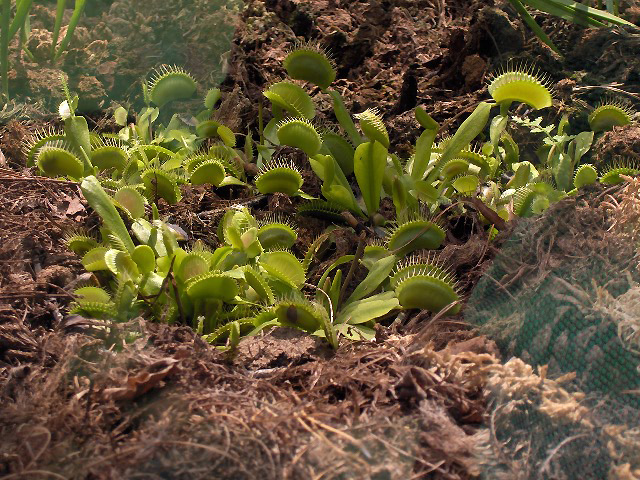
Photo: JoJan, CC BY-SA 3.0 · source

Houseplant · Droseraceae
Venus flytrap
Dionaea muscipula
In other languages: Venusvliegenvanger (Nederlands) · Dionée attrape-mouche (Français)
The Venus flytrap is a carnivorous plant that grows wild only in a small coastal area of North and South Carolina, in the United States. There it lives in sunny, wet, nutrient-poor bogs, where it gets extra nourishment from insects. Each leaf ends in a two-lobed trap with stiff teeth along the edge and a few sensitive trigger hairs inside: if an insect touches them twice, the trap snaps shut. In May–June small white flowers appear on a long stalk. Given rainwater, plenty of sun and a cool winter rest, it can live for many years.
Light
Full sun
warm and bright
Moisture
Moist to wet
must not dry out
Legal basis
Potting soil
Hardiness
Houseplant
min. 0 °C
Size
0.1 m
tall, 0.15 m wide
Flowering
May–June
| Pruning months | March and May |
|---|---|
| Height | 0.1 m |
| Poisonous to people and pets | Not known to be poisonous |
| Flowering | May–June |
Identify
Venus flytrap: how do you recognise it?
- Habit
- Low rosette 10–15 cm across, growing from a short underground rhizome.
- Leaves
- A flat green leaf stalk ending in a two-lobed trap with stiff teeth along the edge; in sun the inside turns red.
- Trap
- Each lobe usually has three trigger hairs. The trap closes in a fraction of a second and digests its prey in roughly one to two weeks.
- Flower
- White, five-petalled flowers about 2 cm across in a small cluster on a stalk 15–30 cm tall, in May–June.
- Roots
- Black and fine, very sensitive to lime and fertiliser.
Flowering: May–June · Plants: February–March · Pruning: March and May
In your garden
Why grow it?
- A fascinating plant to watch up close, for children and adults alike.
- Small and compact: it fits on any sunny windowsill.
- It catches flies and gnats by itself, with no fertiliser or extra feeding.
- In summer it can go outdoors on a sunny balcony or patio.
- It combines nicely with other carnivorous plants in a bowl or bog container.
Venus flytrap: where does it grow best?
- Full sun: ideally several hours of direct sun a day, by a south-facing window or outdoors in summer.
- Poor, acid compost: a mix of unfertilised peat and pure sand or perlite, never ordinary potting compost.
- Always wet in the growing season: stand the pot in a saucer with 1–2 cm of rainwater.
- A cool winter rest from November to February at 0–10 °C, bright and frost-free.
- Normal room air is fine; a closed terrarium is usually too dark and too humid.
- Light
- Sunny
- Potting soil
- Cactus compost or airy, humus-rich compost
- Acidity
- Acid
- Watering
- Generously
- Size
- 0.1 m tall, 0.15 m wide
- Temperature
- Minimum 0 °C
Goes well with
- Sundew: Catches small gnats with sticky tentacles and needs the same care.
- Pitcher plant: Tall, colourful pitchers; it also wants rainwater, sun and a cool winter.
- Sphagnum moss: Keeps the compost moist and acid in a bowl or bog container.
- Butterwort: A small carnivorous plant with sticky leaves; some species suit the same bowl.
Maintenance
Venus flytrap: when and how to plant it?
Plant in February–March.
- Repot in February–March, just before new growth starts, every one to two years.
- Use a mix of unfertilised white peat and pure quartz sand or perlite, roughly half and half.
- Choose a plastic or glazed pot at least 10 cm deep with drainage holes; avoid terracotta, which releases salts.
- Set the rhizome at the same depth as before, with the leaf bases just above the surface, and firm gently.
- Stand the pot straight away in a saucer of rainwater and give it the sunniest spot.
Care
- Water
- Only rainwater, demineralised or distilled water. From March to October the pot stands in 1–2 cm of water; in winter just keep the compost moist.
- Light
- The more sun the better: the traps then stay firm and turn red.
- Feeding
- No fertiliser and no meat. Indoors and outdoors it catches enough insects by itself.
- Traps
- Do not trigger the traps for fun: each trap can only close a limited number of times, and it costs the plant energy.
- Summer outdoors
- From mid-May to September it can stand outside in a sunny, sheltered spot, in its saucer of water.
- Winter rest
- From November to February keep it cool and bright at 0–10 °C, for example on a cold windowsill or in an unheated conservatory.
Tip: From mid-May to September, put it outdoors on a sunny balcony: it gets more light there than behind glass and catches its own food.
Venus flytrap: when to prune it?
Pruning months: March and May.
When: In March, cut off the dead leaves. In May, remove the flower stalk, unless you want to let it flower or collect seed.
How:
- Snip off black, dead traps and leaves at the base with fine scissors.
- Cut off the flower stalk once it is 5–10 cm tall: the plant then puts its energy into new traps.
- If you want to see the flowers or collect seed, only let a strong, mature plant flower.
Caution: Do not pull at the leaves: cut them off so you do not damage the rhizome.
Propagation
- Division
- Older plants form several rosettes. In February–March, when repotting, gently pull or cut them apart, each with its own roots.
- Leaf cuttings
- In spring, pull off a healthy leaf with its white base from the rhizome. Lay it on wet peat in a covered tray in a bright spot; after a few weeks to months, small plants appear.
- Seed
- Pollinate the flowers with a small brush. Sow the fresh seed on wet peat without covering it, in a bright, warm place. It takes several years for the plant to mature.
Venus flytrap: how does it get through the winter?
- It needs a true winter rest: from November to February at 0–10 °C in a bright place. Without it, the plant weakens and dies after a few years.
- In autumn many traps die back and only small, low leaves remain: that is normal.
- Water less during the rest: the compost must stay moist, but the pot does not need to stand in water.
- Protect it from frost; a cold, bright windowsill, an unheated room or a cold greenhouse is ideal.
Diseases and pests
- Black traps: A trap dies after a catch or after closing a few times: that is normal. If many traps turn black, it has too little light or is getting tap water or fertiliser.
- Long, floppy leaves: Too little light. Move it to the sunniest spot or outdoors in summer.
- Grey mould: Grey fluff on dead leaves during a dark, damp winter rest. Cut off dead leaves and provide light and some air movement.
- Lime damage: Brown leaf edges and a failing plant caused by tap water. Repot in a fresh peat mix and use only rainwater from then on.
- Aphids: On young leaves and the flower stalk. Rinse them off with rainwater.
Through the year
- January: Winter rest at 0–10 °C. Keep the compost just moist.
- February: Repot in a fresh peat mix. Divide.
- March: Cut off dead leaves. Move somewhere warmer and sunnier, with a saucer of water.
- April: Growing. Always a layer of rainwater in the saucer.
- May: Remove the flower stalk or let it flower. Outdoors after mid-May.
- June: Flowering. Take leaf cuttings. Full sun.
- July: Catching plenty of insects. Check the water every day.
- August: Top up the water in warm weather.
- September: Collect seed. Still plenty of sun.
- October: Growth slows, traps get smaller. Bring in before frost.
- November: Winter rest in a cool, bright place.
- December: Rest. Little water, no feeding.
You and this species
Did you know?
- In the wild it grows only in a small area along the coast of North and South Carolina, where it is protected.
- A trap only closes when the trigger hairs are touched twice in quick succession: so it does not snap shut for a raindrop.
- Charles Darwin called it ‘one of the most wonderful plants in the world’.