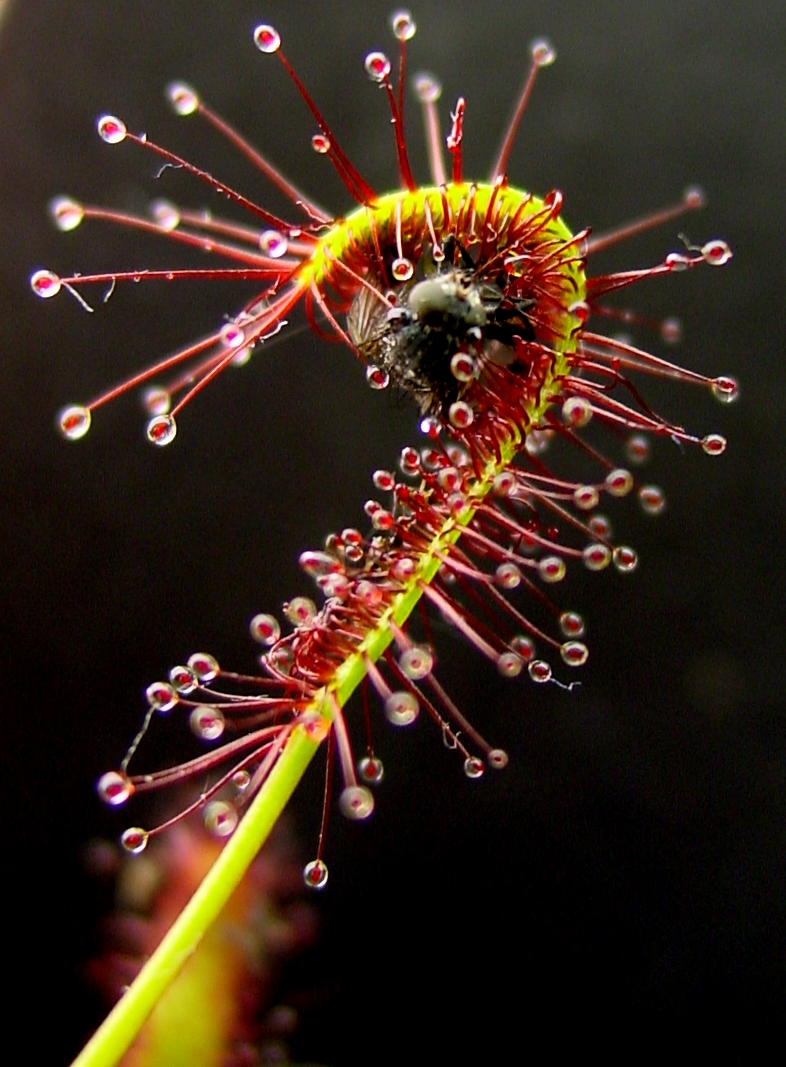
Photo: NoahElhardt, CC BY-SA 3.0 · source

Houseplant · Droseraceae
Cape sundew
Drosera capensis
In other languages: Kaapse zonnedauw (Nederlands) · Droséra du Cap (Français)
Cape sundew comes from the Cape region of South Africa, where it grows in moist, acid soil. It is a small carnivorous plant with narrow, strap-shaped leaves covered in red tentacles bearing glistening, sticky droplets. Small insects stick to them and the leaf slowly curls around the prey. From May to August small pink flowers appear on thin stalks. It is one of the easiest carnivorous plants for a sunny windowsill, as long as you water it with rainwater.
Caution: Never use tap water, chalky compost or fertiliser: the plant dies quickly from them. It seeds itself readily; give spare seedlings away rather than dumping them outdoors.
Light
Full sun
warm and bright
Moisture
Moist to wet
must not dry out
Legal basis
Potting soil
Hardiness
Houseplant
min. 5 °C
Size
0.2 m
tall, 0.15 m wide
Flowering
May–August
| Height | 0.2 m |
|---|---|
| Poisonous to people and pets | Not known to be poisonous |
| Flowering | May–August |
Identify
Cape sundew: how do you recognise it?
- Habit
- Rosette about 15–20 cm high and 15 cm wide, with upright or slanting leaves.
- Leaves
- Narrow and strap-shaped, up to about 10 cm long, with red tentacles tipped with a sticky droplet. The leaf can slowly curl around an insect.
- Flowers
- Small pink to purple (sometimes white) flowers on a thin stalk of about 30 cm, in May–August. The flowers open in the sun and pollinate themselves.
- Roots
- Small and shallow, sensitive to minerals and fertiliser.
Flowering: May–August · Plants: March–April
In your garden
Why grow it?
- Catches small insects itself, such as fruit flies and gnats: a little piece of nature on the windowsill.
- The glistening droplets on the red tentacles make the plant attractive all year round.
- Easy for beginners: no feeding and no high humidity needed.
- Flowers from May to August with small pink flowers.
- Seeds itself readily, so you soon have young plants to give away.
Cape sundew: where does it grow best?
- Light: a sunny windowsill (south, east or west) with at least four hours of sun. In winter a grow lamp helps.
- Temperature: 15–28 °C. In winter not below about 5 °C; 10–15 °C makes a good winter rest.
- Soil: acid, nutrient-poor compost, for example peat mixed with sand or perlite. Not ordinary potting compost with fertiliser.
- Water: only rainwater, demineralised or reverse-osmosis water, never tap water.
- Normal room humidity is usually enough.
- Light
- Sunny
- Potting soil
- Cactus compost or airy, humus-rich compost
- Acidity
- Acid
- Watering
- Generously
- Size
- 0.2 m tall, 0.15 m wide
- Temperature
- Minimum 5 °C
Goes well with
- Venus flytrap: Same rainwater and sunny windowsill, but it needs a cold winter rest.
- Butterwort: An easy carnivorous plant that catches small insects on a sunny windowsill.
- Pitcher plant (Sarracenia): Same acid soil and rainwater; upright growth with trumpet-shaped leaves.
- Sphagnum moss: As a top layer it keeps the compost moist and acid.
Maintenance
Cape sundew: when and how to plant it?
Plant in March–April.
- Repot in March–April, when it is growing actively again, every 1–2 years with fresh compost.
- Use a small plastic or glazed pot (10–12 cm) with drainage holes, not terracotta: it releases minerals.
- Mix an acid, nutrient-poor compost: peat with sand or perlite in equal parts, without fertiliser.
- Carefully take the plant out of the old pot, shake the old compost off the roots and set it at the same depth in the new pot. Firm the compost lightly.
- Water with rainwater until the compost is wet and stand the pot in a saucer.
- Put it back in a bright spot and after a few days in full sun again.
Care
- Water
- Keep the saucer filled with 1–2 cm of rainwater all year round. In winter a little less is fine.
- Feeding
- Do not fertilise: fertiliser harms the roots. The plant gets its food from the insects it catches; you do not need to feed it.
- Light
- The more light, the richer the red colour and the more droplets. Turn the pot now and then.
- Spent flowers
- Cut off flower stalks after flowering if you do not want seed: that saves energy and stops it seeding itself.
- Dead leaves
- Remove brown, dead leaves so that mould cannot take hold.
Tip: Stand the pot in a saucer with 1–2 cm of rainwater on the sunniest windowsill and never use tap water or fertiliser. If you do not want new plantlets, cut off the flower stalks before the seed ripens.
Cape sundew: when to prune it?
When: It is not pruned. You do tidy up dead leaves and faded flower stalks all year round.
How:
- Cut off dried, brown leaves or gently pull them away.
- Cut flower stalks off at the base after flowering if you do not want it to seed.
- Touch the tentacles as little as possible: they are delicate.
Propagation
- Seed
- It is self-fertile and seeds itself. Scatter the seed on moist peat mixed with sand (do not cover it) and keep it bright and warm (20–25 °C) under a clear cover. It germinates after 2–4 weeks.
- Root and leaf cuttings
- In spring, lay pieces of root 2–3 cm long or a healthy leaf on moist peat mixed with sand. Small plantlets form.
Cape sundew: how does it get through the winter?
- It is not hardy. Keep it indoors all year round, at 5 °C minimum.
- In winter, move it somewhere brighter and cooler (10–15 °C); growth is then slower. Still keep some rainwater in the saucer, but a little less.
- If it is too dark, use a grow lamp: without light it loses its droplets.
Diseases and pests
- No dew droplets: Usually too little light or too dry air, sometimes minerals in the water. Give more sun, keep the saucer filled and use rainwater only.
- Brown, drying leaves: An empty saucer or mineral-rich water (tap water). Top up the saucer and flush the compost through with rainwater.
- Mould: Grey mould on dead leaves, especially in still, humid air. Remove dead parts and make sure there is air movement.
- Aphids: May sit on the flower stalks. Rinse them off or wipe them away with a soft brush.
Through the year
- January: Bright, cool spot; grow lamp if light is poor. Saucer slightly less full.
- March: Repot in fresh, acid compost.
- April: Plenty of sun. Keep the saucer filled.
- May: Flowering starts: flower stalks appear.
- June: Flowering. Cut off flower stalks if you wish.
- July: Flowering. Keep the saucer filled.
- August: Last flowers. Collect seed if desired.
- October: Move somewhere cooler and brighter.
- December: Rest: cool and bright, saucer slightly less full.
You and this species
Did you know?
- The glistening droplets are not water but a sticky mucilage that holds the prey.
- The leaf slowly curls around a captured insect within a few hours.
- The name Drosera comes from Greek: droseros means ‘dewy’.