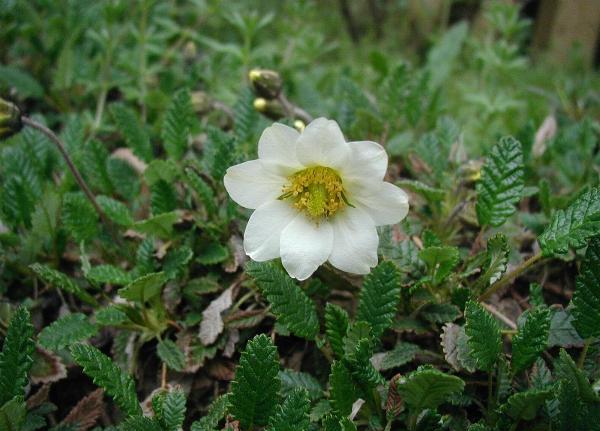
Photo: Sten Porse (user:Sten), CC BY-SA 3.0 · source

Perennial · Rosaceae
Mountain avens
Dryas octopetala
In other languages: Zilverkruid (Nederlands) · Dryade à huit pétales (Français)
Mountain avens grows in the Alps, the Pyrenees and around the North Pole, from Scandinavia and Iceland to Canada, on limestone rocks and scree. Botanically it is an evergreen dwarf shrub that forms low, creeping mats of small, scalloped leaves that look like miniature oak leaves: dark green above and white and felted beneath. From May to July it bears white, saucer-shaped flowers, usually with eight petals and a yellow centre. These are followed by silvery, feathery seed heads that are at least as attractive as the flowers. Gardeners use it in rock gardens, on walls and in troughs.
Light
Full sun
warm and bright
Moisture
Dry to normal
no wet feet
Legal basis
Sand or loam
neutral to chalky
Hardiness
Fully hardy
down to -40 °C
Size
0.1 m
tall, 0.6 m wide
Flowering
May–July
| Height | 0.1 m |
|---|---|
| Native to Belgium | No, planted |
| Good for bees, butterflies and birds | Yes, for bees |
| Poisonous to people and pets | Not known to be poisonous |
| Flowering | May–July |
Identify
Mountain avens: how do you recognise it?
- Habit
- Creeping, woody stems that form a mat 5–10 cm tall and 50–60 cm wide.
- Leaves
- Small, oblong and scalloped, glossy dark green above and white and felted underneath; evergreen.
- Flower
- Saucer-shaped, 2–4 cm across, usually with eight white petals and a ring of yellow stamens, borne singly on short stalks.
- Fruit
- Seeds with long, twisted, feathery tails that together form a silver plume.
- Roots
- Deep-rooting; the creeping stems sometimes root where they touch the ground.
Flowering: May–July · Plants: March–April and September–October
In your garden
Why grow it?
- An evergreen mat that covers the ground all year and keeps weeds down between stones.
- Two seasons of interest: first white flowers, then silvery, feathery seed heads.
- Bees and other pollinators find plenty of pollen in the open flowers.
- Exceptionally hardy and tough on poor, chalky soil.
- Ideal for creeping over the edge of a wall or between large stones.
Mountain avens: where does it grow best?
- Full sun: in shade it hardly flowers and the mat becomes loose.
- Poor, free-draining sandy or loamy soil with lime or grit; neutral to chalky.
- Dry to moist: no standing water, but in the first year no scorching, bone-dry spot either.
- Lovely in a rock garden, on top of a wall, between stepping stones or in a trough.
- Plant 40–50 cm apart, about 4–6 plants per m².
- Light
- Sun
- Soil type
- Sand or loam
- Acidity
- Neutral or chalky
- Moisture
- Dry or normal
- Size
- 0.1 m tall, 0.6 m wide
- Hardiness
- Hardy (to -40 °C)
Goes well with
- Pasque flower: Purple flowers and silvery seed heads too, for the same sunny, chalky spot.
- Houseleek: Fleshy rosettes between the stones, just as tough in drought.
- Creeping thyme: Another scented ground cover, flowering later in summer.
- Cheddar pink: Blue-grey cushions and scented pink flowers at the same time.
- Saxifrage: Small rosettes and dainty flowers for a rock garden or trough.
Maintenance
Mountain avens: when and how to plant it?
Plant in March–April and September–October.
- Plant in March–April or in September–October, from a pot: it dislikes being moved.
- Loosen the soil and, in heavy ground, mix plenty of gravel and limestone grit into the top layer.
- Set the plant at the same depth as in the pot and firm the soil well.
- Leave 40–50 cm between plants.
- Water at planting and during dry weeks in the first year.
- Spread a layer of gravel around the plant: the mat creeps over it, stays dry and weeds get less of a chance.
Care
- Watering
- In dry spells during the first year; after that only in long heatwaves, and a little more often in a trough.
- Feeding
- Not needed. On acid soil, perhaps a little lime in spring.
- Weeding
- Keep the mat free of grasses and weeds: this is the most important job, especially in the first years.
- Fallen leaves
- In autumn, clear fallen tree leaves off the mat so it does not smother.
- Seed heads
- Leave them: they are decorative and stay attractive for a long time.
Tip: Before planting, spread 3–5 cm of gravel or grit around the planting spot: the mat creeps over it, stays dry and weeds get less of a chance.
Mountain avens: when to prune it?
When: Mountain avens hardly needs pruning. At most, cut out dead patches or an over-long stem after flowering.
How:
- Leave the seed heads: they are an ornament and fall by themselves.
- Cut dead or brown patches in the mat back to healthy leaves.
- If the mat gets too big, remove a few creeping stems at the edge rather than shearing the whole plant.
Caution: It regrows poorly from old, bare wood: never cut deep into the mat.
Propagation
- Layers
- Creeping stems sometimes root by themselves. In spring, cut off a rooted piece and pot it up in a sandy mix.
- Cuttings
- In July–August: take semi-ripe cuttings of about 5 cm and root them in sandy compost in a sheltered, light spot.
Mountain avens: how does it get through the winter?
Hardy to −40 °C.
- One of the hardiest garden plants, to about −40 °C: no protection is needed in Belgium.
- Evergreen: the leaves may brown a little in a severe winter, but the mat regrows in spring.
- Wet winters are a greater danger than cold: ensure good drainage and gravel around the base.
- In a trough: leave it outside, but make sure the drainage hole does not get blocked.
Diseases and pests
- Rot: Brown, dying patches after a wet winter. Improve drainage with gravel or plant higher up.
- Weeds in the mat: Grasses grow through the mat and are hard to remove. Weed early and often, and use gravel underneath.
- Few flowers: Too much shade or too rich a soil. Move young plants to a sunny, lean spot.
- Young plants drying out: In the first year the root ball can dry out before the roots go deep enough. Water in dry weather.
Through the year
- March: Plant. Weed the mat. Top up the gravel.
- April: Plant. Detach rooted layers and pot them up.
- May: Flowering starts. Bees visit.
- June: Full flower. Water young plants in dry weather.
- July: Last flowers and silver seed heads. Take cuttings.
- August: Leave the seed heads. Take cuttings.
- September: Plant. Weed.
- October: Plant. Clear fallen leaves off the mat.
- November: Clear fallen leaves off the mat.
Use
Good for wildlife
- Bees
- Nectar and pollen for honeybees and wild bees.
You and this species
Did you know?
- The Younger Dryas, a cold period at the end of the last ice age, is named after this plant: its remains are often found in sediments from that time.
- In Iceland, mountain avens was chosen as the national flower.
- Dryas refers to the dryads, the tree nymphs of Greek mythology, because the leaves look like little oak leaves.