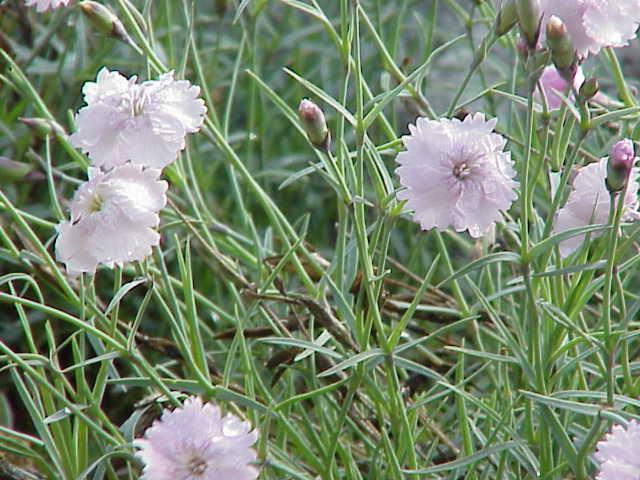
Photo: Kurt Stüber [1], CC BY-SA 3.0 · source

Perennial · Caryophyllaceae
Cheddar pink
Dianthus gratianopolitanus
In other languages: Rotsanjer (Nederlands) · Œillet de Grenoble (Français)
Cheddar pink grows wild on limestone rocks in western and central Europe, from France and Germany to Britain, where it is found only in Cheddar Gorge. It forms low, evergreen cushions of narrow, blue-grey leaves. From May to July these are topped by countless small pink flowers with toothed petals and a strong, sweet scent of cloves. Gardeners choose it for rock gardens, walls and edges, because it asks for little and looks good all year. Well-known cultivars are ‘La Bourboule’, very compact with pink flowers, and ‘Feuerhexe’ with magenta-pink flowers.
Light
Full sun
warm and bright
Moisture
Dry
tolerates drought
Legal basis
Sand or loam
neutral to chalky
Hardiness
Fully hardy
down to -35 °C
Size
0.15 m
tall, 0.3 m wide
Flowering
May–July
| Pruning months | July |
|---|---|
| Height | 0.15 m |
| Native to Belgium | No, planted |
| Good for bees, butterflies and birds | Yes, for bees and butterflies |
| Poisonous to people and pets | Not known to be poisonous |
| Flowering | May–July |
Identify
Cheddar pink: how do you recognise it?
- Habit
- Dense, low mat or cushion 10–15 cm tall and up to 30 cm wide.
- Leaves
- Narrow and grassy, 2–5 cm long, blue-grey with a waxy bloom, evergreen.
- Flower
- Single flowers 2–3 cm across with toothed petals, borne singly or in pairs on short stems.
- Scent
- Sweet and spicy, of cloves; strongest on warm, sunny days.
- Colour
- Pink in the species; cultivars from white and pale pink to magenta.
- Roots
- Fine and fairly shallow; above all it needs a loose, free-draining top layer.
Flowering: May–July · Harvest and fruit: May–July · Plants: March–April and September–October · Pruning: July
In your garden
Why grow it?
- Evergreen, blue-grey cushions that give a rock garden or edge structure all year round.
- Richly scented flowers from May to July: on a warm day you can smell them from a distance.
- Attracts bees and butterflies, which land on the flat little flowers.
- Drought-tolerant: perfect for a wall, a gravel garden, a roof terrace or a trough.
- A low ground cover for sun that gives weeds between the stones little chance.
Cheddar pink: where does it grow best?
- Full sun: the sunnier the spot, the more compact the cushions and the richer the flowering.
- Poor, free-draining sandy or loamy soil, preferably neutral to chalky.
- Dry: in wet, heavy soil the plant rots away in winter.
- Ideal between stones, on top of a wall, in a rock garden or in a trough with gravel.
- Plant 25–30 cm apart, about 10–12 plants per m² for a closed mat.
- Light
- Sun
- Soil type
- Sand or loam
- Acidity
- Neutral or chalky
- Moisture
- Dry
- Size
- 0.15 m tall, 0.3 m wide
- Hardiness
- Hardy (to -35 °C)
Goes well with
- Thyme: Also scented, good for bees and happy in the same dry, sunny spot.
- Stonecrop: Fleshy leaves and later flowers in a dry rock garden.
- Blue fescue: Blue-grey tufts that match the foliage nicely.
- Bellflower: Low species with blue bells as a contrast with the pink pinks.
- Lavender: A scented, silvery-grey partner for a sunny edge.
Maintenance
Cheddar pink: when and how to plant it?
Plant in March–April and September–October.
- Plant in March–April or in September–October, when the soil is not too wet.
- Loosen the soil and, in heavy ground, mix plenty of gravel or coarse sand into the top layer.
- Set the plant at the same depth as in the pot or slightly higher; the base of the stems must not be buried.
- Leave 25–30 cm between plants.
- Water at planting and afterwards only in prolonged dry spells, until it has rooted in.
- Spread a thin layer of gravel or grit around the base: it keeps the neck dry and the leaves clean.
Care
- Watering
- Only in dry weather during the first growing season. After that hardly ever, though plants in pots need water in hot summers.
- Feeding
- Not needed; on acid soil at most a little lime in spring. Too much food makes the cushions loose and bare.
- Deadheading
- After flowering, cut away all spent stems for a neat, compact plant.
- Fallen leaves
- Keep the cushions free of fallen leaves in autumn, so they do not smother under a wet layer.
- Rejuvenating
- After 4–5 years the cushion often goes bare in the centre: replace it with young plants from cuttings.
Tip: Spread a layer of gravel around and under the cushions and cut away all spent stems in July: that keeps Cheddar pink compact for years and stops it rotting in a wet winter.
Cheddar pink: when to prune it?
Pruning months: July.
When: Straight after flowering, in July. Otherwise it needs hardly any pruning.
How:
- Cut all spent flower stems back to the blue-grey cushion.
- At the same time, lightly trim the mat with shears to keep it compact.
- In spring, pull out any dead or discoloured leaves from the cushion.
Caution: Do not cut deep into old, bare stems: they regrow poorly.
Propagation
- Cuttings
- In June–August: cut or pull off non-flowering shoots of 5–8 cm, remove the lower leaves and insert them in sandy cutting compost. They root within a few weeks.
- Layering
- In summer, pin a long, trailing stem to the ground; after a few months, cut off the rooted piece and plant it elsewhere.
Cheddar pink: how does it get through the winter?
Hardy to −35 °C.
- Very hardy, to about −35 °C, and evergreen: no protection is needed in Belgium.
- Wet winters are its worst enemy: ensure good drainage and keep fallen leaves off the cushions.
- In a pot or trough: raise it on pot feet so water can drain away, and simply leave it outside.
Diseases and pests
- Rotting: The cushion turns brown and soft after a wet winter. Plant in free-draining soil, on a wall or in a raised bed.
- Bare centre: Older plants go bare in the middle. Trim after flowering and replace them with cuttings after a few years.
- Rust: Brown or orange pustules on the leaves, mainly in damp weather. Cut off affected parts and give it an airy spot.
- Slugs: Young plants are sometimes eaten. Check in the evening after planting and pick off the slugs.
Through the year
- March: Plant. Pull dead leaves out of the cushion.
- April: Plant. Top up the gravel around the base.
- May: Flowering starts. Enjoy the scent.
- June: Full flower. Bees and butterflies visit.
- July: Trim after flowering. Take cuttings.
- August: Take cuttings or layer stems.
- September: Plant. Plant out rooted cuttings.
- October: Plant. Keep fallen leaves off the cushions.
- November: Keep fallen leaves off the cushions.
Use
Edible and useful
- Flowers (May–July)
- Only scented pinks are worth it: common pink and Cheddar pink smell strongly of cloves, and their petals taste sweet and lightly spicy. Pick the flowers from May to July on a dry morning, when they have just opened, and shake them to remove insects. Pull the petals out of the calyx and snip off the white base: it is bitter. Scatter them over a salad, fruit or a dessert, or infuse them in sugar or syrup: red and deep pink flowers give the best colour. Also pick off the faded flowers so the plant flowers for longer, and leave plenty for the bees and butterflies.
- Storing
- Fresh petals keep for a day in a closed box with damp kitchen paper in the fridge. To dry them, spread them in a single layer on a rack or sieve somewhere airy and out of the sun; in a closed jar away from the light they keep for six months. The scented sugar keeps for a year, the syrup for a few months.
Caution: Only eat flowers from plants that have not been sprayed: florists’ carnations and newly bought plants from the garden centre are often treated; let new plants grow for a season first. Only eat the petals, without the white base, and not the calyx, stems or leaves; use them in moderation, as a garnish or flavouring. Not every pink: in the catalogue, sweet William and China pink are listed as poisonous, and those are not eaten. Never pick wild pinks in the countryside: they are rare there.
Eating and using is at your own risk: see the terms of use.
Recipes
- Sugar scented with pinks (Other · 1 small jar (± 200 g) · 10 min + 2 weeks infusing)
- Syrup of pinks (Syrup · ± 300 ml · 30 min + overnight infusing)
Good for wildlife
- Bees
- Nectar and pollen for honeybees and wild bees.
- Butterflies
- Nectar for butterflies.
You and this species
Did you know?
- The scientific name refers to Grenoble, Gratianopolis in Latin, which is also where the French name comes from.
- In Britain the species grows wild only on the limestone cliffs of Cheddar Gorge, where it is protected.
- Dianthus means ‘flower of the gods’, from the Greek words dios and anthos.